
Cihaner, Atilla
Loading...
Profile URL
Name Variants
C.,Atilla
A., Cihaner
C., Atilla
Cihaner A.
A.,Cihaner
Cihaner, Atilla
Cihaner,A.
Atilla Cihaner
Atilla, Cihaner
Cihaner,Atilla
Cihaner, A.
Cihaner, A
A., Cihaner
C., Atilla
Cihaner A.
A.,Cihaner
Cihaner, Atilla
Cihaner,A.
Atilla Cihaner
Atilla, Cihaner
Cihaner,Atilla
Cihaner, A.
Cihaner, A
Job Title
Profesör Doktor
Email Address
atilla.cihaner@atilim.edu.tr
Main Affiliation
Chemical Engineering
Status
Website
ORCID ID
Scopus Author ID
Turkish CoHE Profile ID
Google Scholar ID
WoS Researcher ID
Sustainable Development Goals
 1
1NO POVERTY
0
Research Products
 2
2ZERO HUNGER
0
Research Products
 3
3GOOD HEALTH AND WELL-BEING
1
Research Products
 4
4QUALITY EDUCATION
0
Research Products
 5
5GENDER EQUALITY
0
Research Products
 6
6CLEAN WATER AND SANITATION
1
Research Products
 7
7AFFORDABLE AND CLEAN ENERGY
3
Research Products
 8
8DECENT WORK AND ECONOMIC GROWTH
0
Research Products
 9
9INDUSTRY, INNOVATION AND INFRASTRUCTURE
0
Research Products
 10
10REDUCED INEQUALITIES
0
Research Products
 11
11SUSTAINABLE CITIES AND COMMUNITIES
0
Research Products
 12
12RESPONSIBLE CONSUMPTION AND PRODUCTION
0
Research Products
 13
13CLIMATE ACTION
0
Research Products
 14
14LIFE BELOW WATER
0
Research Products
 15
15LIFE ON LAND
0
Research Products
 16
16PEACE, JUSTICE AND STRONG INSTITUTIONS
0
Research Products
 17
17PARTNERSHIPS FOR THE GOALS
0
Research Products

Documents
101
Citations
2366
h-index
28

Documents
103
Citations
2258

Scholarly Output
121
Articles
108
Views / Downloads
61/0
Supervised MSc Theses
12
Supervised PhD Theses
0
WoS Citation Count
2257
Scopus Citation Count
2347
Patents
0
Projects
13
WoS Citations per Publication
18.65
Scopus Citations per Publication
19.40
Open Access Source
6
Supervised Theses
12
| Journal | Count |
|---|---|
| Electrochimica Acta | 15 |
| Journal of Electroanalytical Chemistry | 13 |
| Turkish Journal of Chemistry | 6 |
| Dyes and Pigments | 6 |
| Organic Electronics | 6 |
Current Page: 1 / 8
Scopus Quartile Distribution
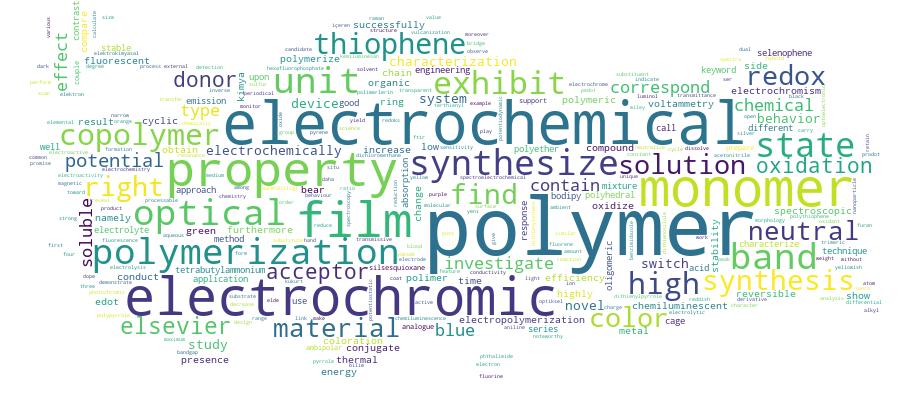
Competency Cloud
99 results
Scholarly Output Search Results
Now showing 1 - 10 of 99
Article Citation - WoS: 45Citation - Scopus: 45An Ambipolar Low Band Gap Material Based on Bodipy and Edot(Elsevier Science Bv, 2009) Algi, Fatih; Cihaner, AtillaA novel donor-acceptor type conducting polymer based on BODIPY dye as acceptor and EDOT units as donor parts is synthesized electrochemically. The unique combination of BODIPY and EDOT units provides an ambipolar (n- and p-doping processes) low band gap material (4). This is the first example of p-n junction in an organic pi-conjugated material where BODIPY unit is incorporated directly in the main chain. Furthermore, the polymer film exhibits electrochromic behavior upon p-doping: a color change from light violet (neutral) to indigo (oxidized). (C) 2009 Elsevier B.V. All rights reserved.Article Citation - WoS: 61Citation - Scopus: 72A Blue To Highly Transmissive Soluble Electrochromic Polymer Based on Poly(3,4-Propylenedioxyselenophene) With a High Stability and Coloration Efficiency(Royal Soc Chemistry, 2011) Ozkut, Merve Icli; Atak, Samed; Onal, Ahmet M.; Cihaner, AtillaThe optical and electrochemical properties of a regioregular and soluble alkylenedioxyselenophene-based electrochromic polymer, namely poly(3,3-didecyl-3,4-dihydro-2H-selenopheno[3,4-b][1,4] dioxepine (PProDOS-C-10), which is synthesized by electrochemical polymerization, are highlighted. It is noted that this unique polymer has a low band gap (1.58 eV) and is exceptionally stable under ambient atmospheric conditions. Polymer films retain 97% of their electroactivity after 40 000 cycles. The percentage transmittance of a PProDOS-C10 film was found to be 56.4% at 638 nm and 55.8% at 700 nm. Furthermore, this novel soluble PProDOS-C10 polymer shows an electrochromic behavior: a color change from pure blue to a highly transparent state in a low switching time (1.0 s) during oxidation, with high coloration efficiencies (328 cm 2 C-1 at 638 nm and 319 cm(2) C-1 at 700 nm) when compared to its thiophene analogue.Article Citation - WoS: 11Citation - Scopus: 13A Low Band Gap Polymer Based on Selenophene and Benzobis (thiadiazole)(Pergamon-elsevier Science Ltd, 2017) Abdulrazzaq, Mohammed; Ozkut, Merve Icli; Gokce, Gurcan; Ertan, Salih; Tutuncu, Esra; Cihaner, AtillaA new derivative of benzobis(thiadiazole) based donor-acceptor-donor type monomers, namely 4,7-di (selenophen-2-yl)benzo[1,2-c;4,5-c']bis[1,2,5]thiadiazole (SeBTSe), was synthesized and its polymerization was carried out successfully via electrochemical polymerization in an electrolyte solution of 0.1 M tetrabutylammonium hexafluorophosphate dissolved in dichloromethane. The monomer SeBTSe is a deep red chromophore and it has four redox states: one oxidation, one neutral and two reduction states. The electrochemical behaviour of the corresponding polymer called PSeBTSe was studied by cyclic and differential pulse voltammetry. There is a good agreement between electrochemical (0.62-0.66 eV) and optical (0.63 eV) bandgaps of the polymer. Like the monomer, the ambipolar polymer has four redox states and electrochromic properties: gray beige at neutral state, smoky azurite at oxidized state, beige at first reduced state and dark beige at second reduced state. (C) 2017 Elsevier Ltd. All rights reserved.Article Citation - WoS: 9Citation - Scopus: 10From Narrow To Narrower: a Very Low Band Gap [1,2,5]thiadiazolo[3,4-G]quinoxaline Donor-Acceptor Type Electrochromic Polymer(Electrochemical Soc inc, 2017) Gokce, Gurcan; Karabay, Baris; Cihaner, Atilla; Ozkut, Merve IcliThe development of low bandgap polymers (or zero bandgap polymers) is still one of the main goals of scientists and many viable paths have been formulated in order to accomplish this. In this study, a donor-acceptor-donor type electrochromic polymer based on [1,2,5]thiadiazolo[3,4-g]quinoxaline acceptor and selenophene donor units with extremely low bandgap (ranging from 0.21 to 0.60 eV depending on bandgap determination method) is synthesized and characterized electrochemically, optically and colorimetrically. Electrochemical and optical studies showed that the polymer film was susceptible to both n- and p-type doping and has a mustard color in its neutral state, and upon oxidation its color changed to brown, and upon reduction the color is light purple. (C) 2017 The Electrochemical Society. All rights reserved.Article Citation - WoS: 11Citation - Scopus: 14Electrochemical Synthesis of New Conducting Copolymers Containing Pseudo-Polyether Cages With Pyrrole(Elsevier Science Sa, 2007) Cihaner, AtillaConducting copolymers have been synthesized via electrochemical oxidation of pyrrole (Py) in the presence of monomer 1, 11 -bis(1,1-pyrrole)-3,6,9-trioxaundecane (I) in an electrolytic solution containing 0.1 M tetrabutylammonium hexafluorophosphate (TBAPF(6)) dissolved in acetonitrile. It is observed that reversible redox behavior of poly(I-co-Py)s shifts to more positive potentials with the increasing amount of I in the comonomer mixture, indicating formation of a copolymer. It is also found that increasing the ratio of I in the comonomer mixture decreases the conductivity of the obtained polymer films. The dark electrical conductivity measurements in the temperature range of 300-100 K revealed the extrinsic type of conduction with activation energy values being in the range of 82.3-16.9 meV. (c) 2007 Elsevier B.V. All rights reserved.Article Citation - WoS: 2Citation - Scopus: 2Synthesis, Properties, and Electrochemistry of a Photochromic Compound Based on Dithienylethene and Prodot(Tubitak Scientific & Technological Research Council Turkey, 2015) Algi, Melek Pamuk; Cihaner, Atilla; Algi, FatihThe synthesis, photochromic features, and electrochemistry of a novel material based on dithienylethene (DTE) and 3,3-didecyl-3,4-dihydro-2H-thieno[3,4-b][1,4]dioxepine (didecyl-ProDOT) units are described. It is noteworthy that 1,2-bis (5-(3,3-didecyl-3,4-dihydro-2H-thieno[3,4-b][1,4]dioxepin-6-yl)-2-methylthiophen-3-yl)cyclopent-1-ene can be efficiently switched between open and closed states by light in both solution and in the solid poly(methyl metacrylate) (PMMA) matrix. It is also found that the emission of this novel compound can be switched on and off upon irradiation.Article Citation - WoS: 28Citation - Scopus: 31Electrochemical Polymerization of 9-Fluorenone(Elsevier Science Sa, 2004) Cihaner, A; Tirkes, S; Önal, AMElectrochemical polymerization of 9-fluorenone, FO, was studied in CH2Cl2 solution with tetrabutylammonium tetrafluoroborate, TBABF(4), as the electrolyte, via constant potential electrolysis, CPE. Prior to CPE, the redox behavior of FO was investigated in the same solvent/electrolytic medium using cyclic voltammetry, CV. CPE of FO yielded an insoluble polymer deposit on the electrode surface. The product was characterized by FTIR spectroscopy techniques. The redox and spectroelectrochernical, SPEL, behavior of the polymer were studied by CV and in situ UV-Vis spectrophotometric techniques at various potentials, respectively. The conductivity was measured using a two-probe technique and the paramagnetic behavior of the polymer was monitored using in situ ESR spectroscopy. (C) 2004 Elsevier B.V. All rights reserved.Article Citation - WoS: 21Citation - Scopus: 21Synthesis and Properties of a Novel Redox Driven Chemiluminescent Material Built on a Terthienyl System(Pergamon-elsevier Science Ltd, 2009) Atilgan, Nurdan; Algi, Fatih; Onal, Ahmet M.; Cihaner, AtillaA novel redox driven chemiluminescent material built on a terthienyl system, namely 5,7-di-ethylenedioxythiophen-2-yl-2,3-dihydro-thieno[3,4-d]pyridazine-1,4-dione (ETE-Lum), which is soluble in both organic media and basic aqueous solution was synthesized and characterized. Furthermore, its polymer, PETE-Lum, which is one of the most rare examples of chemiluminescent polymeric materials bearing a pyridazine unit, was obtained successfully by electrochemical means. Both of the materials give chemiluminescence either by treatment with oxidants (H2O2 and/or KMnO4) or by the application of a potential pulse. (C) 2009 Elsevier Ltd. All rights reserved.Article Citation - WoS: 2Citation - Scopus: 3Impedance Spectroscopy of N-Substituted Oligo-Oxyethylene Polypyrrole Films(John Wiley & Sons inc, 2008) Cihaner, Atilla; Onal, Ahmet M.The electrochemical properties of neutral (dedoped) and oxidized (doped) poly(1,11-bis(1,1-pyrrole)-3,6,9-trioxaundecane) (poly-I) film electrodes were investigated using cyclic voltammetry and electrochemical impedance spectroscopy (EIS) techniques. Poly-I was deposited on glassy carbon electrode (GCE) from acetonitrile solution containing 5.0 x 10(-3) M 1,11-bis(1,1-pyrrole)-3,6,9-trioxaundecane (I) and 0.1 M LiClO4 supporting electrolyte. Doped poly-I exhibits a single semicircle in its complex-capacitance plots, indicating a single dominant ion transport process, together with high capacitance values. These features make this polymer film a candidate for an energy storage material. Also, poly-I can be a candidate as a sensory material for the detection of Ag+ based on impedance parameters. (C) 2008 Wiley Periodicals, Inc.Article Citation - WoS: 24Citation - Scopus: 25A Novel Conducting Polymer Based on Terthienyl System Bearing Strong Electron-Withdrawing Substituents and Its Electrochromic Device Application(Elsevier Science Sa, 2008) Asil, Demet; Cihaner, Atilla; Algi, Fatih; Onal, Ahmet M.A novel conducting polymer bearing strong electron-withdrawing substituents (EWS) directly attached to the 3,4-positions of the thiophene ring was synthesized by electrochemical polymerization of diethyl 2,5-di(thiophen-2-yl)thiophene-3,4-dicarboxylate (SSS-Diester). The polymer (PSSS-Diester) was characterized by cyclic voltammetry, FT-IR and UV-vis spectroscopy. The polymer has a reversible redox process and demonstrates a stable electrochromic behavior: reddish orange in the neutral state, brown in the intermediate state and green in the oxidized state. Optical density and response time of the dual-type electrochromic device based on PSSS-Diester were found to be 0.23 and 0.6 s at 623 nm, respectively. It is also noteworthy that the device shows good environmental and redox stability (i.e. 94% of the optical activity of the device retained after 500th switch). (c) 2008 Elsevier B.V. All rights reserved.
