
Balku, Şaziye
Loading...

Profile URL
Name Variants
B., Saziye
B.,Saziye
Ş.,Balku
Balku, Şaziye
Saziye, Balku
Şaziye, Balku
Balku, Saziye
B.,Şaziye
Balku,Ş.
S.,Balku
S., Balku
Balku,S.
B.,Saziye
Ş.,Balku
Balku, Şaziye
Saziye, Balku
Şaziye, Balku
Balku, Saziye
B.,Şaziye
Balku,Ş.
S.,Balku
S., Balku
Balku,S.
Job Title
Doçent Doktor
Email Address
saziye.balku@atilim.edu.tr
Main Affiliation
Energy Systems Engineering
Status
Former Staff
Website
ORCID ID
Scopus Author ID
Turkish CoHE Profile ID
Google Scholar ID
WoS Researcher ID
Sustainable Development Goals
 1
1NO POVERTY
0
Research Products
 2
2ZERO HUNGER
0
Research Products
 3
3GOOD HEALTH AND WELL-BEING
1
Research Products
 4
4QUALITY EDUCATION
0
Research Products
 5
5GENDER EQUALITY
0
Research Products
 6
6CLEAN WATER AND SANITATION
7
Research Products
 7
7AFFORDABLE AND CLEAN ENERGY
3
Research Products
 8
8DECENT WORK AND ECONOMIC GROWTH
0
Research Products
 9
9INDUSTRY, INNOVATION AND INFRASTRUCTURE
2
Research Products
 10
10REDUCED INEQUALITIES
0
Research Products
 11
11SUSTAINABLE CITIES AND COMMUNITIES
3
Research Products
 12
12RESPONSIBLE CONSUMPTION AND PRODUCTION
0
Research Products
 13
13CLIMATE ACTION
3
Research Products
 14
14LIFE BELOW WATER
0
Research Products
 15
15LIFE ON LAND
0
Research Products
 16
16PEACE, JUSTICE AND STRONG INSTITUTIONS
0
Research Products
 17
17PARTNERSHIPS FOR THE GOALS
0
Research Products

This researcher does not have a Scopus ID.

This researcher does not have a WoS ID.

Scholarly Output
14
Articles
13
Views / Downloads
8/0
Supervised MSc Theses
0
Supervised PhD Theses
1
WoS Citation Count
253
Scopus Citation Count
287
Patents
0
Projects
0
WoS Citations per Publication
18.07
Scopus Citations per Publication
20.50
Open Access Source
5
Supervised Theses
1
| Journal | Count |
|---|---|
| Celal Bayar Üniversitesi Fen Bilimleri Dergisi | 1 |
| Civil Engineering Journal | 1 |
| Energy Conversion and Management | 1 |
| Gazi University Journal of Science | 1 |
| Hittite Journal of Science and Engineering | 1 |
Current Page: 1 / 2
Scopus Quartile Distribution
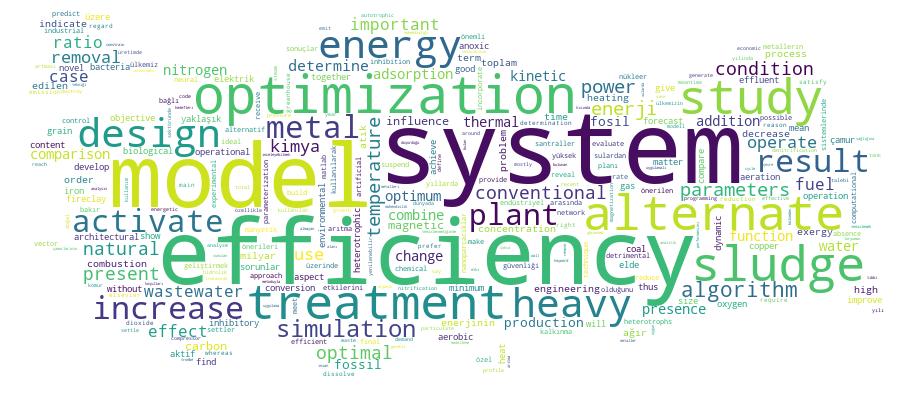
Competency Cloud
14 results
Scholarly Output Search Results
Now showing 1 - 10 of 14
Article Citation - WoS: 2Citation - Scopus: 2Low Carbon Architectural Design(Gazi Univ, 2018) Balku, Saziye; Bal Kocyigit, Filiz; Koçyiğit, Filiz Bal; Architecture; Energy Systems EngineeringTendency towards sustainable energy resources is increasing and leading engineers and architects make joint efforts. Renewable energy potential present in nature can be used more efficiently so that while energy consumption is reducing, rate of energy gain, on the other hand, increases by architectural design methods. A sailing club in Golbasi, Ankara is designed as a low carbon building for optimum usage of solar and wind energy. It can be concluded using an energy efficient architectural design for a building before its construction makes it possible to meet the electrical and heat energy requirements at minimum cost and environmental friendly.Article TÜRKİYE’NİN ENERJİ GÖRÜNÜMÜ VE TORYUMUN ÖNEMİ(Bilim ve Teknoloji, 2014) Balku, ŞaziyeEnerji, yüzyıllar boyunca dünyadaki en önemli konular arasında yer almış ve almaya devam etmektedir. Sayısal olarak ifade etmek istersek, 2010 yılında dünyada 524 katrilyon Btu* enerji tüketilmiştir (1) ve her yıl bu rakam ortalama % 1.5 oranında artmaktadır. Bu enerjinin % 53’ü endüstride, % 26’sı ulaşım ve taşımacılık sektöründe, % 13’ü evlerde % 8’i ise ticaret sektöründe kullanılmaktadır. Toplam enerjinin % 55.37 si elektrik olarak tüketilmektedir. Dünyada kullanılan enerjinin kaynaklarına göre dağılımı Şekil 1’de verilmektedir ve % 87’si (TEP** cinsinden) fosil kaynaklıdır (petrol, kömür ve doğalgaz). Dünya’da birincil enerji kaynağı olarak en fazla kullanılan fosil kaynakların oranının 2040 yılında %78’lere gerilemesi beklenmektedir. Bu gerileme, kullanım miktarında beklenen bir düşüş değil, yenilenebilir kaynak kullanımının artması ile fosil kullanım payının azalması anlamına gelmektedir.Article Citation - WoS: 7Citation - Scopus: 10Ann-Assisted Forecasting of Adsorption Efficiency To Remove Heavy Metals(Tubitak Scientific & Technological Research Council Turkey, 2019) Buaısha, Magdi; Balku, Şaziye; Yaman, Şeniz Özalp; Özalp Yaman, ŞenizIn wastewater treatment, scientific and practical models utilizing numerical computational techniques suchas artificial neural networks (ANNs) can significantly help to improve the process as a whole through adsorption systems.In the modeling of the adsorption efficiency for heavy metals from wastewater, some kinetic models have been used such as pseudo first-order and second-order. The present work develops an ANN model to forecast the adsorption efficiency of heavy metals such as zinc, nickel, and copper by extracting experimental data from three case studies. To do this, we apply trial-and-error to find the most ideal ANN settings, the efficiency of which is determined by mean square error (MSE) and coefficient of determination (R2). According to the results, the model can forecast adsorption efficiency percent (AE%) with a tangent sigmoid transfer function (tansig) in the hidden layer with 10 neurons and a linear transferfunction (purelin) in the output layer. Furthermore, the Levenberg–Marquardt algorithm is seen to be most ideal for training the algorithm for the case studies, with the lowest MSE and high R2 . In addition, the experimental results and the results predicted by the model with the ANN were found to be highly compatible with each other.Article Citation - WoS: 31Citation - Scopus: 35Comparison Between Alternating Aerobic-Anoxic and Conventional Activated Sludge Systems(Pergamon-elsevier Science Ltd, 2007) Balku, SaziyeConventional activated sludge systems ensure removal of colloidal and dissolved carbonaceous organic matter whereas alternating aerobic-anoxic systems, in addition, satisfy a further reduction in nitrogen content of wastewater. Main difference between them is that the alternating system should also include an anoxic operation mode which satisfies denitrification. In other words conventional systems are operated under aerobic conditions whereas alternating systems require a periodical change from aerobic conditions to anoxic conditions. So the most important problem in alternating systems is to find the appropriate durations for both sequences. In this study a comparison between conventional and alternating systems is considered in terms of nitrogen removal and aeration time by simulation under the same conditions together with an optimization algorithm. The results show that an activated sludge system can be operated as an alternating aerobic-anoxic system so that nitrogen removal is also possible during treatment without any additional investment or operational cost. (C) 2007 Elsevier Ltd. All rights reserved.Article 10. Kalkınma Planı Hedefleri ve Nükleer Santraller(Bilim ve Teknoloji, 2013) Balku, ŞaziyeTürkiye Cumhuriyeti 10. Beş Yıllık Kalkınma Planı (2014-2018) resmi hazırlık süreci 5 Haziran 2012 tarihli 14 sayılı Başbakanlık Genelgesiyle başlatılmış ve kurulan Özel İhtisas Komisyonları arasında Enerji Güvenliği ve Verimliliği de yer almıştır. Komisyonu oluşturan akademisyenler, kamu kurum ve kuruluşları ile özel sektör ve sivil toplum kuruluşlarının temsilcileri enerji arz güvenliği, fiyatlarının yüksekliği ve belirsizliği, çevresel sorunlar, iklim değişikliği, yüksek yatırımda finansman ihtiyacı, enerjinin verimsiz kullanılması, dışa bağımlılığı gibi temel sorunlar ve gelişmeler göz önünde tutularak, ülkemiz enerji sektörü için durum analizi yapmak, bir vizyon geliştirmek ve yol haritası oluşturmak üzere çalışmalarını sürdürmüşler ve mevcut durumun değerlendirmesi, sektördeki gelişme eğilimleri ve muhtemel yansımaları, geleceğe dönük beklentiler, güçlü ve zayıf taraflar, fırsatlar-tehditler, sorunlar ve çözüm önerileri, politika ve strateji önerileri ile plana katkıda bulunmuşlardır.Article Citation - WoS: 5Citation - Scopus: 5Heavy Metal Inhibition on an Alternating Activated Sludge System and Its Comparison To Conventional Methods: Case Study of Cu2+(Iwa Publishing, 2021) Buaisha, Magdi; Balku, Saziye; Ozalp-Yaman, SenizIn order to understand the behaviour of wastewater treatment plants (WWTPs) with heavy metal presence, the present study evaluates the treatment process in the presence of heavy metals (Cu2+ as a case study) and compares it with the absence of heavy metals. An activated sludge model is improved by means of incorporating other novel inhibitory kinetic and settler models for this evaluation. To achieve this goal, a simulation algorithm is developed using the MATLAB code to detect any heavy metal influence on the aerobic and anoxic growth of heterotrophic and autotrophic biomass. The code also allows for a comparison of treatment plant performance with and without Cu2+ in both conventional and alternating systems. The results reveal that the presence of heavy metals, in case of the present study for Cu2+ at 0.5 mg/L, in a biological treatment system, has an inhibitory effect on the heterotrophic bacteria but more so on the autotrophic bacteria growth and it prevents nitrification and denitrification, thus negatively effecting on the nitrogen removal in the alternating systems.Article Influence of Temperature on Activated Sludge Systems(2018) Balku, ŞaziyeThe present study aims to determine the influence of temperature in the treatment efficiency of the activated sludge systems. To reach this aim, a simulation study is performed using Matlab® programming language. A biological tank is modelled by the ASM3 (activated sludge model No. 3) and a settling tank is modelled by Takács settling velocity model. For a defined inflow rate and inlet waste water characteristics with the predefined design and operational parameters, the treatment model is simulated. The changes in the kinetic parameters by temperature are estimated from the values given in ASM3 and the dissolved oxygen saturation concentration in water is also concerned as a function of temperature. All the other design and the operational conditions are kept constant during simulations. The simulation algorithm is executed for the temperatures 0°C, 10°C, 20°C, and 30°C. The results show that chemical oxygen demand and total suspended solids reduce slightly with increasing temperature, however, the total nitrogen content in the effluent is changing, first increases for the temperatures 10°C, 20°C, and then decreases for 30°C when it is compared to that of at 0°C. The change in temperature affects mostly the ammonium concentration in the waste water treatment systems.Article Citation - WoS: 169Citation - Scopus: 187Heavy Metal Removal Investigation in Conventional Activated Sludge Systems(C Ej Publishing Group, 2020) Buaisha, Magdi; Balku, Saziye; Ozalp-Yaman, SenizThe combination of industrial and domestic wastewater in municipal WWTPs (waste water treatment plants) may be economically profitable, but it increases the difficulty of treatment, and also has some detrimental effects on the biomass and causes a low-quality final effluent. The present study evaluates the treatment process both in the presence and absence of heavy metals using ASM3 (activated sludge model no.3) so as to improve the model by means of incorporating other novel inhibitory kinetic and settler models. The results reveal that the presence of heavy metal, a case study for copper and cadmium at a concentration of 0.7 mgL(-1) in a biological treatment system has a negative effect on heterotrophic bacteria concentration by 25.00 %, and 8.76 % respectively. Meanwhile, there are no important changes in COD (chemical oxygen demand), SS (total suspended solids) and TN (total nitrogen) in the final effluent in the conventional system. However, all these parameters are acceptable and consistent with EU Commission Directives. The results indicate that ASM3 can predict and provide an opportunity of the operation for an activated sludge wastewater treatment plant that receives the effluent from an industrial plant.Article Citation - WoS: 23Citation - Scopus: 29Analysis of Combined Cycle Efficiency by Simulation and Optimization(Pergamon-elsevier Science Ltd, 2017) Balku, SaziyeNatural gas has been regarded as the cleanest fuel when compared to the other fossil fuels because of its low emission of greenhouse gases and no particulate matter after combustion. Around 22% of the world's power production is based on natural gas. Combined gas-steam power plants operating with natural gas are preferred in recent years due to their high efficiency and less emission. To meet the world's increasing energy demand, natural gas will continue to be used in the future in increasing amounts. For this reason, it is very, important to design and operate such systems in optimal conditions. Energy conversion systems can be analyzed in terms of energetic, exergetic, economic, and environmental aspects for a good management. When the overall efficiency is increased, it can be said that these four aspects will also improve. In the present study, the modeling, simulation and optimization studies on the combined gas-steam power plants are performed. The most important parameters which influence the efficiency of such plants are determined. The simulation results indicate that the crucial unit is the combustion chamber. The optimization results show that the most effective parameters in the power production are air/fuel ratio, gas/steam ratio and the pressure ratio for the compressor and, thus, the gas turbine. The thermal efficiency of the plant increases by 22.55% and the exergy destroyed decreases by 22.65% using optimal design variables determined by the optimization algorithm in which the objective function is the thermal efficiency. The study demonstrates that the modeling, simulation and optimization can be used for the optimal design of the plants before invested, for operating the present plants at optimal conditions and for analyzing the systems. The minimum detrimental effect on the environment can be provided by optimal design and operation under optimal conditions. The originality of the study is to use an objective function by defining a new efficiency term for the maximum power production with the minimum exergy destruction which results 23.49% increase in the thermal efficiency and, in the meantime, 23.61% decrease in the exergy destruction. This new efficiency term can be used as an objective function in the solution of the optimization problems related with the efficiency of power generating in order to achieve better results. (C) 2017 Elsevier Ltd. All rights reserved.Article Citation - WoS: 15Citation - Scopus: 18Control Vector Parameterization Approach in Optimization of Alternating Aerobic-Anoxic Systems(Wiley, 2009) Balku, Saziye; Yuceer, Mehmet; Berber, RidvanDetermination of the optimal aeration profile for an activated sludge system in which nitrification and denitrification take place sequentially in a single reactor (alternating aerobic-anoxic) is an attractive optimization problem because of complexities involved in, and high computational times required for solution. The rigorous dynamic modeling and start-up simulation of such a system, together with aeration profile optimization by an evolutionary algorithm (EA), were tackled in a previous study. In this paper an easy-to-implement dynamic optimization technique based on sequential quadratic programming method and control vector parameterization approach is provided. In comparison with EA, the proposed algorithm gives better results in shorter computation times. Copyright (C) 2009 John Wiley & Sons, Ltd.
