
Khan, Muhammad Umer
Loading...
Profile URL
Name Variants
Khan, Muhammad Umer
K.,Muhammad Umer
Muhammad Umer, Khan
Khan,Muhammad Umer
M.U.Khan
M., Khan
M.,Khan
Khan U.
Khan M.
Khan,M.U.
M. U. Khan
Umer Khan M.
K., Muhammad Umer
Muhammad Umer Khan
Khan, Umer
Khan, Muhammed Umer
Khan, M. U.
Khan, M.U
K.,Muhammad Umer
Muhammad Umer, Khan
Khan,Muhammad Umer
M.U.Khan
M., Khan
M.,Khan
Khan U.
Khan M.
Khan,M.U.
M. U. Khan
Umer Khan M.
K., Muhammad Umer
Muhammad Umer Khan
Khan, Umer
Khan, Muhammed Umer
Khan, M. U.
Khan, M.U
Job Title
Yardımcı Doçent
Email Address
umer.khan@atilim.edu.tr
Main Affiliation
Mechatronics Engineering
Status
Website
ORCID ID
Scopus Author ID
Turkish CoHE Profile ID
Google Scholar ID
WoS Researcher ID
Sustainable Development Goals
 1
1NO POVERTY
0
Research Products
 2
2ZERO HUNGER
4
Research Products
 3
3GOOD HEALTH AND WELL-BEING
1
Research Products
 4
4QUALITY EDUCATION
0
Research Products
 5
5GENDER EQUALITY
0
Research Products
 6
6CLEAN WATER AND SANITATION
0
Research Products
 7
7AFFORDABLE AND CLEAN ENERGY
4
Research Products
 8
8DECENT WORK AND ECONOMIC GROWTH
0
Research Products
 9
9INDUSTRY, INNOVATION AND INFRASTRUCTURE
1
Research Products
 10
10REDUCED INEQUALITIES
0
Research Products
 11
11SUSTAINABLE CITIES AND COMMUNITIES
0
Research Products
 12
12RESPONSIBLE CONSUMPTION AND PRODUCTION
0
Research Products
 13
13CLIMATE ACTION
0
Research Products
 14
14LIFE BELOW WATER
0
Research Products
 15
15LIFE ON LAND
0
Research Products
 16
16PEACE, JUSTICE AND STRONG INSTITUTIONS
0
Research Products
 17
17PARTNERSHIPS FOR THE GOALS
1
Research Products

Documents
38
Citations
641
h-index
13

Documents
30
Citations
476

Scholarly Output
38
Articles
15
Views / Downloads
185/1662
Supervised MSc Theses
11
Supervised PhD Theses
0
WoS Citation Count
253
Scopus Citation Count
374
Patents
0
Projects
0
WoS Citations per Publication
6.66
Scopus Citations per Publication
9.84
Open Access Source
10
Supervised Theses
11
| Journal | Count |
|---|---|
| Applied Sciences | 2 |
| 2018 14th IEEE/ASME International Conference on Mechatronic and Embedded Systems and Applications, MESA 2018 -- 14th IEEE/ASME International Conference on Mechatronic and Embedded Systems and Applications, MESA 2018 -- 2 July 2018 through 4 July 2018 -- Oulu -- 139111 | 2 |
| 2019 2nd International Conference on Communication, Computing and Digital Systems, C-CODE 2019 -- 2nd International Conference on Communication, Computing and Digital Systems, C-CODE 2019 -- 6 March 2019 through 7 March 2019 -- Islamabad -- 146997 | 1 |
| 2020 7th International Conference on Electrical and Electronics Engineering, ICEEE 2020 -- 7th International Conference on Electrical and Electronics Engineering, ICEEE 2020 -- 14 April 2020 through 16 April 2020 -- Antalya -- 160450 | 1 |
| 2021 IEEE International Conference on Robotics, Automation and Artificial Intelligence, RAAI 2021 -- 2021 IEEE International Conference on Robotics, Automation and Artificial Intelligence, RAAI 2021 -- 21 April 2021 through 23 April 2021 -- Virtual, Online -- 176794 | 1 |
Current Page: 1 / 5
Scopus Quartile Distribution
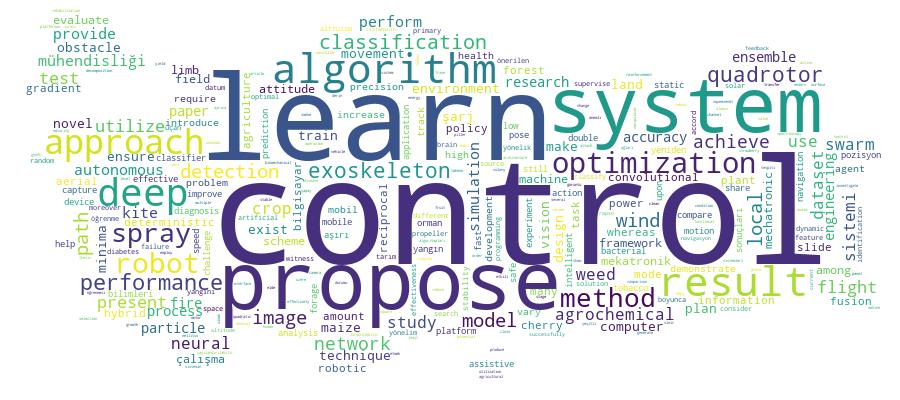
Competency Cloud
12 results
Scholarly Output Search Results
Now showing 1 - 10 of 12
Conference Object Citation - Scopus: 4Convolution Neural Network (cnn) Based Automatic Sorting of Cherries(Institute of Electrical and Electronics Engineers Inc., 2021) Park,H.; Khan,M.U.Cherries are spring fruits enriched with nutrients, and are easily available in food markets around the world. Due to their excess demand, many enterprises solely focused on their processing. Cherries are especially susceptible to pathological-, physiological-diseases and structural degradation due to their soft outer skin. The post-harvest life of the fruit is limited by various characteristics. The agricultural industry has also been at the forefront to get benefits from the advanced machine learning tools. This study presents an image processing-based system for sorting cherries using the convolutional neural network (CNN). For this study, Prunus avium L cherries of export quality, available in Turkey, tagged as ‘0900 Ziraat’, are used. Surprisingly, there exists no dataset for these cherries; hence, we developed our dataset. Through the proposed approach based upon U-Net, the binary classification accuracy of 99% is achieved. Clear identification is demonstrated by the test results of varying mixture ratios of good and bad cherries. It can therefore be said that for cherry sorting and grading, U-Net can be applied as a reliable and promising machine learning tool. ©2021 IEEEConference Object Citation - Scopus: 10Biomechanical Design and Control of Lower Limb Exoskeleton for Sit-To and Stand-To Movements(Institute of Electrical and Electronics Engineers Inc., 2018) Qureshi,M.H.; Masood,Z.; Rehman,L.; Owais,M.; Khan,M.U.In this paper, we present design and development phase of lower limb robotic exoskeleton that can assist paralyzed individuals. Motion of the human wearing exoskeleton is introduced by actuators. Both exoskeleton legs are attached to the supporting frame by passive universal joints. The exoskeleton provides 3 DOFs per limb of which two joints are active and one passive. The control actions i.e., sit-to-stand and stand-to-sit movements are triggered using Double Pole Double Throw (DPDT) toggle switch. The control scheme is implement using Switch control method and the feedback is provided by means of current measurement. This assistive device can be utilized for the disabled persons. The simulation results are provided that evaluates the performance of the control actions on exoskeleton. © 2018 IEEE.Conference Object Citation - Scopus: 9Attitude Control of Quad-Copter Using Deterministic Policy Gradient Algorithms (dpga)(Institute of Electrical and Electronics Engineers Inc., 2019) Ghouri,U.H.; Zafar,M.U.; Bari,S.; Khan,H.; Khan,M.U.In aerial robotics, intelligent control has been a buzz for the past few years. Extensive research efforts can be witnessed to produce control algorithms for stable flight operation of aerial robots using machine learning. Supervised learning has the tendency but training an agent using supervised learning can be a tedious task. Moreover, the data gathering could be expensive and always prone to inaccuracies due to parametric variations and system dynamics. An alternative approach is to ensure the stability of the aerial robots with the help of Deep Re-inforcement Learning (DRL). This paper deals with the intelligent control of quad-copter using deterministic policy gradient algorithms. In this research, state of the art Deep Deterministic Policy Gradient (DDPG) and Distributed Distributional Deep Deterministic Policy Gradient (D4PG) algorithms are employed for attitude control of quad-copter. An open source simulation environment GymFC is used for training of quad-copter. The results for comparative analysis of DDPG D4PG algorithms are also presented, highlighting the attitude control performance. © 2019 IEEE.Conference Object Citation - WoS: 3Biomechanical Design and Control of Lower Limb Exoskeleton for Sit-to-Stand and Stand-to-Sit Movements(Ieee, 2018) Qureshi, Muhammad Hamza; Masood, Zeeshan; Rehman, Linta; Owais, Muhammad; Khan, Muhammad UmerIn this paper, we present design and development phase of lower limb robotic exoskeleton that can assist paralyzed individuals. Motion of the human wearing exoskeleton is introduced by actuators. Both exoskeleton legs are attached to the supporting frame by passive universal joints. The exoskeleton provides 3 DOFs per limb of which two joints are active and one passive. The control actions i.e., sit-to-stand and stand-to-sit movements are triggered using Double Pole Double Throw (DPDT) toggle switch. The control scheme is implement using Switch control method and the feedback is provided by means of current measurement. This assistive device can be utilized for the disabled persons. The simulation results are provided that evaluates the performance of the control actions on exoskeleton.Conference Object Citation - Scopus: 3Reciprocal Altruism-Based Path Planning Optimization for Multi-Agents(Institute of Electrical and Electronics Engineers Inc., 2022) Maeedi,A.; Khan,M.U.; Irfanoglu,B.This paper investigates solutions for the fundamental yet challenging problem of path planning of autonomous multi-agents. The novelty of the proposed algorithm, reciprocal altruism-based particle swarm optimization (RAPSO), lies in the introduction of information sharing among the agents. The RAPSO utilizes kinship relatedness among the agents during the optimization process to reciprocate the significant data. The concept of reciprocation is introduced to ensure that all agents remain in close contact through information exchange. The amount of exchange depends upon their physical location in the search space and their associated health indicator. Agents are classified as donors, recipients, or un-active concerning their health indicator and their positions. The ability of RAPSO to keep all agents closer to local optima through reciprocal altruism is evaluated for path planning optimization problem. Simulation results show that the RAPSO is very competitive when compared with the canonical PSO. The results of the generalized simulation scenario also prove its potential in solving path planning problems in robotics. © 2022 IEEE.Conference Object Citation - WoS: 4Sliding Mode Control for Autonomous Flight of Tethered Kite Under Varying Wind Speed Conditions(Ieee, 2020) Bari, Salman; Khan, Muhammad UmerHigh altitude wind is an energy-abundant source, representing the next generation of wind power technology. The power that can be extracted from wind grows cubically with wind speed, making higher altitudes a desirable choice to harvest wind energy. In this respect, large and fully-automated kites or planes can be used to capture such energy. Flight control is a key research area for using fully-automated kite power systems at utility scale. In this study, a novel control architecture is proposed for autonomous pattern 8 flight of tethered kites under varying wind speed conditions. The proposed scheme does not require a separate control system for turn maneuvers and straight flight path sections. Exponential reaching law-based Sliding Mode Control (SMC) and adaptive sliding mode control schemes are tested for flight control of a kite given a pre-specified trajectory. In this approach, the inversion of plant model is not required to address the problem of possible system instability, thus making the scheme proposed here more resilient towards system perturbations.Conference Object Citation - WoS: 8Attitude Control of Quad-Copter Using Deterministic Policy Gradient Algorithms (dpga)(Ieee, 2019) Ghouri, Usama Hamayun; Zafar, Muhammad Usama; Bari, Salman; Khan, Haroon; Khan, Muhammad UmerIn aerial robotics, intelligent control has been a buzz for the past few years. Extensive research efforts can be witnessed to produce control algorithms for stable flight operation of aerial robots using machine learning. Supervised learning has the tendency but training an agent using supervised learning can be a tedious task. Moreover, the data gathering could be expensive and always prone to inaccuracies due to parametric variations and system dynamics. An alternative approach is to ensure the stability of the aerial robots with the help of Deep Re-inforcement Learning (DRL). This paper deals with the intelligent control of quad-copter using deterministic policy gradient algorithms. In this research, state of the art Deep Deterministic Policy Gradient (DDPG) and Distributed Distributional Deep Deterministic Policy Gradient (D4PG) algorithms are employed for attitude control of quad-copter. An open source simulation environment GymFC is used for training of quad-copter. The results for comparative analysis of DDPG & D4PG algorithms are also presented, highlighting the attitude control performance.Conference Object Citation - WoS: 86Real-Time Machine-Learning Based Crop/Weed Detection and Classification for Variable-Rate Spraying in Precision Agriculture(Ieee, 2020) Alam, Mansoor; Alam, Muhammad Shahab; Roman, Muhammad; Tufail, Muhammad; Khan, Muhammad Umer; Khan, Muhammad TahirTraditional agrochemical spraying techniques often result in over or under-dosing. Over-dosing of spray chemicals is costly and pose a serious threat to the environment, whereas, under-dosing results in inefficient crop protection and thereby low crop yields. Therefore, in order to increase yields per acre and to protect crops from diseases, the exact amount of agrochemicals should be sprayed according to the field/crop requirements. This paper presents a real-time computer vision-based crop/weed detection system for variable-rate agrochemical spraying. Weed/crop detection and classification were performed through the Random Forest classifier. The classification model was first trained offline with our own created dataset and then deployed in the field for testing. Agrochemical spraying was done through application equipment consisting of a PWM-based fluid flow control system capable of spraying the desired amounts of agrochemical directed by the vision-based feedback system. The results obtained from several field tests demonstrate the effectiveness of the proposed vision-based agrochemical spraying framework in real-time.Conference Object Citation - Scopus: 135Real-Time Machine-Learning Based Crop/Weed Detection and Classification for Variable-Rate Spraying in Precision Agriculture(Institute of Electrical and Electronics Engineers Inc., 2020) Alam,M.; Alam,M.S.; Roman,M.; Tufail,M.; Khan,M.U.; Khan,M.T.Traditional agrochemical spraying techniques often result in over or under-dosing. Over-dosing of spray chemicals is costly and pose a serious threat to the environment, whereas, under-dosing results in inefficient crop protection and thereby low crop yields. Therefore, in order to increase yields per acre and to protect crops from diseases, the exact amount of agrochemicals should be sprayed according to the field/crop requirements. This paper presents a real-time computer vision-based crop/weed detection system for variable-rate agrochemical spraying. Weed/crop detection and classification were performed through the Random Forest classifier. The classification model was first trained offline with our own created dataset and then deployed in the field for testing. Agrochemical spraying was done through application equipment consisting of a PWM-based fluid flow control system capable of spraying the desired amounts of agrochemical directed by the vision-based feedback system. The results obtained from several field tests demonstrate the effectiveness of the proposed vision-based agrochemical spraying framework in real-time. © 2020 IEEE.Conference Object Biomechanical Design and Control of Lower Limb Exoskeleton for Sit-To and Stand-To Movements(Institute of Electrical and Electronics Engineers Inc., 2018) Qureshi,M.H.; Masood,Z.; Rehman,L.; Owais,M.; Khan,M.U.In this paper, we present design and development phase of lower limb robotic exoskeleton that can assist paralyzed individuals. Motion of the human wearing exoskeleton is introduced by actuators. Both exoskeleton legs are attached to the supporting frame by passive universal joints. The exoskeleton provides 3 DOFs per limb of which two joints are active and one passive. The control actions i.e., sit-to-stand and stand-to-sit movements are triggered using Double Pole Double Throw (DPDT) toggle switch. The control scheme is implement using Switch control method and the feedback is provided by means of current measurement. This assistive device can be utilized for the disabled persons. The simulation results are provided that evaluates the performance of the control actions on exoskeleton. © 2018 IEEE.
