Şahin, Alper

Loading...
Profile Picture
Name Variants
Şahin, Alper
S., Alper
Şahin A.
Sahin,Alper
Ş., Alper
Alper, Sahin
A., Sahin
Ş.,Alper
Şahin,A.
A.,Sahin
S.,Alper
Sahin, Alper
Sahin,A.
Alper Şahin
Alper, Şahin
A., Şahin
A.,Şahin
Sahın, Alper
Job Title
Yardımcı Doçent
Email Address
alper.sahin@atilim.edu.tr
Main Affiliation
Department of Basic English (Prep School)
Status
Scopus Author ID
Turkish CoHE Profile ID
Google Scholar ID
WoS Researcher ID

Sustainable Development Goals

SDG data is not available
Documents

7

Citations

128

h-index

5

Documents

6

Citations

114

Scholarly Output

4

Articles

3

Views / Downloads

14/0

Supervised MSc Theses

0

Supervised PhD Theses

0

WoS Citation Count

1

Scopus Citation Count

7

WoS h-index

1

Scopus h-index

1

Patents

0

Projects

0

WoS Citations per Publication

0.25

Scopus Citations per Publication

1.75

Open Access Source

3

Supervised Theses

0

Google Analytics Visitor Traffic

JournalCount
Eğitimde ve Psikolojide Ölçme ve Değerlendirme Dergisi1
International Journal of Assessment Tools in Education1
Journal of Pedagogical Research1
Current Page: 1 / 1

Scopus Quartile Distribution

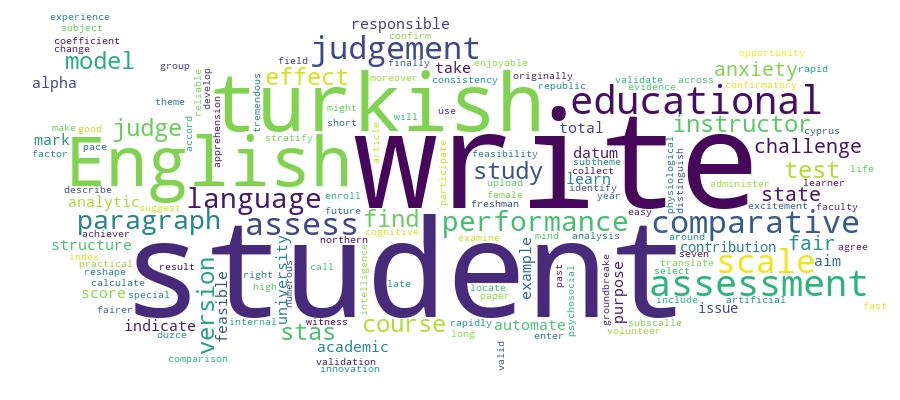
Competency Cloud

GCRIS Competency Cloud

Scholarly Output Search Results

Now showing 1 - 4 of 4
  • Book Part
    Applying Asymmetric Theory to Optimise Instructional, Assessment, and Administrative Designs of Intensive English Programmes
    (Springer Science+Business Media, 2025) Sahin, A.
    Asymmetric Theory emphasizes optimisation, efficiency, and economy by harnessing the transformative power of asymmetry. It offers practical and functional solutions to some complex daily and scientific problems through the application of multilayered asymmetric thinking. The process begins with the careful identification of the most dominant factors influencing the success of the solutions to the problems, ultimately leading to the creation of a main key to successand sub keys to success attached to it. The key tosuccess serves as a guide for its creator as it highlights which factors should be controlled and which should be prioritised over the others. As a result, Asymmetric Theory introduces a structured strategy-oriented approach to problem-solving. This chapter begins by highlighting the importance of Intensive English Programmes (IEPs) for English-medium universities. Then, it introduces the core principles of Asymmetric Theory. Building on these principles, a main key to success is created for the programme development challenge of IEPs followed by the creation of sub keys for optimising their instructional, assessment, and administrative designs. These steps are demonstrated using a think-aloud protocol. Ultimately, this chapter presents how the instructional, assessment, and administrative designs of an educational programme can be effectively optimised through the lens of Asymmetric Theory using IEPs as a comprehensive example. © 2025 The Editor(s) (if applicable) and The Author(s), under exclusive license to Springer Nature Switzerland AG.
  • Article
    Citation - Scopus: 1
    Opportunities and Challenges of AI in Educational Assessment
    (Assoc Measurement & Evaluation Education & Psychology, 2024) Sahın, Alper; Thompson, Nathan; Ercikan, Kadriye
    In the past few years, as artificial intelligence (AI) and large language models (LLM) have rapidly entered our lives, we have witnessed groundbreaking innovations across numerous fields. The rapid pace of these changes has been met with excitement by some and apprehension by others. However, we all agree that they have made tremendous contributions so far and their contributions in the future will reshape our existence. The field of educational assessment is no exception. With this in mind, we issued a call for a special issue themed “Opportunities and Challenges of AI in Educational Assessment.” which finally included seven distinguished articles on subthemes of fair and responsible use of AI in educational assessment, learning analytics, automated scoring, and real-life examples of AI and LLM.
  • Article
    Citation - WoS: 1
    Validation of a New State Test Anxiety Scale (stas)
    (Izzet Kara, 2021) Sahın, Alper
    This study aimed to validate the English version of Sahin’s (2019) State Test Anxiety Scale (STAS) which was originally developed in Turkish based on the latest bio-psychosocial model of test anxiety. For this purpose, the Turkish version of STAS was translated into English and administered to 360 (123 females, 237 males) students from 22 countries. The data were subjected to the confirmatory factor analysis to confirm the three-factor structure as in the Turkish version. Most of the fit indices examined (χ2/df=1.94, CFI=.98, NFI=.96, NNFI=.98, IFI=.98, RMSEA=.05, SRMR=.05) indicated that the data of the STAS had a good fit to the three-factor structure as its Turkish version. The Alpha internal consistency coefficients were found to be .81, .77, .91, and .92, for Physiological effects, Psychosocial effects, Cognitive effects subscales, and the total scale respectively. Stratified Alpha was also calculated and was found to be .93. All in all, evidence collected in this study indicated that the English version of STAS was a valid and reliable scale as its Turkish version.
  • Article
    Citation - Scopus: 6
    Feasibility of Using Comparative Judgement and Student Judges To Assess Writing Performance of English Language Learners
    (Duzce University, Faculty of Education, 2021) Şahin,A.
    This study aims to identify how feasible it is to use comparative judgement (CJ) and student judges to assess the writing performance of English language learners. For this purpose, 35 paragraphs written by the students who were enrolled in a freshman Academic Writing course at a semi-private university located in the Turkish Republic of Northern Cyprus were selected and uploaded to http://www.nomoremarking.com website. Ten instructors of the Academic Writing course and 112 students taking the course volunteered to participate in the study. Then, the students were taken into 5 groups according to their writing performance level. In total, around 350 comparisons were done by each group. The results suggested that it could be feasible to use CJ to assess short writing performance like paragraphs if the instructors were experienced and trained. Moreover, instructors liked CJ and described it as a more practical, easier, fairer, faster, more enjoyable way of marking student papers. The students also liked CJ and it was also found that students who were high achievers in paragraph writing might be used to mark student papers through comparative judgement as long as they were trained. © 2021, Duzce University, Faculty of Education. All rights reserved.