
Mıshra, Alok
Loading...
Profile URL
Name Variants
Mishra, A.
Mishra, A
Mishra A.
Alok, Mishra
Mıshra, Alok
A., Mishra
Alok M.
M., Alok
M.,Alok
Mishra, Alok
Mishra,A.
A.,Mıshra
A.,Mishra
Alok, Mıshra
A., Mıshra
Mıshra,A.
Mishra, A
Mishra A.
Alok, Mishra
Mıshra, Alok
A., Mishra
Alok M.
M., Alok
M.,Alok
Mishra, Alok
Mishra,A.
A.,Mıshra
A.,Mishra
Alok, Mıshra
A., Mıshra
Mıshra,A.
Job Title
Profesor Doktor
Email Address
alok.mishra@atilim.edu.tr
Main Affiliation
Software Engineering
Status
Website
ORCID ID
Scopus Author ID
Turkish CoHE Profile ID
Google Scholar ID
WoS Researcher ID
Sustainable Development Goals
 1
1NO POVERTY
0
Research Products
 2
2ZERO HUNGER
1
Research Products
 3
3GOOD HEALTH AND WELL-BEING
9
Research Products
 4
4QUALITY EDUCATION
6
Research Products
 5
5GENDER EQUALITY
1
Research Products
 6
6CLEAN WATER AND SANITATION
1
Research Products
 7
7AFFORDABLE AND CLEAN ENERGY
0
Research Products
 8
8DECENT WORK AND ECONOMIC GROWTH
0
Research Products
 9
9INDUSTRY, INNOVATION AND INFRASTRUCTURE
8
Research Products
 10
10REDUCED INEQUALITIES
0
Research Products
 11
11SUSTAINABLE CITIES AND COMMUNITIES
4
Research Products
 12
12RESPONSIBLE CONSUMPTION AND PRODUCTION
4
Research Products
 13
13CLIMATE ACTION
4
Research Products
 14
14LIFE BELOW WATER
4
Research Products
 15
15LIFE ON LAND
0
Research Products
 16
16PEACE, JUSTICE AND STRONG INSTITUTIONS
10
Research Products
 17
17PARTNERSHIPS FOR THE GOALS
2
Research Products

Scopus data could not be loaded because of an error. Please refresh the page or try again later.

Documents
170
Citations
2565

Scholarly Output
197
Articles
103
Views / Downloads
163/318
Supervised MSc Theses
13
Supervised PhD Theses
8
WoS Citation Count
2080
Scopus Citation Count
3048
Patents
0
Projects
0
WoS Citations per Publication
10.56
Scopus Citations per Publication
15.47
Open Access Source
42
Supervised Theses
21
| Journal | Count |
|---|---|
| Sensors | 7 |
| TEM Journal | 7 |
| Computers in Human Behavior | 4 |
| Applied Sciences | 4 |
| Electronics Information and Planning | 4 |
Current Page: 1 / 22
Scopus Quartile Distribution
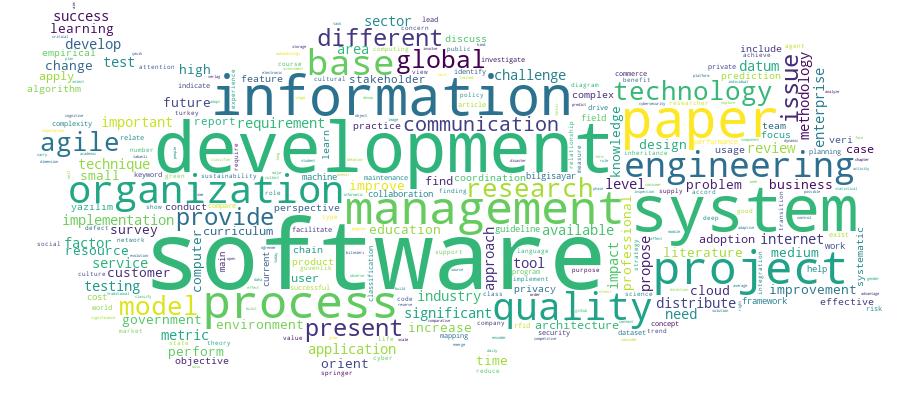
Competency Cloud
12 results
Scholarly Output Search Results
Now showing 1 - 10 of 12
Article Citation - WoS: 11Citation - Scopus: 14Challenges in Agile Software Maintenance for Local and Global Development: an Empirical Assessment(Mdpi, 2023) Almashhadani, Mohammed; Mishra, Alok; Yazici, Ali; Younas, MuhammadAgile methods have gained wide popularity recently due to their characteristics in software development. Despite the success of agile methods in the software maintenance process, several challenges have been reported. In this study, we investigate the challenges that measure the impact of agile methods in software maintenance in terms of quality factors. A survey was conducted to collect data from agile practitioners to establish their opinions about existing challenges. As a result of the statistical analysis of the data from the survey, it has been observed that there are moderately effective challenges in manageability, scalability, communication, collaboration, and transparency. Further research is required to validate software maintenance challenges in agile methods.Article Citation - WoS: 2Citation - Scopus: 8It Service Management (itsm) Education and Research: Global View(Tempus Publications, 2015) Yazici, Ali; Mishra, Alok; Kontogiorgis, Paul; Software EngineeringThis article provides an overview of Information Technology Service Management (ITSM) and investigates the education and research activities in this discipline from a global perspective. The objectives of the study are to inform the training organizations (e.g., universities, training institutes) on the current status of the educational activities in ITSM at undergraduate and graduate levels; and to guide the researchers by providing quantitative data on the research activities conducted in the field. In the educational arena, the statistical data showed that, stand-alone undergraduate/graduate programs are becoming popular among the high school graduates with elevated expectations of the market place, in addition to the appreciation of the IT service management area by the IT sector and the public. The results of the research findings provide guidelines for curriculum developers in the design and implementation of courses for the de facto interdisciplinary ITSM degree/certificate training programs and motivate and guide the researchers by providing the most recent quantitative data on the ITSM field. It is one of the first studies to provide education and research trends in ITSM area. The present study adds to this important stream of emerging research area and contributes by advancing the understanding of ITSM education and research issues. This paper advances the current state of knowledge on ITSM education and explores recent research trends in this area which is becoming standard towards providing quality IT services in enterprises.Conference Object Citation - WoS: 9Successful Requirement Elicitation by Combining Requirement Engineering Techniques(Ieee, 2008) Mishra, Deepti; Mishra, Alok; Yazici, AliThe role of customers and other stakeholders is becoming increasingly significant during requirement engineering activities. Methods of eliciting requirements are now more co-operative. There are many techniques to obtain requirements from customers. Selecting the right techniques according to the characteristics of the project is very important. In some complex problems, combination of requirement engineering techniques should be applied for efficient and successful requirement engineering process. In this paper, we have presented the application of combination of requirement engineering techniques for a real life complex project (Supply Chain Management) with higher requirements volatility developed in a small scale software development organization, This will help in understanding requirements elicitation for such kind of complex software and facilitate in selecting the appropriate techniques towards getting the consistent and complete requirements.Article Citation - WoS: 33Citation - Scopus: 46Software Product Quality Metrics: a Systematic Mapping Study(Ieee-inst Electrical Electronics Engineers inc, 2021) Colakoglu, Fatima Nur; Yazici, Ali; Mishra, AlokIn the current competitive world, producing quality products has become a prominent factor to succeed in business. In this respect, defining and following the software product quality metrics (SPQM) to detect the current quality situation and continuous improvement of systems have gained tremendous importance. Therefore, it is necessary to review the present studies in this area to allow for the analysis of the situation at hand, as well as to enable us to make predictions regarding the future research areas. The present research aims to analyze the active research areas and trends on this topic appearing in the literature during the last decade. A Systematic Mapping (SM) study was carried out on 70 articles and conference papers published between 2009 and 2019 on SPQM as indicated in their titles and abstract. The result is presented through graphics, explanations, and the mind mapping method. The outputs include the trend map between the years 2009 and 2019, knowledge about this area and measurement tools, issues determined to be open to development in this area, and conformity between conference papers, articles and internationally valid quality models. This study may serve as a foundation for future studies that aim to contribute to the development in this crucial field. Future SM studies might focus on this subject for measuring the quality of network performance and new technologies such as Artificial Intelligence (AI), Internet of things (IoT), Cloud of Things (CoT), Machine Learning, and Robotics.Conference Object Informatics Engineering Education in Turkey and Expectations of Software Industry(Ieee, 2018) Yazici, Ali; Mishra, Alok; Karakaya, Ziya; Ustunkok, TolgaIn this study, using the OSYM data, the number of intakes in Informatics Engineering programs in Turkey, accreditation data and the medium of instruction of the program are summarized for the years 2016 and 2017. In addition, the software sector's expectations from the informatics engineering graduates are reassessed based on the academic studies. The developed knowledge-skill gap set was used to evaluate the situation in Turkish informatics engineering programs. Sector expectations are discussed in the context of 2017-2019 Turkey Software Sector Strategy and Action Plan prepared by the Ministry of Science, Industry and Technology of Turkey and some proposals are made for the academia. As a result, it was observed that the expectations of the software industry were similar in all studies. Additionally, the expectations were changed in the direction of developing technologies and this change should be reflected in the informatics engineering programs.Article Citation - WoS: 1Citation - Scopus: 2Software Evolution in Turkey(Univ Osijek, Tech Fac, 2016) Mishra, Alok; Yazici, Ali; Cetin, SemihAccording to a recent Gartner report, Turkey is now to be considered in one of the world's outsourcing destinations since it has secured its place in the list of top 30 countries for Information Technology ( IT), and offshore services. In the last decade, the country has made excellent progress in the software sector, and this is reflected in the rise of its exports to many countries. In this article, we present an overview of advancement of Turkey's software sector, including current trends in software process, testing, quality, and the adoption of agile methods along with techno parks and incentives provided by the government.Article Citation - WoS: 9Citation - Scopus: 17An Assessment of the Software Engineering Curriculum in Turkish Universities: Ieee/Acm Guidelines Perspective(Fac Teacher Education, 2011) Mishra, Alok; Yazici, Ali; Software EngineeringSoftware engineering (SE) education has been emerging as an independent and mature discipline. Accordingly, various studies are being done to provide guidelines for SE education curriculum design. This paper presents software engineering education evolvement in Turkey, present SE education scenario in different universities along with the significance of software technology parks in relevance to software engineering education. The objective of this paper is to provide an assessment of SE curriculum in Turkish Universities with respect to IEEE/ACM guidelines given in SEEK (2004). This study will provide a guideline to universities conducting an SE programme at undergraduate level to align their course curriculum with IEEE/ACM guidelines (SEEK, 2004).Article Citation - WoS: 16Citation - Scopus: 17Organizational Software Piracy: an Empirical Assessment(Taylor & Francis Ltd, 2007) Mishra, Alok; Akman, Ibrahim; Yazici, AliApplication of Information Technology (IT) has had a significant impact on all aspects of business. Due to technology, the ease with which software can be pirated is increasing and is leading to increased concern for copyright protection. This paper reviews and discusses software piracy issues from a global perspective and reports the findings of a survey concerning the impact of sectors like government, private and academic in Turkey. Although software piracy has long been attracting the interest of academics, no quantitative research has ever been realized in this field in the country. Elsewhere also, most of the software piracy-related studies are from individuals' perspectives and are limited to students, academics, cost, and attitudes. Very few have reported findings related to IT professionals and organizations. The survey was conducted among IT managers of large-scale organizations from different sectors such as the government, private and academic community. Based on the survey of 162 IT managers, the results indicated that sectors have significant impact on software piracy to some extent.Article Citation - WoS: 17Citation - Scopus: 24Software Piracy Among It Professionals in Organizations(Elsevier Sci Ltd, 2006) Mishra, Alok; Akman, Ibrahim; Yazici, AliThis paper reviews and discusses software piracy issues from a global perspective. It also reports the findings of a survey concerning the impact of demographic factors on software piracy among IT professionals in Turkey. Although the impact of these factors on software piracy has long been attracting the interest of academics, no quantitative research has ever been realized in this field in the country. Elsewhere also, most of the software piracy-related studies are limited to students and academics and very few have reported findings related to IT professionals in different organizations. The survey was conducted among IT professionals from government and private sector organizations. Based on this survey, the results indicated that gender, age and experience have significant impact on software piracy. The implications of these findings are discussed and compared with other related studies. (c) 2006 Elsevier Ltd. All rights reserved.Review Citation - WoS: 1Citation - Scopus: 1Software Maintenance Practices Using Agile Methods Towards Cloud Environment: a Systematic Mapping(Wiley, 2024) Almashhadani, Mohammed; Mishra, Alok; Yazici, AliAgile methods have emerged to overcome the obstacles of structured methodologies, such as the waterfall, prototype, spiral, and so on. There are studies showing the usefulness of agile approaches in software development. However, studies on Agile maintenance are very limited in number. Regardless of the chosen methodology, software maintenance can be carried out in either a local (on-the-premise) or global (distributed) environment. In a local environment, the software maintenance team is co-located on the same premises, while in a global environment, the team is geographically dispersed from the customer. The main objective of this Systematic Mapping (SM) study is to identify the practices useful for software maintenance using the Agile approaches in the Cloud environment. We have conducted a comprehensive search in well-known digital databases and examined the articles that map to the pre-defined inclusion criteria. The study selected and analyzed 48 articles out of 320 published between 2000 and 2022. The findings of the mapping study reveal that Agile can resolve the major issues faced in traditional software maintenance, making the role of this approach significant in global/distributed software maintenance. Cloud computing plays a vital role in software maintenance. Most of the studies highlight the application of XP- and Scrum-based Agile maintenance models. The study found a need for more Agile maintenance solutions in the cloud, highlighting the importance of agile in software maintenance, both locally and globally. Irrespective of the environment, Cloud computing provides a centralized platform for collaboration and communication, while also offering scalability and flexibility to adapt to diverse infrastructure needs. This allows agile maintenance practices to be implemented across both local and global environments, leveraging the cloud's capabilities to overcome geographical and infrastructural challenges. image
