
Mıshra, Alok
Loading...
Profile URL
Name Variants
Mishra, A.
Mishra, A
Mishra A.
Alok, Mishra
Mıshra, Alok
A., Mishra
Alok M.
M., Alok
M.,Alok
Mishra, Alok
Mishra,A.
A.,Mıshra
A.,Mishra
Alok, Mıshra
A., Mıshra
Mıshra,A.
Mishra, A
Mishra A.
Alok, Mishra
Mıshra, Alok
A., Mishra
Alok M.
M., Alok
M.,Alok
Mishra, Alok
Mishra,A.
A.,Mıshra
A.,Mishra
Alok, Mıshra
A., Mıshra
Mıshra,A.
Job Title
Profesor Doktor
Email Address
alok.mishra@atilim.edu.tr
Main Affiliation
Software Engineering
Status
Website
ORCID ID
Scopus Author ID
Turkish CoHE Profile ID
Google Scholar ID
WoS Researcher ID
Sustainable Development Goals
 1
1NO POVERTY
0
Research Products
 2
2ZERO HUNGER
1
Research Products
 3
3GOOD HEALTH AND WELL-BEING
9
Research Products
 4
4QUALITY EDUCATION
6
Research Products
 5
5GENDER EQUALITY
1
Research Products
 6
6CLEAN WATER AND SANITATION
1
Research Products
 7
7AFFORDABLE AND CLEAN ENERGY
0
Research Products
 8
8DECENT WORK AND ECONOMIC GROWTH
0
Research Products
 9
9INDUSTRY, INNOVATION AND INFRASTRUCTURE
8
Research Products
 10
10REDUCED INEQUALITIES
0
Research Products
 11
11SUSTAINABLE CITIES AND COMMUNITIES
4
Research Products
 12
12RESPONSIBLE CONSUMPTION AND PRODUCTION
4
Research Products
 13
13CLIMATE ACTION
4
Research Products
 14
14LIFE BELOW WATER
4
Research Products
 15
15LIFE ON LAND
0
Research Products
 16
16PEACE, JUSTICE AND STRONG INSTITUTIONS
10
Research Products
 17
17PARTNERSHIPS FOR THE GOALS
2
Research Products

This researcher does not have a Scopus ID.

Documents
170
Citations
2555

Scholarly Output
197
Articles
103
Views / Downloads
161/259
Supervised MSc Theses
13
Supervised PhD Theses
8
WoS Citation Count
2079
Scopus Citation Count
3045
Patents
0
Projects
0
WoS Citations per Publication
10.55
Scopus Citations per Publication
15.46
Open Access Source
42
Supervised Theses
21
| Journal | Count |
|---|---|
| Sensors | 7 |
| TEM Journal | 7 |
| Computers in Human Behavior | 4 |
| Applied Sciences | 4 |
| Electronics Information and Planning | 4 |
Current Page: 1 / 22
Scopus Quartile Distribution
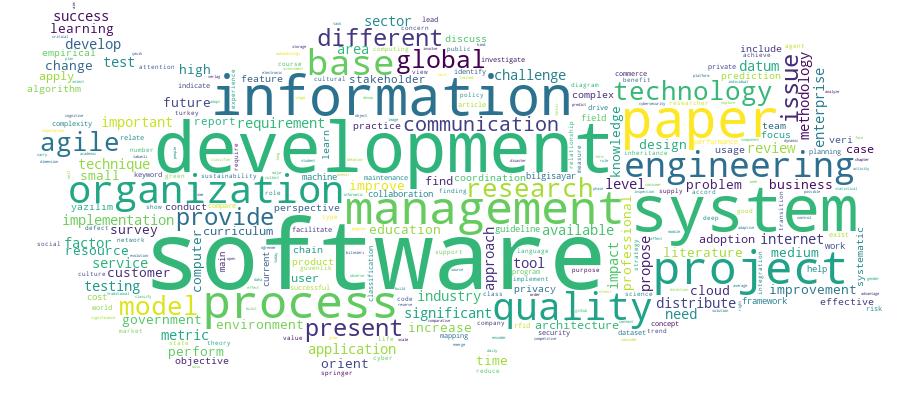
Competency Cloud
25 results
Scholarly Output Search Results
Now showing 1 - 10 of 25
Conference Object Üniversite Yazilim Mühendisligi Programlari Müfredatinin Swebok Kilavuzu Kullanilarak Degerlendirme ve İyilestirilmesi: Türkiye'de Bir Vaka Çalismasi(CEUR-WS, 2015) Garousi,V.; Mishra,A.; Yazici,A.[No abstract available]Book Part E-mentoring in global software development teams: Success factors to develop a common culture(IGI Global, 2013) Colomo-Palacios,R.; Mishra,A.; Casado-Lumbreras,C.; Soto-Acosta,P.Global Software Development (GSD) teams face communication and coordination problems due to spatial, temporal, and cultural separation between team members. Cultural diversity and cross-cultural management are significant issues among GSD teams. In software development projects, mentoring dramatically reduces the learning curve for novice human resources. Due to the large amount of electronic communication instruments, a remarkable number of different e-Mentoring concepts have emerged, which provides opportunity for mentoring that would not otherwise be possible. This chapter presents key success factors to enable e-Mentoring as a tool to develop a common culture in GSD scenarios. These success factors enable the correct application of mentoring programmes and the use of this to build a common culture in organizations that perform GSD. © 2014, IGI Global.Book Part Citation - Scopus: 12Sustainable Software Engineering: Curriculum Development Based on Acm/Ieee Guidelines(Springer International Publishing, 2021) Mishra,A.; Mishra,D.Climate change risk and environmental degradation are the most critical issues of our society. Our technology-influenced daily lifestyle involves many types of software and apps which are used by society at large, and their use is increasing more than ever before. Sustainability is a significant topic for future professionals and more so for software engineers due to its impact on society. It is crucial to motivate and raise concern among students and faculty members regarding sustainability by including it in the Software Engineering (SE) curriculum. This chapter discusses how sustainability can be included in various courses of the SE curriculum by considering ACM/IEEE curriculum guidelines for the SE curriculum, literature review, and various viewpoints so that SE students can attain knowledge on sustainable software engineering. It also includes an assessment of key competences in sustainability for proposed units in the SE curriculum. © Springer Nature Switzerland AG 2021. All rights reserved.Conference Object Citation - Scopus: 1Inventory System Transition Towards ERP(Institute of Electrical and Electronics Engineers Inc., 2019) Alansari,S.; Mishra,A.To do activities effectively and generate a value chain for organization competitiveness, it is required to run supply chain in best way by logistic services information system. Supply chains in the best way using logistic services information. Supply chain management has two purposes, first to deliver the product to the end users via multiple departments and, secondly, to deliver products to last customers because as it is beneficial to manage such product with coordination and monitoring everyday supply.To improve departments by equipping them with the best strategic information system, and to avoid all the associated risks its requires to have a specific system for inventory control. Therefore, the main goal of this paper is to illustrate the transition of the existing systems towards Enterprise Resource Planning (ERP). The study also proposes inception plans to develop the necessary software and search towards the best system by keeping in view many organizational constraints. To the end, a survey is carried out to measure the relationship between management models and organizational innovativeness in internal processes as part of the efforts towards adopting the new system planning. © 2019 IEEE.Conference Object Informatics Engineering Education in Turkey and Expectations of Software Industry;(Institute of Electrical and Electronics Engineers Inc., 2018) Yazici,A.; Mishra,A.; Karakaya,Z.; Ustunkok,T.In this study, using the ÖSYM data, the number of intakes in Informatics Engineering programs in Turkey, accreditation data and the medium of instruction of the program are summarized for the years 2016 and 2017. In addition, the software sector's expectations from the informatics engineering graduates are reassessed based on the academic studies. The developed knowledge-skill gap set was used to evaluate the situation in Turkish informatics engineering programs. Sector expectations are discussed in the context of 2017-2019 Turkey Software Sector Strategy and Action Plan prepared by the Ministry of Science, Industry and Technology of Turkey and some proposals are made for the academia. As a result, it was observed that the expectations of the software industry were similar in all studies. Additionally, the expectations were changed in the direction of developing technologies and this change should be reflected in the informatics engineering programs. © 2018 IEEE.Book Part Citation - Scopus: 1Customer Engagement Strategies of China's E-Commerce Industry and Their Impact on China's Economy Transition(IGI Global, 2019) Yu,L.; Mishra,A.In the past 15 years, China's e-commerce industry has grown tremendously and become the world's largest e-commerce market. This chapter studies some popular e-commerce companies of China, including Alibaba, JD, and Pindoudou. Specifically, the customer engagement strategies of these companies are described and analyzed. This chapter helps readers understand how various customer engagement strategies of China's e-commerce companies have facilitated the change of their consumers' shopping habits-switching from offline shopping centers to online marketplaces and from cash-based payment to credit-based payment. The success of these customer engagement strategies has contributed to the performance improvement of e-commerce companies and could ultimately assist China to transfer from a production economy to a consumption economy. Moreover, these customer engagement strategies developed in China might also be applied to other e-businesses or marketplaces of different regions, especially developing countries that have a similar economy structure as China. © 2020 by IGI Global.Conference Object Citation - WoS: 1Citation - Scopus: 2Use Cases and Object Modelling Using Argouml(Springer-Verlag Berlin, 2011) Complak,W.; Wojciechowski,A.; Mishra,A.; Mishra,D.The key factor in the process of good quality software development is using proper techniques for requirements elicitation, representation and modelling providing foundations to build a logical model of the projected system. One of the most popular functional requirements description methods is use cases and scenarios approach introduced by Jacobson in 1993. Use case diagrams and analysis of functionality necessary for future users of the system allows precise definition of object model of target software system. However there are few fully functional free CASE tools supporting system designer at this software development stage. The article describes process of creating guidelines and formal requirements for design of a software system supporting storage and analysis of data concerning regulatory duties of Polish Telecom (Polish name: Telekomunikacja Polska) in the range of RIO framework agreement regarding collocation with the free UML modelling ArgoUML tool. © 2011 Springer-Verlag.Book Part Citation - Scopus: 6Cyber Stalking: a Challenge for Web Security(IGI Global, 2013) Mishra,A.; Mishra,D.Cyber stalking is a relatively new kind of cyber terrorism crime. Although it often receives a lower priority then cyber terrorism it is an important global issue. Due to new technologies, it is striking in different forms. Due to the Internets provision of anonymity and security it is proliferating quickly. Technology and tools available to curb it have many limitations and are not easy to implement. Legal acts to protect people from cyber stalking are geographically limited to the concerned state or country. This chapter reviews cyber stalking, its approaches, impacts, provision of legal acts, and measures to be taken to prevent it. There is an immediate need for research in the various dimensions of cyber stalking to assess this social problem. © 2013, IGI Global.Conference Object Citation - Scopus: 9Cultural issues in distributed software development: A review(Springer Verlag, 2014) Mishra,A.; Mishra,D.Cultural impact is significant in global or distributed software development. Due to cultural differences, co-ordination and collaboration problems have been reported in case studies and this also leads to low quality deliverables and high turnover in software industry. This paper presents a literature review of distributed software development (DSD) or global software development (GSD) and cultural issues. The main focus is to highlight the current research, observations, as well as practice directions in these areas. Many studies have been performed in culture and global software development, still impact of culture in distributed software development in different dimensions received less attention among researchers. © Springer-Verlag Berlin Heidelberg 2014.Conference Object Citation - WoS: 3Citation - Scopus: 4Global Software Development and Quality Management: a Systematic Review(Springer-Verlag Berlin, 2013) Mishra,D.; Mishra,A.; Colomo-Palacios,R.; Casado-Lumbreras,C.This paper presents a systematic literature review of global software development (GSD) and quality management aspects. The main focus is to highlight the current research and practice direction in these areas. The results have been limited to peer-reviewed conference papers and journal articles, published between 2000 and 2011. The analysis reports that major studies have been performed in quality and process management, while verification and validation issues of GSD can only get limited attention among researchers. This indicates the need for future research (quantitative and qualitative) in these areas. © 2013 Springer-Verlag.

- «
- 1 (current)
- 2
- 3
- »