
Mıshra, Alok
Loading...
Profile URL
Name Variants
Mishra, A.
Mishra, A
Mishra A.
Alok, Mishra
Mıshra, Alok
A., Mishra
Alok M.
M., Alok
M.,Alok
Mishra, Alok
Mishra,A.
A.,Mıshra
A.,Mishra
Alok, Mıshra
A., Mıshra
Mıshra,A.
Mishra, A
Mishra A.
Alok, Mishra
Mıshra, Alok
A., Mishra
Alok M.
M., Alok
M.,Alok
Mishra, Alok
Mishra,A.
A.,Mıshra
A.,Mishra
Alok, Mıshra
A., Mıshra
Mıshra,A.
Job Title
Profesor Doktor
Email Address
alok.mishra@atilim.edu.tr
Main Affiliation
Software Engineering
Status
Website
ORCID ID
Scopus Author ID
Turkish CoHE Profile ID
Google Scholar ID
WoS Researcher ID
Sustainable Development Goals
 1
1NO POVERTY
0
Research Products
 2
2ZERO HUNGER
1
Research Products
 3
3GOOD HEALTH AND WELL-BEING
9
Research Products
 4
4QUALITY EDUCATION
6
Research Products
 5
5GENDER EQUALITY
1
Research Products
 6
6CLEAN WATER AND SANITATION
1
Research Products
 7
7AFFORDABLE AND CLEAN ENERGY
0
Research Products
 8
8DECENT WORK AND ECONOMIC GROWTH
0
Research Products
 9
9INDUSTRY, INNOVATION AND INFRASTRUCTURE
8
Research Products
 10
10REDUCED INEQUALITIES
0
Research Products
 11
11SUSTAINABLE CITIES AND COMMUNITIES
4
Research Products
 12
12RESPONSIBLE CONSUMPTION AND PRODUCTION
4
Research Products
 13
13CLIMATE ACTION
4
Research Products
 14
14LIFE BELOW WATER
4
Research Products
 15
15LIFE ON LAND
0
Research Products
 16
16PEACE, JUSTICE AND STRONG INSTITUTIONS
10
Research Products
 17
17PARTNERSHIPS FOR THE GOALS
2
Research Products

This researcher does not have a Scopus ID.

Documents
170
Citations
2551

Scholarly Output
197
Articles
103
Views / Downloads
726/2439
Supervised MSc Theses
13
Supervised PhD Theses
8
WoS Citation Count
2074
Scopus Citation Count
3043
Patents
0
Projects
0
WoS Citations per Publication
10.53
Scopus Citations per Publication
15.45
Open Access Source
42
Supervised Theses
21
| Journal | Count |
|---|---|
| Sensors | 7 |
| TEM Journal | 7 |
| Computers in Human Behavior | 4 |
| Applied Sciences | 4 |
| Electronics Information and Planning | 4 |
Current Page: 1 / 22
Scopus Quartile Distribution
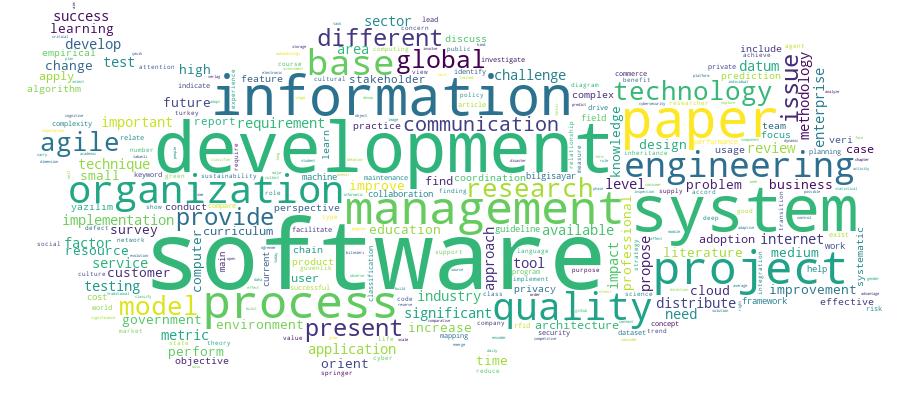
Competency Cloud
22 results
Scholarly Output Search Results
Now showing 1 - 10 of 22
Conference Object Citation - WoS: 7Citation - Scopus: 57Successful Requirement Elicitation by Combining Requirement Engineering Techniques(IEEE, 2008) Mishra,D.; Mishra,A.; Yazici,A.The role of customers and other stakeholders is becoming increasingly significant during requirement engineering activities. Methods of eliciting requirements are now more co-operative. There are many techniques to obtain requirements from customers. Selecting the right techniques according to the characteristics of the project is very important. In some complex problems, combination of requirement engineering techniques should be applied for efficient and successful requirement engineering process. In this paper, we have presented the application of combination of requirement engineering techniques for a real life complex project (Supply Chain Management) with higher requirements volatility developed in a small scale software development organization.This will help in understanding requirements elicitation for such kind of complex software and facilitate in selecting the appropriate techniques towards getting the consistent and complete requirements. ©2008 IEEE.Conference Object Citation - WoS: 2Citation - Scopus: 3Object-oriented inheritance metrics: Cognitive complexity perspective(Springer-Verlag Berlin, 2009) Mishra,D.; Mishra,A.Identifying high cognitive complexity modules can lead to a better quality software system and can help during maintenance also. It has been found that inheritance has an impact on cognitive complexity of a software system. In this paper, two inheritance metrics based on cognitive complexity, one at class level CCI (Class Complexity due to Inheritance) and another at program level ACI (Average Complexity of a program due to Inheritance), have been proposed for object-oriented software systems. These metrics are also compared with other well known object-oriented inheritance metrics. © 2009 Springer Berlin Heidelberg.Book Part Citation - Scopus: 2A Study of Software Process Improvement in Small and Medium Organizations(IGI Global, 2008) Mishra,D.; Mishra,A.Presently, the majority of software development, including outsourcing, is carried out by small and medium size software development organizations all over the world. These organizations are not capable to bear the cost of implementing available software process improvement models like CMMI, SPICE, ISO, and so forth. Therefore, there is a need to address this problem. In this chapter, various software process assessment and software process improvement models for small and medium scale organizations are discussed and compared. This will lead towards development of standardized software process improvement model for small and medium sized software development organizations in the future. © 2008, IGI Global.Article Citation - Scopus: 15Software Quality Assurance Models in Small and Medium Organisations: a Comparison(Inderscience Publishers, 2006) Mishra,A.; Mishra,D.Presently, the majority of software development including outsourcing is carried out by small- and medium-sized software development organisations all over the world. These organisations are not capable of bearing the cost of implementing available software quality models like CMM, SPICE, ISO, etc. Therefore, there is a need to address this problem. In this paper, we have tried to compare the main characteristics, benefits, and limitations of the models for small and medium software development organisations. We believe that this effort will contribute towards the development of a standardised quality improvement model for small- and medium-sized software development organisations. Copyright © 2006 Inderscience Enterprises Ltd.Conference Object Citation - Scopus: 3Achieving Success in Supply Chain Management Software by Agility(Springer Verlag, 2007) Mishra,D.; Mishra,A.Supply chain management is comprehensive software. Due to its scope and unpredictable, complex and unstable requirements, it is not possible to develop it with predictable development process models. Agile methodologies are targeted towards such kind of problems that involves change and uncertainty, and are adaptive rather than predictive. The aim of this paper is to analyze the management and development methodologies used in development of supply chain management software. This paper shows how to overcome risks and handicaps in each development phase of a complex inventive project. It also provides a set of guidelines regarding how the agile methods may be adopted, combined and used in these kinds of projects. © Springer-Verlag Berlin Heidelberg 2007.Conference Object Citation - Scopus: 1Market-Driven Software Project Through Agility: Requirements Engineering Perspective(Springer Verlag, 2009) Mishra,D.; Mishra,A.Time-to-market and insufficient initial requirements are two major challenges that make requirement engineering for market-driven software projects different from bespoke software projects. These challenges can be resolved by using agile methods for market-driven software development as agile methods put emphasis on a dynamic approach for requirement engineering which work closely with an iterative release cycle. In this study, dynamic requirement engineering approach of Agile methods was used for the successful implementation of market-driven software (Supply Chain Management) project. © 2009 Springer Berlin Heidelberg.Conference Object Citation - WoS: 2Citation - Scopus: 3Achieving Success in Supply Chain Management Software by Agility(Springer Verlag, 2007) Mishra,D.; Mishra,A.Supply chain management is comprehensive software. Due to its scope and unpredictable, complex and unstable requirements, it is not possible to develop it with predictable development process models. Agile methodologies are targeted towards such kind of problems that involves change and uncertainty, and are adaptive rather than predictive. The aim of this paper is to analyze the management and development methodologies used in development of supply chain management software. This paper shows how to overcome risks and handicaps in each development phase of a complex inventive project. It also provides a set of guidelines regarding how the agile methods may be adopted, combined and used in these kinds of projects. © Springer-Verlag Berlin Heidelberg 2007.Conference Object Citation - WoS: 3Citation - Scopus: 5Erp System Implementation: an Oil and Gas Exploration Sector Perspective(Springer Verlag, 2009) Mishra,A.; Mishra,D.Enterprise Resource Planning (ERP) systems provide integration and optimization of various business processes which leads to improved planning and decision quality, smoother coordination between business units resulting in higher efficiency, and quicker response time to customer demands and inquiries. This paper reports challenges, opportunities and outcome of ERP implementation in Oil & Gas exploration sector. This study will facilitate in understanding transition, constraints and implementation of ERP in this sector and also provide guidelines from lessons learned in this regard. © 2009 Springer Berlin Heidelberg.Article Emerging Scenario of Human Resource Management Due To Information Technology(2002) Mishra,A.The Information age has reached in knowledge based industrial revolution. Enterprises are networked and use IT Technologies to survive, grow and flourish in a highly competitive business environment of today. The objective of this paper is to assess the various frontiers and cutting-edge information technologies impact on Human Resource Management (HRM) in the present global liberalization of economy. Emerging scenario of HRM is quite different from the last decade. Information and Information Technology are the key drivers of the information era.Book Part Citation - Scopus: 8Cyber Stalking: a Challenge for Web Security(IGI Global, 2007) Mishra,A.; Mishra,D.Cyber stalking is a relatively new kind of cyber terrorism crime. Although it often receives a lower priority then cyber terrorism it is an important global issue. Due to new technologies, it is striking in different forms. Due to the Internets provision of anonymity and security it is proliferating quickly. Technology and tools available to curb it have many limitations and are not easy to implement. Legal acts to protect people from cyber stalking are geographically limited to the concerned state or country. This chapter reviews cyber stalking, its approaches, impacts, provision of legal acts, and measures to be taken to prevent it. There is an immediate need for research in the various dimensions of cyber stalking to assess this social problem. © 2008, IGI Global.

- «
- 1 (current)
- 2
- 3
- »