Akyüz, Göknur Arzu

Loading...
Profile Picture
Name Variants
Goknur Arzu, Akyuz
G.A.Akyüz
G., Akyuz
A.,Goknur Arzu
Akyuz,G.A.
Göknur Arzu, Akyüz
G.,Akyüz
Akyuz, Goknur Arzu
Akyüz,G.A.
A., Goknur Arzu
A.,Göknur Arzu
G.A.Akyuz
Akyüz, Göknur Arzu
Job Title
Doktor
Email Address
Main Affiliation
Industrial Engineering
Status
Former Staff
Website
ORCID ID
Scopus Author ID
Turkish CoHE Profile ID
Google Scholar ID
WoS Researcher ID

Sustainable Development Goals

2

ZERO HUNGER
ZERO HUNGER Logo

0

Research Products

11

SUSTAINABLE CITIES AND COMMUNITIES
SUSTAINABLE CITIES AND COMMUNITIES Logo

0

Research Products

14

LIFE BELOW WATER
LIFE BELOW WATER Logo

0

Research Products

6

CLEAN WATER AND SANITATION
CLEAN WATER AND SANITATION Logo

0

Research Products

1

NO POVERTY
NO POVERTY Logo

0

Research Products

5

GENDER EQUALITY
GENDER EQUALITY Logo

0

Research Products

9

INDUSTRY, INNOVATION AND INFRASTRUCTURE
INDUSTRY, INNOVATION AND INFRASTRUCTURE Logo

1

Research Products

16

PEACE, JUSTICE AND STRONG INSTITUTIONS
PEACE, JUSTICE AND STRONG INSTITUTIONS Logo

0

Research Products

17

PARTNERSHIPS FOR THE GOALS
PARTNERSHIPS FOR THE GOALS Logo

0

Research Products

15

LIFE ON LAND
LIFE ON LAND Logo

0

Research Products

10

REDUCED INEQUALITIES
REDUCED INEQUALITIES Logo

0

Research Products

7

AFFORDABLE AND CLEAN ENERGY
AFFORDABLE AND CLEAN ENERGY Logo

0

Research Products

8

DECENT WORK AND ECONOMIC GROWTH
DECENT WORK AND ECONOMIC GROWTH Logo

0

Research Products

4

QUALITY EDUCATION
QUALITY EDUCATION Logo

0

Research Products

12

RESPONSIBLE CONSUMPTION AND PRODUCTION
RESPONSIBLE CONSUMPTION AND PRODUCTION Logo

0

Research Products

3

GOOD HEALTH AND WELL-BEING
GOOD HEALTH AND WELL-BEING Logo

0

Research Products

13

CLIMATE ACTION
CLIMATE ACTION Logo

0

Research Products
This researcher does not have a Scopus ID.
This researcher does not have a WoS ID.
Scholarly Output

12

Articles

7

Views / Downloads

50/364

Supervised MSc Theses

1

Supervised PhD Theses

1

WoS Citation Count

314

Scopus Citation Count

437

WoS h-index

4

Scopus h-index

3

Patents

0

Projects

0

WoS Citations per Publication

26.17

Scopus Citations per Publication

36.42

Open Access Source

1

Supervised Theses

2

Google Analytics Visitor Traffic

JournalCount
International Journal of Cloud Applications and Computing2
International Journal of Production Research2
International Annual Conference of the American Society for Engineering Management 2013, ASEM 2013 -- International Annual Conference of the American Society for Engineering Management 2013, ASEM 2013 -- 3 October 2013 through 5 October 2013 -- Minneapolis, MN -- 1058631
ACM International Conference Proceeding Series -- 2015 International Conference on Engineering and MIS, ICEMIS 2015 -- 24 September 2015 through 26 September 2015 -- Istanbul -- 1191631
Total Quality Management & Business Excellence1
Current Page: 1 / 2

Scopus Quartile Distribution

Competency Cloud

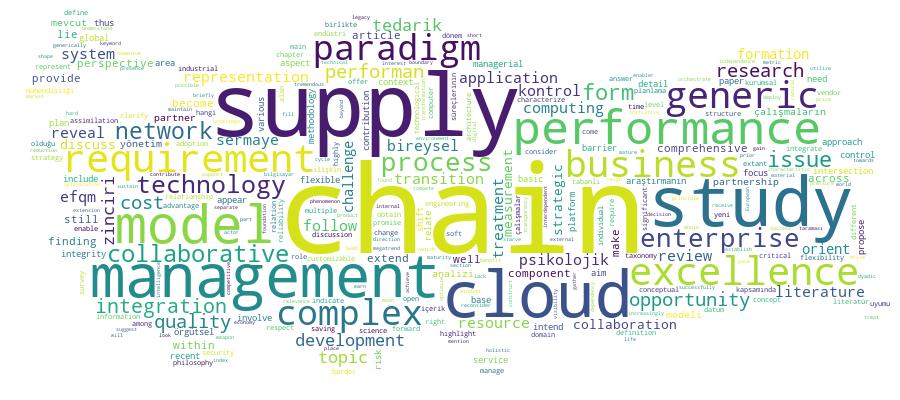
GCRIS Competency Cloud

Scholarly Output Search Results

Now showing 1 - 6 of 6
  • Article
    Citation - WoS: 11
    Citation - Scopus: 13
    Quality Excellence in Complex Supply Networks: Efqm Excellence Model Reconsidered
    (Routledge Journals, Taylor & Francis Ltd, 2015) Akyuz, Goknur Arzu
    Under the business pressures and megatrends shaping today's supply chains (SCs), enterprises have to compete and sustain as part of increasingly complex, highly interdependent and web-enabled supply networks. Achieving excellence in such a context has a meaning far beyond excellence within the enterprise boundaries and requires more than successfully established and maintained enterprise systems. Extant literature from both SC Management and Quality Management domains still appear to lack comprehensive and clarified definitions and requirements for quality excellence within complex supply networks. To contribute in this direction, this study aims at defining, clarifying and discussing quality excellence requirements within collaborative and complex supply networks. All the principles, discussions and requirements are structured and founded on the components of well-established European Foundation for Quality Management's (EFQM) Excellence Model. Therefore, this article answers the following research questions: 'What are the requirements of excellence in complex supply networks?' and 'How EFQM components should be considered and treated in a collaborative setting?' The contribution of this study lies in providing the requirements, definitions and extensions of EFQM components and a multi-partner representation for the extended setting. The findings suggest that a multi-partner, collaborative and network-centric understanding of each EFQM components is needed with respect to the soft and hard aspects, while a cross-partner excellence mindset is to be deployed across the network.
  • Article
    Citation - WoS: 2
    A Generic, Cloud-Based Representation for Supply Chains (sc's)
    (Igi Global, 2013) Akyuz, Goknur Arzu; Rehan, Mohammad
    As a very recent IT paradigm, Cloud Computing is gaining momentum and receiving more and more interest in literature. With various characteristics such as offering flexibility, cost reductions, platform independence and on-demand service, cloud approach opens up tremendous opportunities from Supply Chain (SC) perspective. However, extant literature reveals that adoption and assimilation of the technology is not mature in SC domain and cloud-based modelling initiatives are only recent. To fill this gap, this study discusses the opportunities of cloud computing from SC perspective and proposes a generic representation based on cloud philosophy. The proposed representation is conceptual, flexible and customizable, utilizing and highlighting the cloud benefits in a multi-partner setting. Therefore, this article is an answer to the research questions: "what are the opportunities of cloud philosophy for SC domain?" and "how can supply chains be represented generically based on cloud technology in multi-actor environment?". Contribution of this study lies in comprehensive treatment of cloud computing and supply chain intersection as well as the generic representation.
  • Review
    Citation - WoS: 7
    Enterprise Application Integration (eai), Service Oriented Architectures (soa) and Their Relevance To E-Supply Chain Formation
    (Academic Journals, 2010) Rehan, Mohammad; Akyuz, Goknur Arzu
    The greatest challenge of e-supply chain formation is the integration of cross-application processes in a seamless manner. As platform independent, web-based interoperability are becoming key issues in web-based integration and supply chain formation, organisations are in search of architectural solutions to overcome these challenges. Thus, this paper focuses on the service oriented architectures (SOA) as the recent trend in cross-platform enterprise application integration. SOA paradigm is discussed in detail with special focus on e-supply chain formation. Findings indicate that SOA still appears as the most convenient paradigm to meet the challenges of today's e-supply chain formation requirements.
  • Article
    Citation - WoS: 2
    A Generic, Multi-Period and Multi-Partner Cost Optimizing Model for Cloud-Based Supply Chain
    (Igi Global, 2016) Akyuz, Goknur Arzu; Rehan, Mohammad
    Cloud technology in a multi-enterprise, collaborative context is one of the most promising topics at IT-Supply Chain (SC) intersection. Cloud comes with well-proven advantages and cost savings; enabling collaboration and business intelligence. Cloud transition is still on-going with individual enterprise-level transitions. However, collaborative paradigm dictates that entire network well-being is to be considered over enterprise-level concerns. Thus, handling the transition of a single enterprise is not sufficient for strategic network leverage. Planning and managing across multiple enterprises is required, taking into consideration various cost items and budget constraints. In this study, a multi-period multi-partner cost-optimizing model is developed for network-level management of cloud transition for a SC. The model produces an optimal transition plan, indicating timing of the transition for each partner to obtain the maximum cost savings across network over a specified planning horizon. The model proposed is generic, flexible and customizable for different sectors/settings.
  • Article
    Citation - WoS: 45
    Citation - Scopus: 71
    Requirements for Forming an 'e-supply Chain'
    (Taylor & Francis Ltd, 2009) Akyuz, Goknur Arzu; Rehan, Mohammad
    In today's digital economy, web-based integration of the enterprises to form an e-supply chain is a critical weapon for orchestrating the whole supply chain towards competitiveness. This paper intends to discuss the requirements for forming an e-supply chain from different perspectives, such as integration with the legacy systems, timing and prior presence of ERP (enterprise resources planning) systems, BPR (business process re-engineering) needs of internal and external business processes and business intelligence/decision support needs. A look at technical knowledge and structure to construct an e-supply chain is provided. Challenges involved in forming an e-supply chain are also briefly mentioned as a separate section in this paper. During the study, requirements are gathered by making a review of recent literature.
  • Article
    Citation - WoS: 247
    Citation - Scopus: 350
    Supply Chain Performance Measurement: a Literature Review
    (Taylor & Francis Ltd, 2010) Akyuz, Goknur Arzu; Erkan, Turan Erman
    This paper is intended to provide a critical literature review on supply chain performance measurement. The study aims at revealing the basic research methodologies/approaches followed, problem areas and requirements for the performance management of the new supply chain era. The review study covers articles coming from major journals related with the topic, including a taxonomy study and detailed investigation as to the methodologies, approaches and findings of these works. The methodology followed during the conduct of this research includes starting with a broad base of articles lying at the intersection of supply chain, information technology (IT), performance measurement and business process management topics and then screening the list to have a focus on supply chain performance measurement. Findings reveal that performance measurement in the new supply era is still an open area of research. Further need of research is identified regarding framework development, empirical cross-industry research and adoption of performance measurement systems for the requirements of the new era, to include the development of partnership, collaboration, agility, flexibility, information productivity and business excellence metrics. The contribution of this study lies in the taxonomy study, detailed description and treatment of methodologies followed and in shedding light on future research.