Say, Bilge

Loading...
Profile Picture
Name Variants
Say, Bilge
S., Bilge
Bilge, Say
B.,Say
Say,B.
S.,Bilge
B., Say
Job Title
Doktor Öğretim Üyesi
Email Address
bilge.say@atilim.edu.tr
Main Affiliation
Software Engineering
Status
Former Staff
Website
ORCID ID
Scopus Author ID
Turkish CoHE Profile ID
Google Scholar ID
WoS Researcher ID

Sustainable Development Goals

NO POVERTY1
NO POVERTY
0
Research Products
ZERO HUNGER2
ZERO HUNGER
0
Research Products
GOOD HEALTH AND WELL-BEING3
GOOD HEALTH AND WELL-BEING
0
Research Products
QUALITY EDUCATION4
QUALITY EDUCATION
0
Research Products
GENDER EQUALITY5
GENDER EQUALITY
0
Research Products
CLEAN WATER AND SANITATION6
CLEAN WATER AND SANITATION
0
Research Products
AFFORDABLE AND CLEAN ENERGY7
AFFORDABLE AND CLEAN ENERGY
0
Research Products
DECENT WORK AND ECONOMIC GROWTH8
DECENT WORK AND ECONOMIC GROWTH
0
Research Products
INDUSTRY, INNOVATION AND INFRASTRUCTURE9
INDUSTRY, INNOVATION AND INFRASTRUCTURE
1
Research Products
REDUCED INEQUALITIES10
REDUCED INEQUALITIES
0
Research Products
SUSTAINABLE CITIES AND COMMUNITIES11
SUSTAINABLE CITIES AND COMMUNITIES
0
Research Products
RESPONSIBLE CONSUMPTION AND PRODUCTION12
RESPONSIBLE CONSUMPTION AND PRODUCTION
0
Research Products
CLIMATE ACTION13
CLIMATE ACTION
0
Research Products
LIFE BELOW WATER14
LIFE BELOW WATER
0
Research Products
LIFE ON LAND15
LIFE ON LAND
0
Research Products
PEACE, JUSTICE AND STRONG INSTITUTIONS16
PEACE, JUSTICE AND STRONG INSTITUTIONS
0
Research Products
PARTNERSHIPS FOR THE GOALS17
PARTNERSHIPS FOR THE GOALS
0
Research Products
This researcher does not have a Scopus ID.
This researcher does not have a WoS ID.
Scholarly Output

14

Articles

8

Views / Downloads

8/22

Supervised MSc Theses

2

Supervised PhD Theses

1

WoS Citation Count

62

Scopus Citation Count

96

Patents

0

Projects

0

WoS Citations per Publication

4.43

Scopus Citations per Publication

6.86

Open Access Source

6

Supervised Theses

3

JournalCount
2008 23rd International Symposium on Computer and Information Sciences, ISCIS 2008 -- 2008 23rd International Symposium on Computer and Information Sciences, ISCIS 2008 -- 27 October 2008 through 29 October 2008 -- Istanbul -- 750801
44th Euromicro Conference on Software Engineering and Advanced Applications (SEAA) -- AUG 29-31, 2018 -- Prague, CZECH REPUBLIC1
CEUR Workshop Proceedings -- Joint Conference of the 31st International Workshop on Software Measurement and 16th International Conference on Software Process and Product Measurement, IWSM-MENSURA 2022 -- 28 September 2022 through 30 September 2022 -- Izmir -- 1842831
Cognition, Technology & Work1
Computer Applications in Engineering Education1
Current Page: 1 / 2

Scopus Quartile Distribution

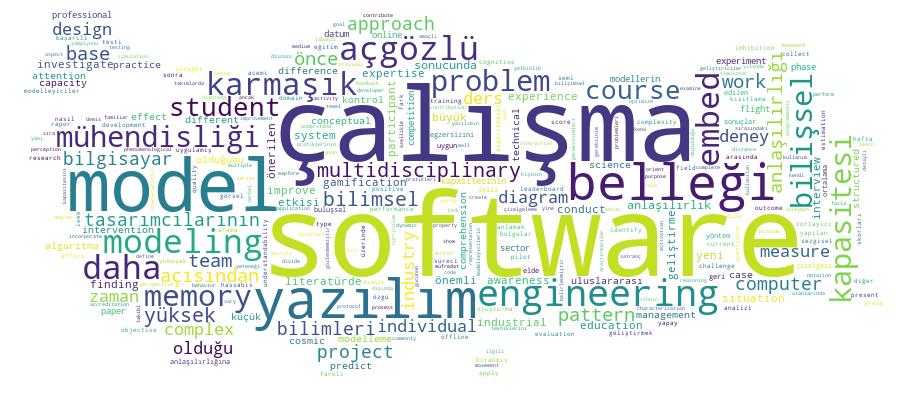
Competency Cloud

GCRIS Competency Cloud

Scholarly Output Search Results

Now showing 1 - 3 of 3
  • Conference Object
    Citation - WoS: 3
    Citation - Scopus: 11
    Towards Modeling Patterns for Embedded Software Industry: Feedback From the Field
    (Ieee, 2018) Akdur, Deniz; Demirors, Onur; Say, Bilge
    The analysis, design, implementation and testing of software for embedded systems are not trivial. Software modeling is a commonly used approach in the embedded software industry to manage complexity of these phases. The modeling approaches vary since the characteristics of modeling such as its purpose, the medium type used, the lifecycle phase used, differ among systems and industrial sectors. Our previous research identified and defined the modeling approach patterns in embedded software development projects based on quantitative data. In this paper, to validate and improve the pre-investigated pattern set, we present a series of semi-structured interviews over eight months with 53 embedded software professionals across a variety of target industrial sectors and roles. With the help of these interviews, the different modeling approach patterns in embedded software development were better understood and the hidden patterns not evident in the previous study were identified along with a documentation of personalized modeling experiences.
  • Conference Object
    Citation - Scopus: 7
    Cognitive Aspects of Error Finding on a Simulation Conceptual Modeling Notation
    (2008) Kiliç,Ö.; Say,B.; Demirörs,O.
    The aim of the study is to investigate and compare experimentally the error finding strategies of a notation-familiar group with degrees in computer science related fields and a domain-familiar group on a simulation conceptual modeling representation based on UML. The use of eye movement and verbal protocols together with performance data underline the differences such as error finding and reasoning between two groups. The experiment with 20 participants also reveals that the diagrammatic complexity and the degree of causal chaining are the properties of diagrams that affect understanding, reasoning and problem solving with conceptual modeling representations. In a follow-up study with 24 university students, it is seen that these properties are independent of gender. The study also emphasizes the combination of different data collection modalities, namely eye movements, verbal protocol and performance data to be effective in uncovering individual differences in human-computer interaction studies in the domain of software engineering. © 2008 IEEE.
  • Conference Object
    Citation - Scopus: 1
    A Survey on Cosmic Students Estimation Challenge
    (CEUR-WS, 2022) Hacaloglu,T.; Say,B.; Unlu,H.; Omural,N.K.; Demirors,O.
    Software project management is a significant software engineering practice that is highly related to achieving software-specific project goals. This study aims to share students’ perceptions of incorporating an international software estimation challenge called “COSMIC Students’ Estimation Challenge” into a software project management course. For this aim, students were taught the COSMIC Functional Size Measurement method and entered the competition. After the competition, a questionnaire asking for the students’ opinions was collected. The objective of the research is to get an insight into to what extent incorporating this type of competition activity -a challenge- can contribute to students’ learning perceptions. In the long run, the findings can contribute to creating a foresight about making the necessary curriculum arrangements to form a more up-to-date and dynamic education plan by including the methods applied in the software industry in Software Engineering education. The results suggest that this kind of competition experience and preparation is helpful for students to learn the COSMIC method. © 2020 Copyright for this paper by its authors.