
Kılıç, Sadık Engin
Loading...
Profile URL
Name Variants
K.,Sadik Engin
Sadık Engin, Kılıç
Kılıç S.
S. E. Kılıç
Kılıç, Sadık Engin
S.E.Kılıç
Kiliç S.
S.,Kılıç
Kilic S.
K.,Sadık Engin
K., Sadik Engin
Kilic,S.E.
S. E. Kilic
K., Sadık Engin
Kılıç,S.E.
Sadik Engin, Kilic
Sadık Engin Kılıç
S., Kilic
Kilic, Sadik Engin
Kilic,Sadik Engin
S.E.Kilic
Kilic, S. Engin
Sadık Engin, Kılıç
Kılıç S.
S. E. Kılıç
Kılıç, Sadık Engin
S.E.Kılıç
Kiliç S.
S.,Kılıç
Kilic S.
K.,Sadık Engin
K., Sadik Engin
Kilic,S.E.
S. E. Kilic
K., Sadık Engin
Kılıç,S.E.
Sadik Engin, Kilic
Sadık Engin Kılıç
S., Kilic
Kilic, Sadik Engin
Kilic,Sadik Engin
S.E.Kilic
Kilic, S. Engin
Job Title
Profesör Doktor
Email Address
engin.kilic@atilim.edu.tr
Main Affiliation
Manufacturing Engineering
Status
ORCID ID
Scopus Author ID
Turkish CoHE Profile ID
Google Scholar ID
WoS Researcher ID
Sustainable Development Goals
 1
1NO POVERTY
0
Research Products
 2
2ZERO HUNGER
0
Research Products
 3
3GOOD HEALTH AND WELL-BEING
1
Research Products
 4
4QUALITY EDUCATION
0
Research Products
 5
5GENDER EQUALITY
0
Research Products
 6
6CLEAN WATER AND SANITATION
0
Research Products
 7
7AFFORDABLE AND CLEAN ENERGY
2
Research Products
 8
8DECENT WORK AND ECONOMIC GROWTH
0
Research Products
 9
9INDUSTRY, INNOVATION AND INFRASTRUCTURE
12
Research Products
 10
10REDUCED INEQUALITIES
0
Research Products
 11
11SUSTAINABLE CITIES AND COMMUNITIES
0
Research Products
 12
12RESPONSIBLE CONSUMPTION AND PRODUCTION
5
Research Products
 13
13CLIMATE ACTION
1
Research Products
 14
14LIFE BELOW WATER
0
Research Products
 15
15LIFE ON LAND
1
Research Products
 16
16PEACE, JUSTICE AND STRONG INSTITUTIONS
0
Research Products
 17
17PARTNERSHIPS FOR THE GOALS
0
Research Products

Documents
40
Citations
1067
h-index
17

Documents
29
Citations
610

Scholarly Output
34
Articles
19
Views / Downloads
214/1689
Supervised MSc Theses
4
Supervised PhD Theses
2
WoS Citation Count
382
Scopus Citation Count
483
Patents
0
Projects
0
WoS Citations per Publication
11.24
Scopus Citations per Publication
14.21
Open Access Source
10
Supervised Theses
6
| Journal | Count |
|---|---|
| The International Journal of Advanced Manufacturing Technology | 4 |
| Machining Science and Technology | 3 |
| Procedia CIRP | 3 |
| Journal of Cleaner Production | 2 |
| International Journal of Computer Integrated Manufacturing | 2 |
Current Page: 1 / 4
Scopus Quartile Distribution
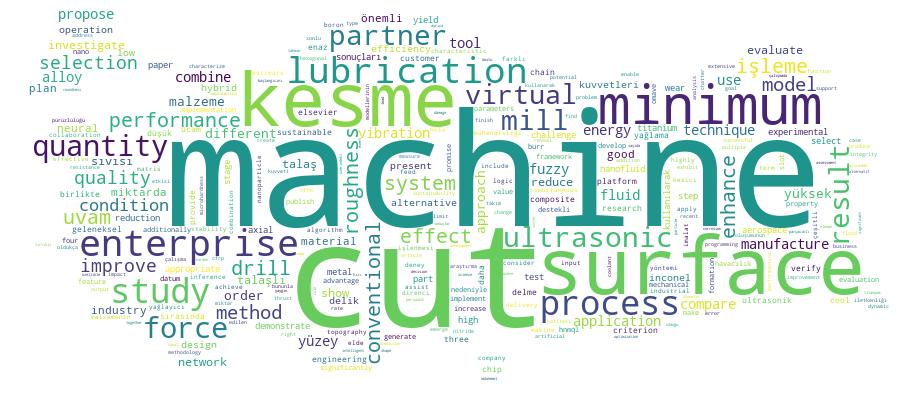
Competency Cloud
9 results
Scholarly Output Search Results
Now showing 1 - 9 of 9
Conference Object Citation - WoS: 5Citation - Scopus: 6Investigation of the Effects of Axial Ultrasonic Vibrations on Chatter Stability in Milling with Bull Nose Cutters(Elsevier Science BV, 2023) Namlu, Ramazan Hakki; Kilic, Zekai Murat; Lorain, Raphael; Kilic, Sadik EnginUltrasonic vibrations-assisted machining has positive effects on the chatter stability and surface integrity of the process. Radial vibration-assisted milling is effective but it needs an advanced control of vibration trajectory hence is not easy to implement. The aim of this paper is to investigate the effects of axial ultrasonic vibrations on stability through disturbing the chip regeneration. A simple way of predicting the stability increase is proposed using missed-cut effect that reduces the effective number of teeth in cut. The axial vibrations are shown to introduce radial runout such that a regular cutter will show the characteristics of a serrated tool. For a 2-tooth bull nose cutter, the proposed method was verified by milling of Ti-6Al-4V material. The results showed that the axial ultrasonic vibrations increased limit axial depth of cut by more than 40%. Therefore, applying axial vibrations would be a simple solution to improve chatter resistance in machining difficult-to-cut materials while avoiding the cost and complexity of serrated rounded edges. The attention on using axial ultrasonic vibrations in milling is increasing, hence further research on modelling the machining dynamics combined with the velocity effects will be needed following this study. (c) 2023 The Authors. Published by Elsevier B.V. This is an open access article under the CC BY-NC-ND license (https://creativecommons.org/licenses/by-nc-nd/4.0)Conference Object Citation - Scopus: 1Ontology Based Virtual Enterprise System Domain Modeling(DEStech Publications Inc., 2014) Lotfi Sadigh,B.; Ünver,H.Ö.; Dogdu,E.; Kiliç,S.E.A virtual enterprise (VE) is a product oriented temporary consortium which forms a collaboration platform to fulfil a specific common purpose (typically to create a product) by benefiting from various capabilities of multiple VE partner enterprises. VE lifecycle consists of 3 distinct phases including VE Formation, Operation and Dissolution. VE partner enterprises are selected from virtual breeding environment (VBE) based on specific criteria considering the new VE project specifications. In order to select the most appropriate partners for the forthcoming VE project, it is required to have comprehensive information regarding the VBE members, their current conditions, capabilities, capacities and their past performances. This database continuously changes and it is dynamic. Ontologies and the corresponding knowledge bases provide the best tools for modelling such complex domain knowledge and highly dynamic data requirements. Ontologies not only help model and capture complex domain knowledge, but also improve the sharing and reusability of data and knowledge providing a suitable environment for software agents and human communications. The VE system must be able to demonstrate what types of resources exist, where they are located, and how much resource capacity is available to be used by the consortium. In this paper a pilot Virtual Enterprise system model developed for OSTIM organized industrial park in Ankara will be presented in detail. The objective of this system model is to enable SMEs in the region to collaborate effectively in order to produce eco-friendly high value added products. © Copyright 2014 by DEStech Publications, Inc. All rights reserved.Conference Object Citation - WoS: 20Citation - Scopus: 26An Experimental Study on Surface Quality of Al6061-T6 in Ultrasonic Vibration-Assisted Milling with Minimum Quantity Lubrication(Elsevier Science BV, 2022) Namlu, Ramazan Hakki; Yilmaz, Okan Deniz; Lotfisadigh, Bahram; Kilic, S. EnginAl6061-T6 is frequently used in the automotive and aerospace industries, where milling is an essential process, due to its high strength-to-weight ratio. In order to achieve improved surface quality in milling, Ultrasonic Vibration-Assisted Milling (UVAM) has been introduced recently. Besides, Minimum Quantity Lubrication (MQL) is another advanced method to enhance the surface properties of the cutting by improving the coolant performance. However, the effects of simultaneous implementation of UVAM and MQL methods has not yet been studied sufficiently. This paper investigates the effects of applying UVAM in tandem with MQL in cutting of Al6061-T6. The results showed that surface quality enhanced with this combination. (c) 2022 The Authors. Published by Elsevier B.V. This is an open access article under the CC BY-NC-ND license (https://creativecommons.org/licenses/by-nc-nd/4.0)Conference Object Citation - WoS: 10Citation - Scopus: 13A Multi-Agent System Model for Partner Selection Process in Virtual Enterprise(Elsevier Science Bv, 2014) Sadigh, B. Lotfi; Arikan, F.; Ozbayoglu, A. M.; Unver, H. O.; Kilic, S. E.; Lotfi Sadigh, B.Virtual Enterprise (VE) is a collaboration model between multiple business partners in a value chain. VE information system deals with highly dynamic information from heterogeneous data sources. In order to manage and store dynamic VE information in the database, an ontology based VE model has been developed. To select winner enterprises in VE, a Multi Agent System (MAS) has been developed. Communication and data transition among agents and system entities are based on defined rules in VE ontology model. One of the most important contributions of agents in VE system is in partner selection step of VE formation phase. In this step several agents with different goals and strategies are collaborating and competing each other to win the negotiation procedure or maximize the profit for their assigned enterprise. Different strategies are developed for the agents depending on their appetite for winning the auction against maximizing the profit. Several simulations were run and the results are stored. These results are fed into a neural network in order to predict which enterprise will win the auction and what will be the profit margin. The motivation is to provide a forecasting agent for the customers about the outcomes of the auctions so that they can plan ahead and take the necessary action. Early results indicate such simulated multi-agent VE formations can be used in real systems. A Multi-Agent System Model for Partner Selection Process in Virtual Enterprise (C) 2014 Published by Elsevier B.V.Conference Object Citation - Scopus: 42d Fe Modelling of Machining: a Comparison of Different Approaches With Experiments(2005) Bil,H.; Tekkaya,A.E.; Kiliç,S.E.[No abstract available]Conference Object Citation - WoS: 12Citation - Scopus: 12Multi-Axial Ultrasonic Vibration-Assisted Machining of Inconel 718 Using Al2O3-CuO Hybrid Nanofluid MQL(Elsevier Science BV, 2024) Namlu, Ramazan Hakki; Lotfi, Bahram; Kilic, Sadik EnginInconel 718 is a widely used superalloy in the aerospace industry, owing to its exceptional creep and corrosion resistance, as well as its ability to retain strength at elevated temperatures. However, its machinability presents challenges due to its low thermal conductivity and high work hardening rate during conventional machining, resulting in inadequate surface quality. To address this issue, a recent technique known as Ultrasonic Vibration-Assisted Machining (UVAM) has emerged. UVAM involves applying high-frequency, low-amplitude vibrations to the cutting tool or workpiece. Additionally, Minimum Quantity Lubrication (MQL) has been considered as an alternative cooling technique to enhance machining performance. Optimizing the performance of UVAM can be achieved by employing various vibration axes. Additionally, the effectiveness of MQL can be enhanced through the utilization of nanofluids. This study investigates the combined application of multi-axis UVAM and Al2O3-CuO added Hybrid Nanofluid MQL (HNMQL) during the milling of Inconel 718. The evaluation parameters include surface roughness, topography, burr formations, and cutting forces. The results demonstrate that the simultaneous use of multi-axis UVAM and HNMQL significantly improves the machining performance of Inconel 718. This combination leads to better surface quality and overall process efficiency, offering promising prospects for the aerospace industry and other applications involving difficult-to-cut materials. (c) 2024 The Authors. Published by Elsevier B.V.Conference Object Citation - WoS: 5Citation - Scopus: 10Design of a Customer's Type Based Algorithm for Partner Selection Problem of Virtual Enterprise(Elsevier Science Bv, 2016) Nikghadam, Shahrzad; Ozbayoglu, Ahmet Murat; Unver, Hakki Ozgur; Kilic, Sadik EnginVirtual Enterprise (VE) is a temporary platform for individual enterprises to collaborate with each other, sharing their core competencies to fulfill a customer demand. In order to improve the customer satisfaction, the most successful VEs select their consortium's members based on customer's preferences. There is quite extensive literature in the field of partner selection in VE, each proposing a new approach to evaluate and select the most appropriate partners among pool of enterprises. However, none of the studies in literature recommend which partner selection methodology should be used in each project with a particular customer attitude. In this study an algorithm is proposed which classifies the customers into three categories; passive, standard and assertive. Three different approaches; Fuzzy Logic-FAHP TOPSIS and Goal programming are used for each customer type respectively. This classification is beneficial since the problem's characteristics; such as vagueness of data, change as the customer's attitude varies. The results certify that, adopting this algorithm not only helps the VE to select the most appropriate partners based on customer preferences, but also the model adapts itself to each customer's attitude. As a result, the overall system flexibility is significantly improved. (C) 2016 The Authors. Published by Elsevier B.V.Conference Object Citation - Scopus: 2Evaluation of Partner Companies Based on Fuzzy Inference System for Establishing Virtual Enterprise Consortium(Springer Verlag, 2015) Nikghadam,S.; LotfiSadigh,B.; Ozbayoglu,A.M.; Unver,H.O.; Kilic,S.E.Virtual Enterprise (VE) is one of the growing trends in agile manufacturing concepts. Under this platform companies with different skills and core competences are cooperate with each other in order to accomplish a manufacturing goal. Success of VE, as a consortium, highly depends on the success of its partners. So it is very important to choose the most appropriate companies to enroll in VE. In this study a Fuzzy Inference System (FIS) based approach is developed to evaluate and select the potential enterprises. The evaluation is conducted based on four main criteria; unit price, delivery time, quality and past performance. These criteria are considered as inputs of FIS and specific membership functions are designed for each. By applying fuzzy rules the output of the model, partnership chance, is calculated. In the end, the trustworthy of the model is tested and verified by comparing it with fuzzy-TOPSIS technique providing a sample. © Springer International Publishing Switzerland 2015.Conference Object Partner Selection in Formation of Virtual Enterprises Using Fuzzy Logic(SciTePress, 2015) Nikghadam,S.; Sadigh,B.L.; Ozbayoglu,A.M.; Unver,H.O.; Kilic,S.E.Virtual Enterprise (VE) is a temporary cooperation among independent enterprises to build up a dynamic collaboration framework for manufacturing. One of the most important steps to construct a successful VE is to select the most qualified partners to take role in the project. This paper is a survey of ranking the volunteer companies with respect to four evaluation criteria, proposed unit price, delivery time, quality and enterprises' past performance. Fuzzy logic method is proposed to deal with these four conflicting criteria, considered as input variables of the model. As each criterion is different in nature with the other criterion, various membership functions are used to fuzzify the input values. The next step is to construct the logical fuzzy rules combining the inputs to conclude the output. Mamdani's approach is adopted to evaluate the output in this Fuzzy Inference System. The result of the model is the partnership chance of each partner to participate in VE. A partner with highest partnership chance will be the winner of the negotiation. Implementation of this model to the illustrative example of a partner selection problem in virtual enterprise and comparing it with fuzzy-TOPSIS approach verifies the feasibility of the proposed approach and the computational results are satisfactory. Copyright © 2015 SCITEPRESS - Science and Technology Publications All rights reserve.
