Uzundurukan, Arife

Loading...
Profile Picture
Name Variants
U., Arife
Uzundurukan,A.
Uzundurukan, Arife
A., Uzundurukan
Arife, Uzundurukan
A.,Uzundurukan
U.,Arife
Job Title
Araştırma Görevlisi
Email Address
arife.saglam@atilim.edu.tr
Main Affiliation
Energy Systems Engineering
Status
Former Staff
Website
ORCID ID
Scopus Author ID
Turkish CoHE Profile ID
Google Scholar ID
WoS Researcher ID

Sustainable Development Goals

NO POVERTY1
NO POVERTY
0
Research Products
ZERO HUNGER2
ZERO HUNGER
0
Research Products
GOOD HEALTH AND WELL-BEING3
GOOD HEALTH AND WELL-BEING
0
Research Products
QUALITY EDUCATION4
QUALITY EDUCATION
0
Research Products
GENDER EQUALITY5
GENDER EQUALITY
0
Research Products
CLEAN WATER AND SANITATION6
CLEAN WATER AND SANITATION
0
Research Products
AFFORDABLE AND CLEAN ENERGY7
AFFORDABLE AND CLEAN ENERGY
5
Research Products
DECENT WORK AND ECONOMIC GROWTH8
DECENT WORK AND ECONOMIC GROWTH
0
Research Products
INDUSTRY, INNOVATION AND INFRASTRUCTURE9
INDUSTRY, INNOVATION AND INFRASTRUCTURE
0
Research Products
REDUCED INEQUALITIES10
REDUCED INEQUALITIES
0
Research Products
SUSTAINABLE CITIES AND COMMUNITIES11
SUSTAINABLE CITIES AND COMMUNITIES
0
Research Products
RESPONSIBLE CONSUMPTION AND PRODUCTION12
RESPONSIBLE CONSUMPTION AND PRODUCTION
0
Research Products
CLIMATE ACTION13
CLIMATE ACTION
0
Research Products
LIFE BELOW WATER14
LIFE BELOW WATER
0
Research Products
LIFE ON LAND15
LIFE ON LAND
0
Research Products
PEACE, JUSTICE AND STRONG INSTITUTIONS16
PEACE, JUSTICE AND STRONG INSTITUTIONS
0
Research Products
PARTNERSHIPS FOR THE GOALS17
PARTNERSHIPS FOR THE GOALS
0
Research Products
This researcher does not have a Scopus ID.
This researcher does not have a WoS ID.
Scholarly Output

5

Articles

5

Views / Downloads

4/0

Supervised MSc Theses

0

Supervised PhD Theses

0

WoS Citation Count

221

Scopus Citation Count

234

Patents

0

Projects

0

WoS Citations per Publication

44.20

Scopus Citations per Publication

46.80

Open Access Source

2

Supervised Theses

0

JournalCount
International Journal of Hydrogen Energy3
International Journal of Energy Research1
Renewable Energy1
Current Page: 1 / 1

Scopus Quartile Distribution

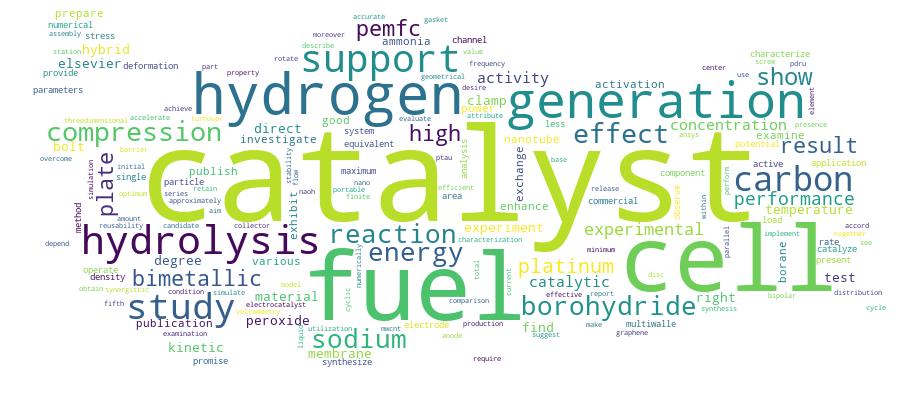
Competency Cloud

GCRIS Competency Cloud

Scholarly Output Search Results

Now showing 1 - 3 of 3
  • Article
    Citation - WoS: 45
    Citation - Scopus: 46
    Carbon Nanotube-Graphene Supported Bimetallic Electrocatalyst for Direct Borohydride Hydrogen Peroxide Fuel Cells
    (Pergamon-elsevier Science Ltd, 2021) Uzundurukan, Arife; Akca, Elif Seda; Budak, Yagmur; Devrim, Yilser
    At present study, carbon nanotube-graphene (CNT-G) supported PtAu, Au and Pt catalysts were prepared by microwave-assisted synthesis method to investigate the direct liquid-fed sodium borohydride/hydrogen peroxide (NaBH4/H2O2) fuel cell performance. Prepared catalysts were characterized by TGA, XRD, TEM, ICP-OES, cyclic voltammetry and rotating disc electrode (RDE) voltammetry. The catalysts were tested in a single NaBH4/H2O2 fuel cell with 25 cm(2) active area to evaluate fuel cell performance. The effects of temperature and fuel concentration on fuel cell performance were examined to observed best operating conditions. As a result of direct NaBH4/H2O2 fuel cell experiments, maximum power densities of 139 mW/cm(2), 125 mW/cm(2) and 113 mW/cm(2) were obtained for PtAu/CNT-G, Au/CNT-G and Pt/CNT-G catalysts, respectively. PtAu/CNT-G catalyst showed the enhanced NaBH4/H2O2 fuel cell performance, which was higher than the Pt/CNT-G catalyst and Au/CNT-G catalyst at 50 degrees C. The enhanced NaBH4/H2O2 performance can be attributed to synergistic effects between Pt and Au particles on CNT-G support providing a better catalyst utilization and interaction. These results suggest that the prepared PtAu/CNT-G catalyst is a promising anode catalyst for NaBH4/H2O2 fuel cell application. (c) 2020 Elsevier Ltd. All rights reserved.
  • Article
    Citation - WoS: 21
    Citation - Scopus: 21
    Investigation of Hydrogen Production From Sodium Borohydride by Carbon Nano Tube-Graphene Supported Pdru Bimetallic Catalyst for Pem Fuel Cell Application
    (Wiley, 2022) Al-Msrhad, Tuqa Majeed Hameed; Devrim, Yilser; Uzundurukan, Arife; Budak, Yagmur
    In this study, hydrogen (H-2) generation from the hydrolysis of sodium borohydride (NaBH4) catalyzed by bimetallic Palladium-Ruthenium (PdRu) supported on multiwalled carbon nanotube-graphene (MWCNT-GNP) hybrid material is investigated. The effect of various parameters such as temperature, NaBH4 concentration, and catalyst loading and effect of base concentration are examined to observed optimum operating conditions. Experimental results show that the PdRu/MWCNT-GNP bimetallic catalyst has high catalytic activity on NaBH4 hydrolysis reaction. It has been found that PdRu/MWCNT-GNP catalyst shows low activation energy of 22.33 kJ/mol for hydrolysis reaction of NaBH4. The PdRu/MWCNT-GNP catalyst also exhibits H-2 generation rate of 79.2 mmol/min center dot g(cat) at 45 degrees C. It shows good cycle stability in the catalyst reusability test and retained 89% of its initial catalytic activity after fifth use. The high catalytic activity of the PdRu/MWCNT-GNP catalyst makes it promising in H-2 generation from NaBH4 hydrolysis for commercial proton exchange membrane fuel cell (PEMFC) applications.
  • Article
    Citation - WoS: 52
    Citation - Scopus: 57
    Examination of Compression Effects on Pemfc Performance by Numerical and Experimental Analyses
    (Pergamon-elsevier Science Ltd, 2020) Uzundurukan, Arife; Bilgili, Muhittin; Devrim, Yilser
    In the present study, the effects of compression method on Proton Exchange Membrane Fuel Cell (PEMFC) performance were investigated both numerically and experimentally. Total deformation of the components within the PEMFC was simulated by ANSYS threedimensional finite element analysis (3D FEA). Moreover, geometrical and material properties of all components of PEMFC such as bipolar plates (BPP), membrane electrode assembly (MEA), gasket, current collector plate (CCP), screw and nut were implemented for accurate simulation of compression. In the experimental part, PEMFC tests were performed with 25 cm(2) active area single cell having 3 channel parallel in series (3 PS) flow channel via PEMFC test station with H-2 and air at 60 degrees C. The maximum power density was achieved as 0.458 W/cm(2) and 0.480 W/cm(2) for bolt compression and clamping plates compression, respectively. The equivalent stress values were found as 120 MPa that under 4389 N the clamping plates and 1600 MPa under bolt compression with 1.3 Nm torque. When numerical and experimental studies are examined together, it is seen that bolt compression has higher deformation and less equivalent stress than clamping plates compression. (c) 2020 Hydrogen Energy Publications LLC. Published by Elsevier Ltd. All rights reserved.