Hacaloğlu, Tuna

Loading...
Profile Picture
Name Variants
Hacaloğlu,T.
H.,Tuna
T., Hacaloğlu
T.,Hacaloğlu
Hacaloglu, Tuna
Tuna, Hacaloğlu
Hacaloglu,T.
T., Hacaloglu
H., Tuna
Tuna, Hacaloglu
T.,Hacaloglu
Hacaloğlu, Tuna
Hacaloglu T.
Job Title
Doktor Öğretim Üyesi
Email Address
tuna.hacaloglu@atilim.edu.tr
Main Affiliation
Information Systems Engineering
Status
Website
ORCID ID
Scopus Author ID
Turkish CoHE Profile ID
Google Scholar ID
WoS Researcher ID

Sustainable Development Goals

2

ZERO HUNGER
ZERO HUNGER Logo

0

Research Products

11

SUSTAINABLE CITIES AND COMMUNITIES
SUSTAINABLE CITIES AND COMMUNITIES Logo

0

Research Products

14

LIFE BELOW WATER
LIFE BELOW WATER Logo

0

Research Products

6

CLEAN WATER AND SANITATION
CLEAN WATER AND SANITATION Logo

0

Research Products

1

NO POVERTY
NO POVERTY Logo

0

Research Products

5

GENDER EQUALITY
GENDER EQUALITY Logo

0

Research Products

9

INDUSTRY, INNOVATION AND INFRASTRUCTURE
INDUSTRY, INNOVATION AND INFRASTRUCTURE Logo

0

Research Products

16

PEACE, JUSTICE AND STRONG INSTITUTIONS
PEACE, JUSTICE AND STRONG INSTITUTIONS Logo

0

Research Products

17

PARTNERSHIPS FOR THE GOALS
PARTNERSHIPS FOR THE GOALS Logo

3

Research Products

15

LIFE ON LAND
LIFE ON LAND Logo

0

Research Products

10

REDUCED INEQUALITIES
REDUCED INEQUALITIES Logo

0

Research Products

7

AFFORDABLE AND CLEAN ENERGY
AFFORDABLE AND CLEAN ENERGY Logo

0

Research Products

8

DECENT WORK AND ECONOMIC GROWTH
DECENT WORK AND ECONOMIC GROWTH Logo

0

Research Products

4

QUALITY EDUCATION
QUALITY EDUCATION Logo

0

Research Products

12

RESPONSIBLE CONSUMPTION AND PRODUCTION
RESPONSIBLE CONSUMPTION AND PRODUCTION Logo

0

Research Products

3

GOOD HEALTH AND WELL-BEING
GOOD HEALTH AND WELL-BEING Logo

0

Research Products

13

CLIMATE ACTION
CLIMATE ACTION Logo

0

Research Products
Documents

25

Citations

285

h-index

8

Documents

15

Citations

153

Scholarly Output

28

Articles

13

Views / Downloads

96/0

Supervised MSc Theses

0

Supervised PhD Theses

0

WoS Citation Count

153

Scopus Citation Count

265

WoS h-index

6

Scopus h-index

8

Patents

0

Projects

0

WoS Citations per Publication

5.46

Scopus Citations per Publication

9.46

Open Access Source

9

Supervised Theses

0

Google Analytics Visitor Traffic

JournalCount
IEEE Software2
CEUR Workshop Proceedings -- Joint of the 33rd International Workshop on Software Measurement and the 18th International Conference on Software Process and Product Measurement, IWSM-MENSURA 2024 -- 30 September 2024 through 4 October 2024 -- Montreal -- 2044672
18th IFIP WG 6.11Conference on e-Business, e-Services, and e-Society (I3E) -- SEP 18-20, 2019 -- Norwegian Univ Sci & Technol, Fac Informat Technol & Elect Engn, Dept Comp, Trondheim, NORWAY1
45th Euromicro Conference on Software Engineering and Advanced Applications (SEAA) / 22nd Euromicro Conference on Digital System Design (DSD) -- AUG 28-30, 2019 -- Kallithea, GREECE1
48th Euromicro Conference on Software Engineering and Advanced Applications -- AUG 31-SEP 02, 2022 -- SPAIN1
Current Page: 1 / 5

Scopus Quartile Distribution

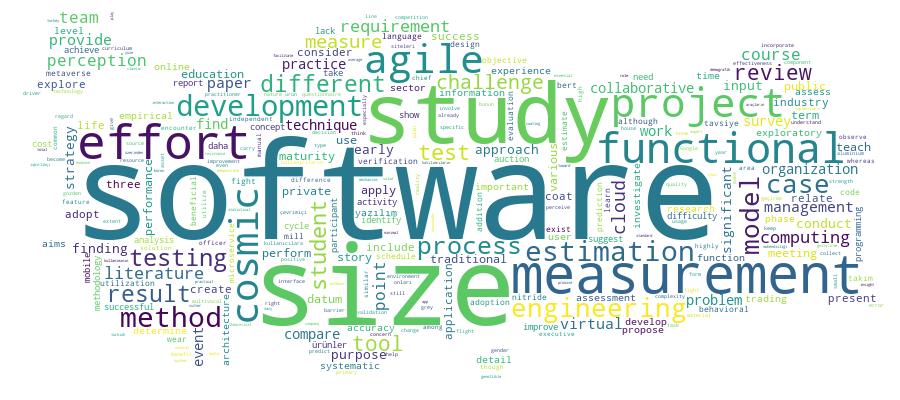
Competency Cloud

GCRIS Competency Cloud

Scholarly Output Search Results

Now showing 1 - 10 of 15
  • Conference Object
    Citation - WoS: 7
    Citation - Scopus: 12
    Utilization of Three Software Size Measures for Effort Estimation in Agile World: A Case Study
    (IEEE, 2022) Unlu, Huseyin; Hacaloglu, Tuna; Buber, Fatma; Berrak, Kivilcim; Leblebici, Onur; Demirors, Onur
    Functional size measurement (FSM) methods, by being systematic and repeatable, are beneficial in the early phases of the software life cycle for core project management activities such as effort, cost, and schedule estimation. However, in agile projects, requirements are kept minimal in the early phases and are detailed over time as the project progresses. This situation makes it challenging to identify measurement components of FSM methods from requirements in the early phases, hence complicates applying FSM in agile projects. In addition, the existing FSM methods are not fully compatible with today's architectural styles, which are evolving into event-driven decentralized structures. In this study, we present the results of a case study to compare the effectiveness of different size measures: functional -COSMIC Function Points (CFP)-, event-based - Event Points-, and code length-based - Line of Code (LOC)- on projects that were developed with agile methods and utilized a microservice- based architecture. For this purpose, we measured the size of the project and created effort estimation models based on three methods. It is found that the event-based method estimated effort with better accuracy than the CFP and LOC-based methods.
  • Conference Object
    Software Change Size Measurement: an Exploratory Systematic Mapping Study
    (CEUR-WS, 2024) Hacaloglu, T.; Küçükateş Ömüral, N.; Kılınç Soylu, G.; Demirörs, O.
    Change in software projects can occur through various channels. Customers may request modifications or new features; appraisal activities such as reviews or testing may uncover issues that necessitate adjustments, or products may need to adapt to changes in their operating environment. Therefore, it is essential to assess these changes explicitly and objectively within the scope of software engineering activities. Specifically, quantifying change by measuring its size is crucial for successful management, as without a meaningful metric, it is impossible to accurately assess its impact on the project's effort, schedule, and cost. This study aims to explore the concept of change in software engineering literature, with a particular emphasis on the methods used to measure its size. The study reveals that the current literature on this topic is still in its early stages and the measurement and estimation of changes remain challenging throughout both development and maintenance phases. According to the reviewed articles, size is primarily used for effort estimation. Various software artifacts from different stages of the Software Development Life Cycle (SDLC) serve as input for change measurement, highlighting the need for a versatile size measurement applicable across all SDLC phases. Most of the reviewed articles interpret change in the context of maintenance activities. This research sets a benchmark for the status of software size measures for software change and highlights related problems to suggest further research topics. © 2024 Copyright for this paper by its authors.
  • Conference Object
    Citation - Scopus: 7
    Challenges of using software size in agile software development: A systematic literature review
    (CEUR-WS, 2018) Hacaloglu,T.; Demirors,O.
    Software size is a fundamental measure for software management. Size is used for a variety of purposes, such as benchmarking, normalization, and portfolio measurement, and it is frequently considered as the sole input of estimation. Estimations can be produced for various reasons; e.g., to predict effort, cost and duration of software development projects. There are different types of software size measures. Particularly in projects where agile methodologies are adopted, measurement becomes a significant challenge as it is perceived as a non-value-added task and records of tasks such as requirements identification are not always consistent. The difficulties of applying traditional size measurement techniques in agile contexts, however, do not diminish the need, and new methods and techniques are introduced to improve the manageability of the agile projects. In this paper, we discuss estimation and measurement approaches in relation with ―software size in agile contexts. Based on this review, we present the perceptions of software size and related challenges, such as misinterpretation of size, difficulties in implementation, and acceptability of the measurement processes. We anticipate that providing a baseline for the state of software size measures in agile contexts and presenting related challenges, particularly in terms of its acceptability by practitioners can shed light on the development of new techniques. © 2018 CEUR-WS. All rights reserved.
  • Conference Object
    Citation - Scopus: 1
    A Survey on Cosmic Students Estimation Challenge
    (CEUR-WS, 2022) Hacaloglu,T.; Say,B.; Unlu,H.; Omural,N.K.; Demirors,O.
    Software project management is a significant software engineering practice that is highly related to achieving software-specific project goals. This study aims to share students’ perceptions of incorporating an international software estimation challenge called “COSMIC Students’ Estimation Challenge” into a software project management course. For this aim, students were taught the COSMIC Functional Size Measurement method and entered the competition. After the competition, a questionnaire asking for the students’ opinions was collected. The objective of the research is to get an insight into to what extent incorporating this type of competition activity -a challenge- can contribute to students’ learning perceptions. In the long run, the findings can contribute to creating a foresight about making the necessary curriculum arrangements to form a more up-to-date and dynamic education plan by including the methods applied in the software industry in Software Engineering education. The results suggest that this kind of competition experience and preparation is helpful for students to learn the COSMIC method. © 2020 Copyright for this paper by its authors.
  • Conference Object
    Citation - Scopus: 8
    An Exploratory Case Study on Effort Estimation in Microservices
    (Institute of Electrical and Electronics Engineers Inc., 2023) Unlu,H.; Hacaloglu,T.; Omural,N.K.; Caliskanel,N.; Leblebici,O.; Demirors,O.
    Software project management plays an important role in producing high-quality software, and effort estimation can be considered as a backbone for successful project management. Size is a very significant attribute of software by being the only input to perform early effort estimation. Even though functional size measurement methods showed successful results in effort estimation of traditional data-centric architectures such as monoliths, they were not designed for today's architectures which are more service-based and decentralized such as microservices. In these new systems, the event concept is highly used specifically for communication among different services. By being motivated by this fact, in this study, we looked for more microservice-compatible ways of sizing microservices using events and developed a method accordingly. Then, we conducted an exploratory case study in an organization using agile methods and measured the size of 17 Product Backlog Items (PBIs) to assess how this proposed method can be useful in effort estimation in microservices. The implication from the case study is that despite performing a more accurate effort estimation using the proposed size measurement than COSMIC, we were unable to significantly outperform using the total number of events. However, our suggested approach demonstrated to us a different way to use software size in terms of events, namely, to determine the coupling complexity of the project. This finding can be beneficial specifically when evaluating the change requests. © 2023 IEEE.
  • Conference Object
    Cosmic Light Vs Cosmic Classic Manual: Case Studies in Functional Size Measurement
    (CEUR-WS, 2020) Hacaloglu,T.; Unlu,H.; Demirors,O.; Abran,A.
    Functional size has been used in software engineering for more than 40 years. When measured early in the software development life cycle, it can serve as direct input for effort estimation. The COSMIC Functional Size Measurement (FSM) method developed by the Common Software Measurement Consortium (COSMIC) is the latest ISO-compliant functional sizing method. A streamlined manual titled ''Software Development Velocity with COSMIC Function Points'' summarizes the measurement process and shortens the learning time. The aim of this study is to compare the classic COSMIC FSM manual and this new “light” manual in terms of accuracy of the resulting FSM applied to case studies. The findings show that use of the light manual results in accurate measurement. In addition, there were no significant time differences between the two. With respect to the variations in COSMIC Function Points (CFP) values in the two case studies, they three causes were identified: the Object of Interest (OOI) concept and corresponding data groups, details regarding Functional Process Independence, and Error/Confirmation messages related to the scope of the information included in the manuals. Copyright © 2020 for this paper by its authors.
  • Conference Object
    Citation - WoS: 3
    Citation - Scopus: 4
    Users' Behavioral Strategies Toward Mobile App Problems: Fight or Flight
    (Springer international Publishing Ag, 2019) Inal, Yavuz; Hacaloglu, Tuna
    In this paper, we identify two distinct behavioral strategies for dealing with problems encountered in the use of mobile apps - fight or flight. In the fight strategy, individuals do not give up using an app when faced with a problem; rather, they experiment with different ways to cope with that problem, whereas the flight strategy refers to the user's decision to uninstall an app when they encounter a problem and/or their intention to use an alternative app. These strategies were identified from an analysis of documents, which forty-two users reported, and can be used to understand how users deal with encountered problems. The participants were asked to use a mobile app of their choice for one week and report the behavioral strategies they utilized to counter problems they experienced. According to the findings obtained from content analysis, the most reported complaints concerned the categories of interface design, functional error, feature request, and feature removal. The participants who complained about functional errors, frustrating features, and slow application speed stopped using the app (flight behavior) whereas those that were dissatisfied with the interface, a missing feature or the content of the app continued to use the app and tried to overcome the problems (fight behavior).
  • Conference Object
    Citation - WoS: 1
    Citation - Scopus: 3
    A Software Development Process Model for Cloud by Combining Traditional Approaches
    (Springer international Publishing Ag, 2015) Hacaloglu, Tuna; Eren, P. Erhan; Mishra, Deepti; Mishra, Alok
    Even though cloud computing is a technological paradigm that has been adopted more and more in various domains, there are few studies investigating the software development lifecycle in cloud computing applications and there is still not a comprehensive software development process model developed for cloud computing yet. Due to the nature of cloud computing that is completely different from the traditional software development, there is a need of suggesting process models to perform the software development systematically to create high quality software. In this study, we propose a new conceptual Software Development Life Cycle Model for Cloud Software Development that incorporates characteristics of different process models for traditional software development. The proposed model takes traditional model's specific characteristics into account and also considers cloud's specific nature i.e. advantages and challenges as well.
  • Conference Object
    Citation - Scopus: 21
    Examining the Use of Non-Fungible Tokens (nfts) as a Trading Mechanism for the Metaverse
    (Springer Science and Business Media Deutschland GmbH, 2022) Yilmaz,M.; Hacaloğlu,T.; Clarke,P.
    The notion of a metaverse seems hard to define but encourages the impression that it can be considered as a new virtual metaphysical landscape that somehow goes beyond our geographical locations and understanding (i.e., independent of time and space). Based on virtual reality, augmented reality, and blockchain, it is envisioned as an independent but extended world that is planned to be a digital virtuality entrenched not only in our old habits such as gaming and entertainment but also in virtual asset trade. In particular, trading is a pillar of the virtual economy, and auction houses will be crucial for Metaverse trading. This exploratory study examines the possibility of using an auction environment to improve the trading capabilities in a virtual universe. We investigate the cases of creating a virtual auction house with the potential of social trading of virtual assets with crypto coins and bartering. To this end, we built a virtual auction house and tested it initially using a set of scenarios. Our preliminary findings suggest that creating a virtual trading environment would be beneficial as an environment for buying and selling virtual assets and exploring their consequences. © 2022, Springer Nature Switzerland AG.
  • Conference Object
    Exploratory Review of Quantum Computing Software Requirements Specification and Their Measurement
    (CEUR-WS, 2024) Hacaloglu, T.; Soubra, H.; Bourque, P.
    Quantum software sets itself apart from classical software owing to its powerful computational abilities rooted in entanglement and superposition. Unlike classical software, quantum software diverges notably across various dimensions, including computational models, hardware architectures, algorithms, deployment platforms, and problem domains. Quantum software is also often not standalone and interacts heavily with classical software, stressing the importance of carefully considering hybridization. From a software engineering standpoint, researchers generally agree that a different approach is required for quantum software, and they advocate a Quantum Software Development Life Cycle (SDLC). This exploratory study briefly outlines the specifics of quantum software, overviews the proposed approaches regarding the software requirements of quantum software, and then reviews the current alternatives for measuring the functional size of quantum software. This study indicates that only a few papers in the literature discuss the requirements and functional size measurements of quantum software. Their results are also mostly conceptual and have not yet been empirically validated. Functional size measurement using quantum software remains an open area for further research. © 2024 Copyright for this paper by its authors.