Çağıltay, Nergiz

Loading...
Profile Picture
Name Variants
Çağıltay, Nergis E.
Nergiz, Çağıltay
Çağıltay, Nergiz
Nergiz, Cagiltay
Ç.,Nergiz
C.,Nergiz
N., Cagiltay
N.,Çağıltay
Cagiltay, Nergiz
Cagiltay,N.
Çağıltay,N.
N.,Cagiltay
C., Nergiz
Çağıltay, Nergiz Ercil
Cagiltay, Nergiz Ercil
Çağıltay, Nergiz E.
Job Title
Profesör Doktor
Email Address
nergiz.cagiltay@atilim.edu.tr
Main Affiliation
Software Engineering
Status
Former Staff
Website
ORCID ID
Scopus Author ID
Turkish CoHE Profile ID
Google Scholar ID
WoS Researcher ID

Sustainable Development Goals

NO POVERTY1
NO POVERTY
0
Research Products
ZERO HUNGER2
ZERO HUNGER
0
Research Products
GOOD HEALTH AND WELL-BEING3
GOOD HEALTH AND WELL-BEING
0
Research Products
QUALITY EDUCATION4
QUALITY EDUCATION
33
Research Products
GENDER EQUALITY5
GENDER EQUALITY
0
Research Products
CLEAN WATER AND SANITATION6
CLEAN WATER AND SANITATION
0
Research Products
AFFORDABLE AND CLEAN ENERGY7
AFFORDABLE AND CLEAN ENERGY
1
Research Products
DECENT WORK AND ECONOMIC GROWTH8
DECENT WORK AND ECONOMIC GROWTH
0
Research Products
INDUSTRY, INNOVATION AND INFRASTRUCTURE9
INDUSTRY, INNOVATION AND INFRASTRUCTURE
1
Research Products
REDUCED INEQUALITIES10
REDUCED INEQUALITIES
0
Research Products
SUSTAINABLE CITIES AND COMMUNITIES11
SUSTAINABLE CITIES AND COMMUNITIES
1
Research Products
RESPONSIBLE CONSUMPTION AND PRODUCTION12
RESPONSIBLE CONSUMPTION AND PRODUCTION
0
Research Products
CLIMATE ACTION13
CLIMATE ACTION
0
Research Products
LIFE BELOW WATER14
LIFE BELOW WATER
0
Research Products
LIFE ON LAND15
LIFE ON LAND
0
Research Products
PEACE, JUSTICE AND STRONG INSTITUTIONS16
PEACE, JUSTICE AND STRONG INSTITUTIONS
3
Research Products
PARTNERSHIPS FOR THE GOALS17
PARTNERSHIPS FOR THE GOALS
3
Research Products
This researcher does not have a Scopus ID.
This researcher does not have a WoS ID.
Scholarly Output

137

Articles

79

Views / Downloads

139/334

Supervised MSc Theses

26

Supervised PhD Theses

3

WoS Citation Count

1179

Scopus Citation Count

1502

Patents

0

Projects

0

WoS Citations per Publication

8.61

Scopus Citations per Publication

10.96

Open Access Source

17

Supervised Theses

29

JournalCount
18th IEEE International Symposium on Personal, Indoor and Mobile Radio Communication -- SEP 03-07, 2007 -- Athens, GREECE7
IEEE Access5
Computers & Education3
Surgical Innovation3
Journal of Eye Movement Research3
Current Page: 1 / 10

Scopus Quartile Distribution

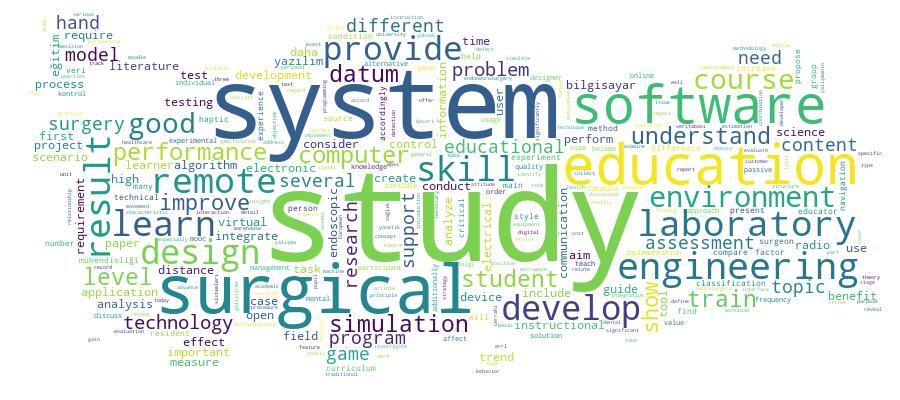
Competency Cloud

GCRIS Competency Cloud

Scholarly Output Search Results

Now showing 1 - 1 of 1
  • Review
    Citation - WoS: 8
    Citation - Scopus: 9
    A Systematic Review on Classification and Assessment of Surgical Skill Levels for Simulation-Based Training Programs
    (Elsevier Ireland Ltd, 2023) Tonbul, Gokcen; Topalli, Damla; Cagiltay, Nergiz Ercil
    Background: Nowadays, advances in medical informatics have made minimally invasive surgery (MIS) procedures the preferred choice. However, there are several problems with the education programs in terms of surgical skill acquisition. For instance, defining and objectively measuring surgical skill levels is a challenging process. Accordingly, the aim of this study is to conduct a literature review for an investigation of the current approaches for classifying the surgical skill levels and for identifying the skill training tools and measurement methods.Materials and Methods: In this research, a search is conducted and a corpus is created. Exclusion and inclusion criteria are applied by limiting the number of articles based on surgical education, training approximations, hand movements, and endoscopic or laparoscopic operations. To satisfy these criteria, 57 articles are included in the corpus of this study.Results: Currently used surgical skill assessment approaches have been summarized. Results show that various classification approaches for the surgical skill level definitions are being used. Besides, many studies are con-ducted by omitting particularly important skill levels in between. Additionally, some inconsistencies are also identified across the skill level classification studies.Conclusion: In order to improve the benefits of simulation-based training programs, a standardized interdisci-plinary approach should be developed. For this reason, specific to each surgical procedure, the required skills should be identified. Additionally, appropriate measures for assessing these skills, which can be defined in simulation-based MIS training environments, should be refined. Finally, the skill levels gained during the developmental stages of these skills, with their threshold values referencing the identified measures, should be redefined in a standardized manner.