Çağıltay, Nergiz

Loading...
Profile Picture
Name Variants
Çağıltay, Nergis E.
Nergiz, Çağıltay
Çağıltay, Nergiz
Nergiz, Cagiltay
Ç.,Nergiz
C.,Nergiz
N., Cagiltay
N.,Çağıltay
Cagiltay, Nergiz
Cagiltay,N.
Çağıltay,N.
N.,Cagiltay
C., Nergiz
Çağıltay, Nergiz Ercil
Cagiltay, Nergiz Ercil
Çağıltay, Nergiz E.
Job Title
Profesör Doktor
Email Address
nergiz.cagiltay@atilim.edu.tr
Main Affiliation
Software Engineering
Status
Former Staff
Website
ORCID ID
Scopus Author ID
Turkish CoHE Profile ID
Google Scholar ID
WoS Researcher ID

Sustainable Development Goals

4

QUALITY EDUCATION
QUALITY EDUCATION Logo

33

Research Products

7

AFFORDABLE AND CLEAN ENERGY
AFFORDABLE AND CLEAN ENERGY Logo

1

Research Products

9

INDUSTRY, INNOVATION AND INFRASTRUCTURE
INDUSTRY, INNOVATION AND INFRASTRUCTURE Logo

1

Research Products

11

SUSTAINABLE CITIES AND COMMUNITIES
SUSTAINABLE CITIES AND COMMUNITIES Logo

1

Research Products

16

PEACE, JUSTICE AND STRONG INSTITUTIONS
PEACE, JUSTICE AND STRONG INSTITUTIONS Logo

3

Research Products

17

PARTNERSHIPS FOR THE GOALS
PARTNERSHIPS FOR THE GOALS Logo

3

Research Products
This researcher does not have a Scopus ID.
This researcher does not have a WoS ID.
Scholarly Output

137

Articles

79

Views / Downloads

544/3630

Supervised MSc Theses

26

Supervised PhD Theses

3

WoS Citation Count

1157

Scopus Citation Count

1469

WoS h-index

17

Scopus h-index

20

Patents

0

Projects

0

WoS Citations per Publication

8.45

Scopus Citations per Publication

10.72

Open Access Source

17

Supervised Theses

29

Google Analytics Visitor Traffic

JournalCount
18th IEEE International Symposium on Personal, Indoor and Mobile Radio Communication -- SEP 03-07, 2007 -- Athens, GREECE7
IEEE Access5
Computers & Education3
International Journal of Human–Computer Interaction3
Surgical Innovation3
Current Page: 1 / 10

Scopus Quartile Distribution

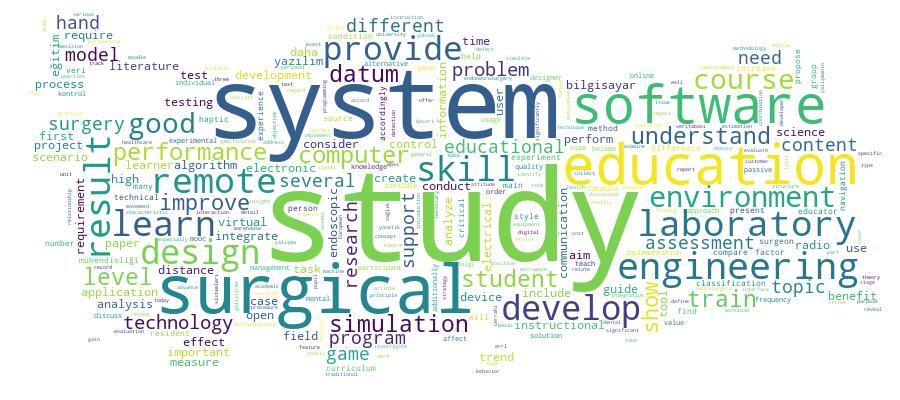
Competency Cloud

GCRIS Competency Cloud

Scholarly Output Search Results

Now showing 1 - 2 of 2
  • Article
    Citation - WoS: 16
    Citation - Scopus: 15
    Using Eye-Movement Events To Determine the Mental Workload of Surgical Residents
    (int Group Eye Movement Research, 2018) Dalveren, Gonca Gokce Menekse; Cagiltay, Nergiz Ercil
    These days, eye-tracking is one of the promising technologies used in different fields such as aviation, arts, sports, psychology and driving for several purposes. Even though it is being used for health purposes, studies involving eye-tracking are rare in the field of endo-neurosurgery. This study aims to use this technology to promote our understanding of the effect related to computer-based instructional materials on mental workload of endo-neurosurgery residents. Four computer-based simulation scenarios are developed based on skill development requirements of endo-neurosurgery residents. Two of them were designed as general models and the other two as simulated surgical models. During these surgery procedures, in real settings, surgical residents need to use their both hands simultaneously to control the endoscope and the operational tool in a coordinated fashion. Therefore, to shed light on the participants' behaviors, these scenarios are performed with dominant-hand, non-dominant hand and, finally with both-hands using haptic interfaces. Twenty-three residents volunteered in this study. Their eye-movements were recorded while performing the scenarios. According to the results of this study, when performing the simulated surgical models, an increase in the participants' mental workload was recorded when compared to the other scenarios. Accordingly, it can be concluded that the eye-movements of surgical residents can provide insights about the anticipated level of difficulty about the skill-based tasks. This information might be very critical to properly design and organize instructional materials for endo-neurosurgery, and also to better guide and evaluate the progress of trainees in computer simulation-based skill training environments.
  • Article
    Citation - WoS: 8
    Citation - Scopus: 10
    Evaluation of Ten Open-Source Eye-Movement Classification Algorithms in Simulated Surgical Scenarios
    (Ieee-inst Electrical Electronics Engineers inc, 2019) Dalveren, Gonca Gokce Menekse; Cagiltay, Nergiz Ercil
    Despite providing several insights into visual attention and evidence regarding certain brain states and psychological functions, classifying eye movements is a highly demanding process. Currently, there are several algorithms to classify eye movement events which use different approaches. However, to date, only a limited number of studies have assessed these algorithms under specific conditions, such as those required for surgical training programmes. This study presents an investigation of ten open-source eye-movement classification algorithms using the Eye Tribe eye-tracker. The algorithms were tested on the eye-movement records obtained from 23 surgical residents, who performed computer-based surgical simulation tasks under different hand conditions. The aim was to offer data for the improvement of surgical training programmes. According to the results, due to the different classification methods and default threshold values, the ten algorithms produced different results. Considering the fixation duration, the only common event for all of the investigated algorithms, the binocular-individual threshold (BIT) algorithm resulted in a different clustering compared to the other algorithms. Based on the other set of common events, three clusters were determined by eight algorithms (except BIT and event detection (ED)), distinguishing dispersion-based, velocity-based and modified versions of velocity-based algorithms. Accordingly, it was concluded that dispersion-based and velocity-based algorithms provided different results. Additionally, as it individually specifies the threshold values for the eye-movement data, when there is no consensus about the threshold values to be set, the BIT algorithm can be selected. Especially for such cases like simulation-based surgical skill-training, the use of individualised threshold values in the BIT algorithm can be more beneficial in classifying the raw eye data and thus evaluating the individual progress levels of trainees based on their eye movement behaviours. In conclusion, the threshold values had a critical effect on the algorithm results. Since default values may not always be suitable for the unique features of different data sets, guidelines should be developed to indicate how the threshold values are set for each algorithm.