Akbaş Uslu, Gülçin

Loading...
Profile Picture
Name Variants
Gulcin, Akbas Uslu
G.,Akbas Uslu
G., Akbaş Uslu
Akbas Uslu,G.
A., Gülçin
Akbaş Uslu, Gülçin
A.,Gulcin
A.U.Gülçin
Akbas Uslu, Gulcin
A.,Gülçin
G., Akbas Uslu
Gülçin, Akbaş Uslu
A. U. Gülçin
Akbaş Uslu,G.
G.,Akbaş Uslu
Gülçin Akbaş Uslu
A., Gulcin
Akbas Uslu,Gulcin
A. U. Gulcin
Akbaş,G.
Akbas, Gulcin
Akbaş, Gülçin
Job Title
Doktor Öğretim Üyesi
Email Address
gulcin.akbasuslu@atilim.edu.tr
Main Affiliation
Department of Psychology
Status
Website
Scopus Author ID
Turkish CoHE Profile ID
Google Scholar ID
WoS Researcher ID

Sustainable Development Goals

5

GENDER EQUALITY
GENDER EQUALITY Logo

4

Research Products

14

LIFE BELOW WATER
LIFE BELOW WATER Logo

0

Research Products

10

REDUCED INEQUALITIES
REDUCED INEQUALITIES Logo

2

Research Products

3

GOOD HEALTH AND WELL-BEING
GOOD HEALTH AND WELL-BEING Logo

0

Research Products

2

ZERO HUNGER
ZERO HUNGER Logo

0

Research Products

9

INDUSTRY, INNOVATION AND INFRASTRUCTURE
INDUSTRY, INNOVATION AND INFRASTRUCTURE Logo

0

Research Products

16

PEACE, JUSTICE AND STRONG INSTITUTIONS
PEACE, JUSTICE AND STRONG INSTITUTIONS Logo

2

Research Products

11

SUSTAINABLE CITIES AND COMMUNITIES
SUSTAINABLE CITIES AND COMMUNITIES Logo

0

Research Products

8

DECENT WORK AND ECONOMIC GROWTH
DECENT WORK AND ECONOMIC GROWTH Logo

0

Research Products

13

CLIMATE ACTION
CLIMATE ACTION Logo

0

Research Products

4

QUALITY EDUCATION
QUALITY EDUCATION Logo

0

Research Products

6

CLEAN WATER AND SANITATION
CLEAN WATER AND SANITATION Logo

0

Research Products

1

NO POVERTY
NO POVERTY Logo

0

Research Products

15

LIFE ON LAND
LIFE ON LAND Logo

0

Research Products

17

PARTNERSHIPS FOR THE GOALS
PARTNERSHIPS FOR THE GOALS Logo

3

Research Products

7

AFFORDABLE AND CLEAN ENERGY
AFFORDABLE AND CLEAN ENERGY Logo

0

Research Products

12

RESPONSIBLE CONSUMPTION AND PRODUCTION
RESPONSIBLE CONSUMPTION AND PRODUCTION Logo

0

Research Products
This researcher does not have a Scopus ID.
Documents

16

Citations

294

Scholarly Output

11

Articles

9

Views / Downloads

10/0

Supervised MSc Theses

0

Supervised PhD Theses

0

WoS Citation Count

100

Scopus Citation Count

110

WoS h-index

4

Scopus h-index

4

Patents

0

Projects

0

WoS Citations per Publication

9.09

Scopus Citations per Publication

10.00

Open Access Source

6

Supervised Theses

0

Google Analytics Visitor Traffic

JournalCount
Sex Roles2
Cyberfeminism and Gender Violence in Social Media1
Examining Complex Intergroup Relations: Through the Lens of Turkey1
Journal of Adult Development1
Journal of Language and Social Psychology1
Current Page: 1 / 2

Scopus Quartile Distribution

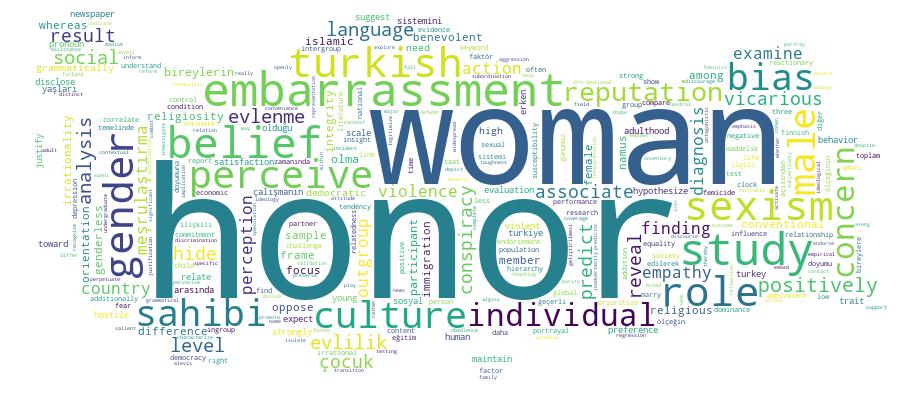
Competency Cloud

GCRIS Competency Cloud

Scholarly Output Search Results

Now showing 1 - 6 of 6
  • Article
    Citation - WoS: 3
    Citation - Scopus: 3
    The Role of Honor Concerns in Disclosing (vs. Hiding) COVID-19 Diagnosis: Insights from Turkiye
    (Springer/plenum Publishers, 2023) Ceylan-Batur, Suzan; Dogulu, Canay; Akbas, Gulcin; Yet, Barbaros; Uskul, Ayse K. K.
    Members of honor cultures value engaging in moral behaviors and managing their social image to maintain their honor. These two goals reflect reputation and integrity concerns, which also have bearing on gender roles. In the current study, we examined a) evaluations of women and men described as diagnosed with COVID-19 and as either hiding or disclosing their diagnosis, b) the moderating role of honor concerns (reputation and integrity) and the gender of the infected person in these evaluations, and c) the relationship between honor concerns and individuals' own disclosure preferences among participants living in Turkiye, a country that exemplifies an honor culture. Findings revealed that participants with stronger reputation concerns evaluated a woman's hiding behavior more favorably than that of a man's. Moreover, higher integrity concerns were associated with lower levels of participants' own preference to hide a diagnosis for both men and women, whereas reputation concerns were positively associated with a preference for hiding a diagnosis among men only. Furthermore, a content analysis of participants' open-ended explanations of their views on women's and men's motivation to hide a diagnosis revealed further evidence for the gendered nature of reputation concerns. Our findings point to the importance of prioritizing integrity concerns (and downplaying reputation concerns) in public health campaigns in honor cultures.
  • Article
    Citation - WoS: 13
    Citation - Scopus: 13
    Are Gender-Neutral Pronouns Really Neutral? Testing a Male Bias in the Grammatical Genderless Languages Turkish and Finnish
    (Sage Publications inc, 2023) Renstrom, Emma A.; Lindqvist, Anna; Akbas, Gulcin; Hekanaho, Laura; Senden, Marie Gustafsson
    Languages differ in how grammatically salient gender is. We explored if grammatically gender-neutral pronouns in Finnish and Turkish, two grammatically genderless languages, are gender neutral or male biased, thereby activating male, rather than female, exemplars. We also tested whether differences in national level gender equality influence the male bias. Results indicated a male bias in both languages, whereas national level gender equality had no influence. Implications for gender-fair language reforms in grammatically genderless languages are discussed.
  • Book Part
    Citation - Scopus: 2
    Unveiling the Portrayal of Intimate Partner Violence Against Women in the Media: Insights From an Honor Culture
    (IGI Global, 2023) Akbaş,G.; Ceylan-Batur,S.
    Intimate partner violence (IPV) against women is a pervasive global issue. The media plays a significant role in shaping society's perceptions and understanding of IPV. This study focuses on the representation of femicide in Turkish newspapers, with a specific focus on the context of Turkey as an honor culture characterized by a distinct emphasis on female sexual purity and male dominance. Honor cultures often justify violence against women in the name of preserving honor. This research aims to investigate how newspapers depict honor-based IPV through quantitative analysis, content analysis, discourse analysis, and frame analysis of femicide cases. The findings reveal that newspapers frame IPV within an honor culture by victim-blaming and justifying men's violent behavior. Additionally, news coverage often portrays honor-based IPV as isolated incidents, failing to recognize its reflection of the broader honor culture. These portrayals inadvertently perpetuate and legitimize IPV, discouraging women from seeking assistance and support. © 2023, IGI Global. All rights reserved.
  • Article
    Citation - WoS: 2
    Anti-Immigration Conspiracy Beliefs Are Associated With Endorsement of Conventional and Violent Actions Opposing Immigration and Attitudes Towards Democracy Across 21 Countries
    (SpringerNature, 2025) Thomas, Emma F.; Stothard, Christina; Besta, Tomasz; Akbas, Gulcin; Becker, Julia C.; Becker, Maja; van Zomeren, Martijn
    Despite widespread speculation that conspiracy beliefs foster anti-democratic outcomes, the empirical picture is inconsistent. To clarify this literature, we examine the relationships that conspiracy beliefs have with commitment to reactionary action and criticism of democracy, focusing on a global issue: immigration. We expected that people who believe that their government uses immigration to diversify the population against citizens' wishes (anti-migration conspiracy beliefs) would be more committed to conventional and violent action to oppose immigration, and more critical of democracy. However, societal-level factors - economic performance and democratic functioning - were expected to influence (strengthen, weaken) these links. As hypothesized, multi-level analyses (N = 4353) from 21 countries revealed that economic prosperity attenuated the positive link between anti-migration conspiracy beliefs and commitment to reactionary action. Paradoxically, more democratic societies evidenced stronger links between conspiracy beliefs and conventional (but not violent) action to oppose immigration. Thus, more democratic societies appear to invite conventional forms of action to oppose immigration which may, in turn, weaken democratic norms of inclusion. Results highlight the interplay of individual- and societal-level factors underlying illiberal movements.
  • Article
    Namus Sistemini Meşrulaştırma Ölçeği’nin Geliştirilmesi
    (2020) Akbaş, Gülçin; Uğurlu, Nuray Sakallı; Batur, Suzan Ceylan; Doğulu, Canay
    Bu çalışmanın amacı, sistemi meşrulaştırmakuramı (Jost ve Banaji, 1994) temelinde, bireylerin toplumdaki namus düzenini meşrulaştırma eğilimlerini değerlendiren namus sistemini meşrulaştırma (NSM) ölçeğini geliştirmektir. Bu amaçla; namusla ilgili alanyazın, raporlar ve haberlerdeki söylemlerden yola çıkılarak 28 maddelik bir havuz oluşturulmuştur. Çalışmanın örneklemi, 275’i kadın 158’si erkek olmak üzere toplam 433 (Ort.yaş= 31.77, S= 7.61)yetişkin katılımcıdan oluşmaktadır. Açımlayıcı ve doğrulayıcı faktör analizleri sonuçları, toplam varyansın%52.34’ünü açıklayan 10 maddelik tek faktörlü bir yapı ortaya koymuştur. Maddelerin aldıkları faktör yükleri .67 ve .79 arasında, madde-toplam korelasyonları ise .58 ve .72 arasında değişmektedir. Ayrıca, NSM ölçeğinin içtutarlık katsayısının .90 olduğu bulunmuştur. Ölçeğin namuslailgili diğer değişkenler (namusu onaylama, namus adına kadına uygulanan şiddete yönelik tutumlar) ve diğer sistemi meşrulaştırma ideolojileri (cinsiyet sistemini meşrulaştırma, korumacı ve düşmanca cinsiyetçilik) ile anlamlıilişkisi ölçeğin geçerli olduğuna işaret etmektedir. Elde edilen bulgular ışığında, NSM ölçeğinin ilgili alanyazında kullanılmak için geçerli ve güvenilir bir ölçüm aracı olduğu sonucuna varılmıştır.
  • Book Part
    Perceptions of Discrimination and Social Contact Among Alevis and Sunnis in Turkey: Findings From Two Field Studies
    (Taylor and Francis, 2022) Akbaş,G.; Ray-Yol,E.; Sümer,N.
    [No abstract available]