Akış, Ebru

Loading...
Profile Picture
Name Variants
A., Ebru
E., Akis
E., Akış
Akis E.
Akış,E.
Ebru Akış
E.,Akış
A.,Ebru
E.,Akis
Akis,E.
Akiş E.
Akış, Ebru
Akis, Ebru
Akis,Ebru
Ebru, Akış
Ebru, Akis
Job Title
Doktor Öğretim Üyesi
Email Address
ebru.akis@atilim.edu.tr
Main Affiliation
Civil Engineering
Status
Website
Scopus Author ID
Turkish CoHE Profile ID
Google Scholar ID

Sustainable Development Goals

2

ZERO HUNGER
ZERO HUNGER Logo

0

Research Products

11

SUSTAINABLE CITIES AND COMMUNITIES
SUSTAINABLE CITIES AND COMMUNITIES Logo

2

Research Products

14

LIFE BELOW WATER
LIFE BELOW WATER Logo

0

Research Products

6

CLEAN WATER AND SANITATION
CLEAN WATER AND SANITATION Logo

0

Research Products

1

NO POVERTY
NO POVERTY Logo

0

Research Products

5

GENDER EQUALITY
GENDER EQUALITY Logo

0

Research Products

9

INDUSTRY, INNOVATION AND INFRASTRUCTURE
INDUSTRY, INNOVATION AND INFRASTRUCTURE Logo

1

Research Products

16

PEACE, JUSTICE AND STRONG INSTITUTIONS
PEACE, JUSTICE AND STRONG INSTITUTIONS Logo

1

Research Products

17

PARTNERSHIPS FOR THE GOALS
PARTNERSHIPS FOR THE GOALS Logo

0

Research Products

15

LIFE ON LAND
LIFE ON LAND Logo

0

Research Products

10

REDUCED INEQUALITIES
REDUCED INEQUALITIES Logo

0

Research Products

7

AFFORDABLE AND CLEAN ENERGY
AFFORDABLE AND CLEAN ENERGY Logo

0

Research Products

8

DECENT WORK AND ECONOMIC GROWTH
DECENT WORK AND ECONOMIC GROWTH Logo

0

Research Products

4

QUALITY EDUCATION
QUALITY EDUCATION Logo

0

Research Products

12

RESPONSIBLE CONSUMPTION AND PRODUCTION
RESPONSIBLE CONSUMPTION AND PRODUCTION Logo

1

Research Products

3

GOOD HEALTH AND WELL-BEING
GOOD HEALTH AND WELL-BEING Logo

0

Research Products

13

CLIMATE ACTION
CLIMATE ACTION Logo

0

Research Products
Documents

11

Citations

48

h-index

4

Documents

0

Citations

0

Scholarly Output

18

Articles

13

Views / Downloads

84/693

Supervised MSc Theses

5

Supervised PhD Theses

0

WoS Citation Count

23

Scopus Citation Count

35

WoS h-index

3

Scopus h-index

4

Patents

0

Projects

0

WoS Citations per Publication

1.28

Scopus Citations per Publication

1.94

Open Access Source

8

Supervised Theses

5

Google Analytics Visitor Traffic

JournalCount
Neural Computing and Applications2
Buildings1
Iğdır Üniversitesi Fen Bilimleri Enstitüsü Dergisi1
Innovative Infrastructure Solutions1
Jeoloji Muhendisligi Dergisi1
Current Page: 1 / 3

Scopus Quartile Distribution

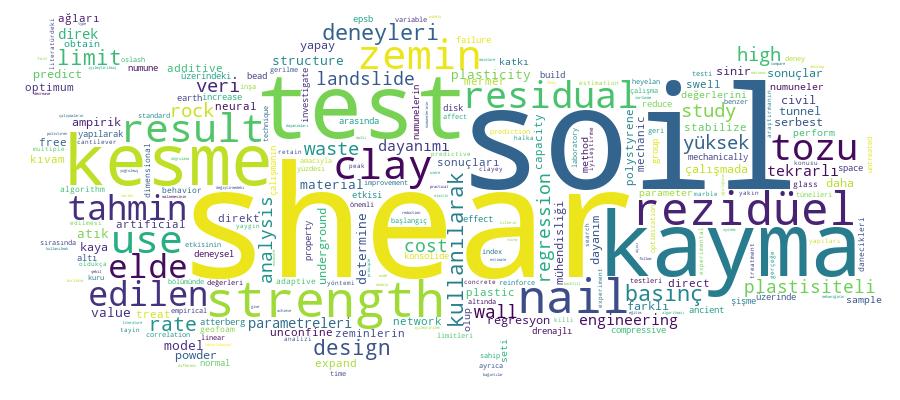
Competency Cloud

GCRIS Competency Cloud

Scholarly Output Search Results

Now showing 1 - 3 of 3
  • Master Thesis
    Killi Zeminlerde Katkı Maddesi Olarak Cam Tozu ve Genleştirilmiş Polistren (eps) Kullanılması
    (2022) Çiğdem, Öykü Yağmur; Akış, Ebru
    İklim değişikliğinin insan yaşamı üzerindeki etkisinin daha belirgin hale gelmesiyle atık yönetimi önem kazanmaktadır. Bu çalışmada, atık malzemelerin yüksek plastisiteli kil zemin iyileştirmesi üzerindeki etkisinin araştırılması amaçlanmıştır. Atık malzeme olarak, katı atıklar arasında en düşük dönüşüm oranına sahip olan cam tozu (%4.43) ve genleştirilirmiş polistiren (EPS) (%4.47) seçilmiştir. Cam tozu ve EPS, tek tek ve birlikte kullanılarak zemin parametreleri üzerindeki etkisi Atterberg limit, standart proktor, şişme yüzdesi tayini ve serbest basınç testleri yürütülerek değerlendirilmiştir. Katkı yüzdeleri, EPS için kuru numune ağırlığının %0.3, %0.9 ve %2'si olarak seçilirken, cam tozu için kuru numune ağırlığının %2, %4 ve %6'sı olarak belirlenmiştir. Test sonuçları, katkı maddesi olarak sadece cam tozu kullanıldığında malzemenin serbest basınç dayanımında artışa ve şişme yüzdelerinde azalışa neden olduğunu göstermiştir. Ancak, sadece EPS kullanıldığında hem şişme yüzdeleri hem de serbest basınç dayanımı değerlerinde azalma görülmüştür. Her iki katkı malzemesinin %4 cam tozu ve %0.9 EPS olarak belirlenmesi durumunda ise dayanım ve şişme yüzdesi en etkili iyileştirme ile sonuçlanmıştır. Deneysel çalışmaya ek olarak, bu çalışmadan elde edilen veriler ve literatürdeki benzer çalışmaların sonuçları ile veri dosyaları oluşturulmuştur. Söz konusu veriler kullanılarak regresyon analizi ve Yapay Sinir Ağları (YSA) analizleri yürütülmüştür.
  • Article
    Citation - WoS: 12
    Citation - Scopus: 13
    Predictive Models for Mechanical Properties of Expanded Polystyrene (eps) Geofoam Using Regression Analysis and Artificial Neural Networks
    (Springer London Ltd, 2022) Akis, E.; Guven, G.; Lotfisadigh, B.
    Initial elastic modulus and compressive strength are the two most important engineering properties for modeling and design of EPS geofoams, which are extensively used in civil engineering applications such as light-fill material embankments, retaining structures, and slope stabilization. Estimating these properties based on geometric and physical parameters is of great importance. In this study, the compressive strength and modulus of elasticity values are obtained by performing 356 unconfined compression tests on EPS geofoam samples with different shapes (cubic or disc), dimensions, loading rates, and density values. Using these test results, the mechanical properties of the specimens are predicted by linear regression and artificial neural network (ANN) methods. Both methods predicted the initial modulus of elasticity (E-i), 1% strain (sigma(1)), 5% strain (sigma(5)), and 10% strain (sigma(10)) strength values on a satisfactory level with a coefficient of correlation (R-2) values of greater than 0.901. The only exception was in prediction of sigma(1) and E-i in disc-shaped samples by linear regression method where the R-2 value was around 0.558. The results obtained from linear regression and ANN approaches show that ANN slightly outperform linear regression prediction for E-i and sigma(1) properties. The outcomes of the two methods are also compared with results of relevant studies, and it is observed that the calculated values are consistent with the results from the literature.
  • Article
    Citation - Scopus: 6
    Predictive Models for Treated Clayey Soils Using Waste Powdered Glass and Expanded Polystyrene Beads Using Regression Analysis and Artificial Neural Network
    (Springer Science and Business Media Deutschland GmbH, 2024) Akis,E.; Akış, Ebru; Cigdem,O.Y.; Akış, Ebru; Civil Engineering; Civil Engineering
    Waste materials contribute to a wide range of environmental and economic problems. To minimize their effects, a safe strategy for reducing such negative impact is required. Recycling and reusing waste materials have proved to be effective measures in this respect. In this study, an eco-friendly treatment is investigated based on using waste powdered glass (WGP) and EPS beads (EPSb) as mechanical and chemical admixers in soils. For this purpose, Atterberg limit, standard proctor, free swell, and unconfined compression tests are performed on soil samples with different ratios of waste materials at their optimum moisture contents. The obtained test results indicate that adding WGP to cohesive soils increases the unconfined compressive strength (UCS) and reduces free swell (FS). In contrast, using EPSb reduces both FS and UCS of the treated soil samples. An optimum combination of both waste materials is determined for the improvement of the properties of high plasticity clay used in this study. Furthermore, multiple linear regression (MLR) and artificial neural network (ANN) methods are used to predict the FS and UCS of the clayey soils based on the data obtained here and the experimental test results reported in the literature. Once the FS and UCS values of untreated soil and additive percentages are defined as independent variables, both methods are shown to predict the FS and UCS values of the treated soil samples on a satisfactory level with the coefficient of correlation (R2) values greater than 0.926. Additionally, when only the index properties (liquid limit, plastic limit, and plasticity index) of the soil samples with waste materials are used as dependent variables, the R2 values obtained by the ANN method are 0.968 and 0.974 for FS and UCS, respectively. The results of the untreated soil samples' FS and UCS tests are known, and the linear regression and ANN techniques yield similar results. Lastly, the ANN method is used to predict the FS and UCS of the treated samples in accordance to the limited predictors (e.g., only the Atterberg limits of the soil sample). © The Author(s) 2024.