
Akış, Ebru
Loading...
Profile URL
Name Variants
A., Ebru
E., Akis
E., Akış
Akis E.
Akış,E.
Ebru Akış
E.,Akış
A.,Ebru
E.,Akis
Akis,E.
Akiş E.
Akış, Ebru
Akis, Ebru
Akis,Ebru
Ebru, Akış
Ebru, Akis
E., Akis
E., Akış
Akis E.
Akış,E.
Ebru Akış
E.,Akış
A.,Ebru
E.,Akis
Akis,E.
Akiş E.
Akış, Ebru
Akis, Ebru
Akis,Ebru
Ebru, Akış
Ebru, Akis
Job Title
Doktor Öğretim Üyesi
Email Address
ebru.akis@atilim.edu.tr
Main Affiliation
Civil Engineering
Status
Website
ORCID ID
Scopus Author ID
Turkish CoHE Profile ID
Google Scholar ID
WoS Researcher ID
Sustainable Development Goals
2
ZERO HUNGER

0
Research Products
11
SUSTAINABLE CITIES AND COMMUNITIES

2
Research Products
14
LIFE BELOW WATER

0
Research Products
6
CLEAN WATER AND SANITATION

0
Research Products
1
NO POVERTY

0
Research Products
5
GENDER EQUALITY

0
Research Products
9
INDUSTRY, INNOVATION AND INFRASTRUCTURE

1
Research Products
16
PEACE, JUSTICE AND STRONG INSTITUTIONS

1
Research Products
17
PARTNERSHIPS FOR THE GOALS

0
Research Products
15
LIFE ON LAND

0
Research Products
10
REDUCED INEQUALITIES

0
Research Products
7
AFFORDABLE AND CLEAN ENERGY

0
Research Products
8
DECENT WORK AND ECONOMIC GROWTH

0
Research Products
4
QUALITY EDUCATION

0
Research Products
12
RESPONSIBLE CONSUMPTION AND PRODUCTION

1
Research Products
3
GOOD HEALTH AND WELL-BEING

0
Research Products
13
CLIMATE ACTION

0
Research Products

Documents
11
Citations
48
h-index
4

Documents
0
Citations
0

Scholarly Output
18
Articles
13
Views / Downloads
84/693
Supervised MSc Theses
5
Supervised PhD Theses
0
WoS Citation Count
23
Scopus Citation Count
35
WoS h-index
3
Scopus h-index
4
Patents
0
Projects
0
WoS Citations per Publication
1.28
Scopus Citations per Publication
1.94
Open Access Source
8
Supervised Theses
5
Google Analytics Visitor Traffic
| Journal | Count |
|---|---|
| Neural Computing and Applications | 2 |
| Buildings | 1 |
| Iğdır Üniversitesi Fen Bilimleri Enstitüsü Dergisi | 1 |
| Innovative Infrastructure Solutions | 1 |
| Jeoloji Muhendisligi Dergisi | 1 |
Current Page: 1 / 3
Scopus Quartile Distribution
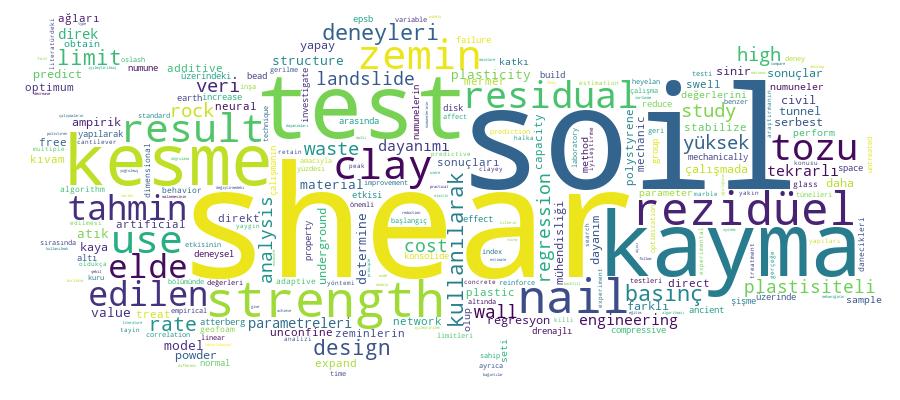
Competency Cloud
10 results
Scholarly Output Search Results
Now showing 1 - 10 of 10
Article Citation - WoS: 1Citation - Scopus: 1The Effect of Group Behavior on the Pull-Out Capacity of Model Soil Nails in High Plasticity Clay(Springer int Publ Ag, 2024) Akis, Ebru; Bakir, Bahadir Sadik; Yilmaz, Mustafa TolgaSoil nailing technique is widely used in stabilizing roadway and tunnel portal cut excavations. The key parameter in the design of soil nail systems is the pull-out capacity. The pull-out capacity of soil nails can be estimated either from the studies involving similar soil conditions or from the empirical formulas available in the literature. Particularly, it has been documented placing nails closer than a certain minimum distance results in a reduction in the pull-out resistance of a nail placed in sand. However, this requirement has not been discussed for the nail groups located within clay formations. In order to investigate the influence of nail spacing on the pull-out resistance of nails, a series of laboratory pull-out experiments were performed in clay of high plasticity. The results of these experiments showed a remarkable trend. Specifically, there was a significant reduction in the pull-out capacity of a nail when the spacing between nails two times the nail diameter (2 & Oslash;). In contrast, the pull-out capacity of a nail embedded in clay remained unaffected by neighboring nails, provided the spacing was maintained at six times the nail diameter (6 & Oslash;). In addition, during the conducted pull-out tests, it was observed that the failure mode of a single nail and 6 & Oslash; spaced group nails near the surface results as heaving around the single nail. However, in the case of closely positioned (2 & Oslash; spaced) nails, the affected area following nail failure exhibits distinct characteristics, which operate as a group. This leads to the occurrence of failure in the form of heaving around the group of nails.Article İlk Çağlardan Günümüze Yer Altı Yapıları, Kaya Yapıları ve Kaya Mekaniği(2017) Akış, Ebru; Satıcı, ÖzgürYer altındaki alanların kullanımı insanlar için antik dönemlere uzanan eski bir alışkanlıktır. Atalarımız, mağaraları vahşi hayattan korunmak için barınak olarak kullandılar, ayrıca değerli mineralleri çıkarmak için kazarak yer altı boşlukları oluşturdular. Bu boşlukları kutsal alan, mezar veya depo olarak kullandılar. Bu kullanım amaçlarına ek olarak, savaşlar sırasında saldırı veya surları geçmek amacıyla tüneller inşa ettiler. Daha sonraları, tüneller yerleşim yerlerine su getirmek veya söz konusu alanları selden korumak amacıyla yapıldı. İlk kez ne zaman kullanıldıkları bilinmemekle birlikte, birbirleriyle bağlantılı olarak inşa edilen yer altı yapıları insanlık tarihi boyunca barınma amacıyla da kullanıldı. Sonraki yüzyıllarda, ulaşım sistemlerine duyulan ihtiyaç nedeniyle yeni kazı tekniklerinin kullanıldığı ulaşım ve iletim tünelleri inşa edildi. Bu dönemde, çoğunluğu kaya ortamda yer alan su geçişi tünelleri, demiryolu tünelleri ve karayolu tünelleri yapıldı. İlk kazılar elle yapılmış olup, daha sonra kolay kazmak için ateşin kullanıldığı bilinmektedir. Bu tekniği, barut, patlayıcılar ve tünel açma makinaları takip etmiştir. Şu veya bu şekilde, eski uygarlıklar kaya mekaniğinin temel prensiplerini kullanmış ve bu prensipleri yer altı yapılarının inşasında uygulamışlardır. Kaya mekaniğinin prensipleri, tüm bu yapıların olmazsa olmaz unsurudur. Bu derlemede, kaya mekaniğinin tarihçesi kısaca anlatılacak, tarihi ve anıtsal yer altı ve kaya yapılarından örnekler sunulacaktırArticle Citation - Scopus: 4Cost Efficient Design of Mechanically Stabilized Earth Walls Using Adaptive Dimensional Search Algorithm(Turkish Chamber of Civil Engineers, 2020) Kazemzadeh Azad,S.; Akiş,E.Mechanically stabilized earth walls are among the most commonly used soil-retaining structural systems in the construction industry. This study addresses the optimum design problem of mechanically stabilized earth walls using a recently developed metaheuristic optimization algorithm, namely adaptive dimensional search. For a cost efficient design, different types of steel reinforcement as well as reinforced backfill soil are treated as discrete design variables. The performance of the adaptive dimensional search algorithm is investigated through cost optimization instances of mechanically stabilized earth walls under realistic design criteria specified by standard design codes. The numerical results demonstrate the efficiency and robustness of the adaptive dimensional search algorithm in minimum cost design of mechanically stabilized earth walls and further highlight the usefulness of design optimization in engineering practice. © 2020 Turkish Chamber of Civil Engineers. All rights reserved.Article Citation - WoS: 12Citation - Scopus: 13Predictive Models for Mechanical Properties of Expanded Polystyrene (eps) Geofoam Using Regression Analysis and Artificial Neural Networks(Springer London Ltd, 2022) Akis, E.; Guven, G.; Lotfisadigh, B.Initial elastic modulus and compressive strength are the two most important engineering properties for modeling and design of EPS geofoams, which are extensively used in civil engineering applications such as light-fill material embankments, retaining structures, and slope stabilization. Estimating these properties based on geometric and physical parameters is of great importance. In this study, the compressive strength and modulus of elasticity values are obtained by performing 356 unconfined compression tests on EPS geofoam samples with different shapes (cubic or disc), dimensions, loading rates, and density values. Using these test results, the mechanical properties of the specimens are predicted by linear regression and artificial neural network (ANN) methods. Both methods predicted the initial modulus of elasticity (E-i), 1% strain (sigma(1)), 5% strain (sigma(5)), and 10% strain (sigma(10)) strength values on a satisfactory level with a coefficient of correlation (R-2) values of greater than 0.901. The only exception was in prediction of sigma(1) and E-i in disc-shaped samples by linear regression method where the R-2 value was around 0.558. The results obtained from linear regression and ANN approaches show that ANN slightly outperform linear regression prediction for E-i and sigma(1) properties. The outcomes of the two methods are also compared with results of relevant studies, and it is observed that the calculated values are consistent with the results from the literature.Article Yüksek Plastisiteli Killerde Rezidüel Kayma Direncinin Direkt Kesme Deneyi Sonuçları Kullanılarak Tayin Edilmesi(2021) Akış, EbruHeyelanlar doğal afet sayılarının afet türlerine göre dağılımı dikkate alındığında %45 ile en sık karşılaşılan doğa olaylarıdır.Heyelan çözüm projelerinin yapılabilmesi için heyelan sırasında kayma düzleminde oluşan rezidüel kayma dayanımıparametrelerinin gerçeğe en yakın şekilde tahmin edilmesi gerekir. Söz konusu parametreler, tekrarlı direkt kesme ve halka kesmedeneyleri yapılarak tayin edilebildiği gibi, geri analiz ya da zeminin fiziksel özellikleri yardımıyla literatürdeki korelasyonlarkullanılarak da öngörülebilmektedir. Kayma dayanımı parametreleri geri analiz yöntemi kullanılarak tayin edilirken, yeraltı suyudurumunun rezidüel kayma dayanımı değerlerini direkt olarak etkilediği bilinmektedir. Ayrıca, heyelan sırasındaki yeraltı suyudurumunun gerçeğe yakın olarak öngörülmesinin zorluğu aşikârdır. Öte yandan, literatürden elde edilen rezidüel kayma dayanımıparametreleri oldukça geniş bir aralıkta sonuçlar verebilmektedir. Tüm bunların yanı sıra, halka kesme deneyleri laboratuvarlardayaygın olarak yapılmamakta, yaygın olarak yapılan tekrarlı direkt kesme deneylerinin ise zemin cinsine bağlı olarak çok düşükhızlarda yapılması gerekebilmektedir. Bu sebeple, deney süresi deneylerin pratikte kullanımını olumsuz yönde etkilemektedir.Yukarıda belirtilen kısıtlamaların çerçevesinde bu çalışmada normal konsolide ve yüksek plastisiteli killerde pik ve rezidüel kaymadirenci açıları arasındaki ilişki incelenmiştir. Araştırmanın ilk kısmında ülkemiz literatüründeki çalışmaların sonuçlarıdeğerlendirilerek, kalıcı kayma direnci ile zemin indeks ve pik kayma direnci arasında ampirik bağıntılar öngörülmüştür. Dahasonra, örselenmiş yüksek plastisiteli kil numunelerle tekrarlı direkt kesme deneyleri yapılmış, elde edilen sonuçlar ile önerilenbağıntılar karşılaştırılmıştır.Article The Estimation of the Residual Shear Strength of High Plastic Clays Based on Direct Shear Test Results(Gazi Univ, 2021) Akis, EbruLandslides are the most common incidents with a rate of 45% considering the distribution of natural disaster numbers to disaster types. In order to make remedial measures for the landslides, the residual shear strength parameters formed in the shear plane during the landslide must be estimated as close to the reality as possible. These parameters can be determined by multi-reversal direct shear, ring shear tests, back calculations, correlations in the literature by means of physical properties of the soil. The difficulty of predicting the groundwater conditions during landslide is obvious and it directly affects the residual shear strength values when shear strength parameters are determined using the back analysis method. On the other hand, residual shear strength parameters obtained from the literature can give a wide range. Besides, ring shear tests are not commonly performed in laboratories and depending on the type of soil, multi reveral direct shear tests may need to be performed at very low speeds. Relatively long test time adversely affects the practical use of the multi reversal direct shear tests. In this study, the relationship between peak and residual shear strength in normally consolidated high plastic clays was studied within the framework of the above restrictions. Firstly, the empirical correlation between the residual shear strength and the index porperties and peak shear strength was predicted by evaluating the results of the studies in our country's literature. Then, the results obtained from the multi reversal direct shear tests with remoulded high plastic clay samples and the predicted values were compared.Review Citation - Scopus: 1Underground Structures, Rock Structures and Rock Mechanics From Ancient Era To the Modern Age;(TMMOB - Jeoloji Muhendisleri Odasi, 2017) Akiş,E.; Satici,Ö.Usage of underground space is an old habit for human beings since ancient era. Our ancestors have used caves as a shelter for protection from the wild life and nature, and they excavated caves to extract valuable minerals. They also used them as sanctuaries, tombs or for storage of goods. In addition, they built tunnels to be used as assault systems or to underpass fortifications during ancient warfare. Later on, tunnels were driven to supply water to the towns or to protect the towns from floods. They also built them for communication purposes. Though not knowing the exact time when they were first used, natural underground structures which have several interconnections were also built for underground dwelling purposes through the human history. In the following centuries, due to the need of transportation facilities, transportation tunnels were constructed where new excavation techniques were also used. Navigation canal tunnels, railway tunnels and road tunnels were constructed during that period. All these structures were mostly excavated in rocks. The first excavations were performed manually. Later on, fire technique had been used to excavate more easily. This was followed by the methods in which gunpowder, explosives and tunneling machinery were used. By some means or other, ancient civilizations had used fundamental principles of rock mechanics and applied these principles in the construction of the underground structures. Principles of rock mechanics are the sine qua non for all of these structures and facilities. In this review paper, the history and evaluation of rock mechanics will be given briefly and some examples of historical and monumental underground and rock structures will be presented. © 2017, TMMOB - Jeoloji Muhendisleri Odasi. All rights reserved.Article Citation - WoS: 5Citation - Scopus: 6Investigation of the Effect of Shearing Rate on Residual Strength of High Plastic Clay(Springer Heidelberg, 2020) Akis, Ebru; Mekael, Ahmad; Yilmaz, Mustafa TolgaThe residual shear strength on failure plane is a crucial parameter to be estimated for analysis of an active landslide. This strength must be determined precisely to build a reliable theoretical model for calculations. The multi-reversal direct-shear test is a practical method to determine this shear strength in laboratory due to wider availability of apparatus. The shearing rate is among the factors that significantly affect the precision of test results for clay specimens. However, limits for this rate are yet to be clarified to shorten the duration of multi-reversal direct-shear tests. In this study, two tests series at different shearing rates were performed to investigate the effect of shearing rate on the residual strength of highly plastic clay sample recovered from a landslide area in Northern Turkey. The shearing rates were set to 0.024 mm/min which was decreased to 0.001 mm/min during the last forward shearing phase for the first test series, whereas the rate was fixed to 0.0007 mm/min for the second test series. The residual friction angle determined by these tests was interpreted by using a theoretical analysis of the landslide, and they were compared with the estimations due to empirical relationships given in the literature. It is concluded that, although the rate of 0.024 mm/min is consistent with the recommendations in literature, this rate can yield overestimation of residual shear strength determined in multi-reversal direct-shear tests.Article Citation - WoS: 3Cost Efficient Design of Mechanically Stabilized Earth Walls Using Adaptive Dimensional Search Algorithm(Turkish Chamber Civil Engineers, 2020) Azad, Saeid Kazemzadeh; Akış, EbruMechanically stabilized earth walls are among the most commonly used soil-retaining structural systems in the construction industry. This study addresses the optimum design problem of mechanically stabilized earth walls using a recently developed metaheuristic optimization algorithm, namely adaptive dimensional search. For a cost efficient design, different types of steel reinforcement as well as reinforced backfill soil are treated as discrete design variables. The performance of the adaptive dimensional search algorithm is investigated through cost optimization instances of mechanically stabilized earth walls under realistic design criteria specified by standard design codes. The numerical results demonstrate the efficiency and robustness of the adaptive dimensional search algorithm in minimum cost design of mechanically stabilized earth walls and further highlight the usefulness of design optimization in engineering practice.Article Eps Daneciklerinin Ve/veya Cam Tozunun Killi Zeminlerin Kıvam Limitlerine Etkisi ve Limitlerin Ysa ve Regresyon ile Tahmin Edilmesi(2023) Akış, Ebru; Çiğdem, Öykü YağmurZeminlerin kıvam özellikleri, zeminlerin sınıflandırmasında ve parametrelerinin tahmin edilmesinde önemli bir araçtır. Bu çalışmanın ilk bölümünde atık malzeme ile iyileştirilen killi zeminin kıvam limitlerinde meydana gelen değişiklikler deneysel olarak incelenmiştir. Çalışmada birleştirilmiş zemin sınıflamasına göre yüksek plastisiteli kil olan bentonit kullanılmıştır. Bentonit, yalnız atık cam tozu, yalnız atık genleştirilmiş polistiren (EPS) daneleri ve her iki katkı malzemesinin farklı oranlarda kullanılmasıyla iyileştirilmiş ve likit limit ve plastik limit deneyleri yapılmıştır. Çalışmanın ikinci bölümünde ise bu çalışmada elde edilen sonuçlar ile literatürdeki benzer çalışmaların deney sonuçları kullanılarak cam tozu ve/veya EPS daneleriyle iyileştirilen zeminlerin kıvam limitleri için 65 veri derlenmiştir. Bu verilerin %80’i eğitim veri seti, %20’si doğrulama veri seti olarak kullanılmak üzere düzenlenmiştir. Çoklu lineer regresyon yöntemiyle ampirik bağıntılar, eğitim veri seti kullanılarak elde edilmiştir. Yine, aynı veri seti yapay sinir ağları yönteminde kullanılmış ve algoritma eğitilmiştir. Her iki yöntem, doğrulama veri seti ile çalıştırılmış ve sonuçlar karşılaştırılmıştır. Her iki yöntemde de eğitim ve doğrulama veri setlerinden elde edilen determinasyon katsayıları oldukça yüksek olup iyileştirilmiş killerin kıvam limitlerinin gerçeğe yakın tahmin edileceği düşünülmektedir. Ayrıca, yapay sinir ağları yöntemi ile elde edilen sonuçların seçilen veri setlerinden bağımsız olduğunu kontrol etmek amacıyla, öğrenme yöntemlerinde genellikle uygulanan bir yaklaşım olan çapraz geçerlilik testi yapılarak çalışmada kullanılan algoritmanın geçerliliği test edilmiştir. Bu çalışma sonucunda, atık cam tozu ve/veya atık EPS daneleriyle iyileştirilen killi zeminlerin kıvam limitlerinin tahmin edilmesinde kullanılmak üzere ampirik bağıntılar ve yapay sinir ağları yöntemi önerilmektedir
