
Mıshra, Deepti
Loading...

Profile URL
Name Variants
Deepti, Mıshra
Deepti, Mishra
M.,Deepti
M., Deepti
Mishra,D.
D.,Mıshra
Mishra, Deepti
Mıshra, Deepti
Mıshra,D.
D.,Mishra
D., Mishra
Mıshra, Deeptı
Mishra, D
Deepti, Mishra
M.,Deepti
M., Deepti
Mishra,D.
D.,Mıshra
Mishra, Deepti
Mıshra, Deepti
Mıshra,D.
D.,Mishra
D., Mishra
Mıshra, Deeptı
Mishra, D
Job Title
Doktor Öğretim Üyesi
Email Address
Main Affiliation
Computer Engineering
Status
Former Staff
Website
ORCID ID
Scopus Author ID
Turkish CoHE Profile ID
Google Scholar ID
WoS Researcher ID
Sustainable Development Goals
 1
1NO POVERTY
0
Research Products
 2
2ZERO HUNGER
0
Research Products
 3
3GOOD HEALTH AND WELL-BEING
8
Research Products
 4
4QUALITY EDUCATION
4
Research Products
 5
5GENDER EQUALITY
1
Research Products
 6
6CLEAN WATER AND SANITATION
0
Research Products
 7
7AFFORDABLE AND CLEAN ENERGY
0
Research Products
 8
8DECENT WORK AND ECONOMIC GROWTH
0
Research Products
 9
9INDUSTRY, INNOVATION AND INFRASTRUCTURE
2
Research Products
 10
10REDUCED INEQUALITIES
0
Research Products
 11
11SUSTAINABLE CITIES AND COMMUNITIES
0
Research Products
 12
12RESPONSIBLE CONSUMPTION AND PRODUCTION
3
Research Products
 13
13CLIMATE ACTION
4
Research Products
 14
14LIFE BELOW WATER
4
Research Products
 15
15LIFE ON LAND
0
Research Products
 16
16PEACE, JUSTICE AND STRONG INSTITUTIONS
3
Research Products
 17
17PARTNERSHIPS FOR THE GOALS
1
Research Products

This researcher does not have a Scopus ID.

This researcher does not have a WoS ID.

Scholarly Output
102
Articles
41
Views / Downloads
54/60
Supervised MSc Theses
4
Supervised PhD Theses
1
WoS Citation Count
930
Scopus Citation Count
1312
Patents
0
Projects
0
WoS Citations per Publication
9.12
Scopus Citations per Publication
12.86
Open Access Source
13
Supervised Theses
5
| Journal | Count |
|---|---|
| Acta Polytechnica Hungarica | 4 |
| Computer Standards & Interfaces | 3 |
| Confederated International Workshops and Posters: EI2N plus NSF ICE, ICSP plus INBAST, ISDE, ORM, OTMA, SWWS plus MONET plus SeDeS, and VADER -- OCT 17-21, 2011 -- Hersonissos, GREECE | 3 |
| Tehnicki Vjesnik | 3 |
| Journal of Universal Computer Science | 3 |
Current Page: 1 / 14
Scopus Quartile Distribution
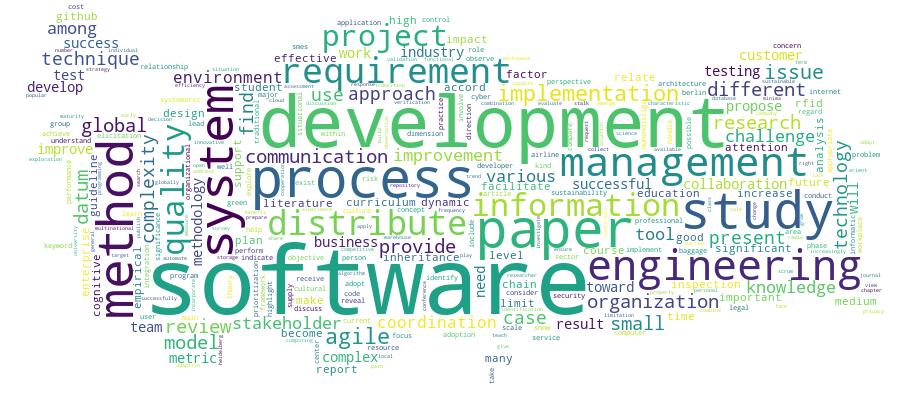
Competency Cloud
14 results
Scholarly Output Search Results
Now showing 1 - 10 of 14
Book Part Citation - Scopus: 2A Study of Software Process Improvement in Small and Medium Organizations(IGI Global, 2008) Mishra,D.; Mishra,A.Presently, the majority of software development, including outsourcing, is carried out by small and medium size software development organizations all over the world. These organizations are not capable to bear the cost of implementing available software process improvement models like CMMI, SPICE, ISO, and so forth. Therefore, there is a need to address this problem. In this chapter, various software process assessment and software process improvement models for small and medium scale organizations are discussed and compared. This will lead towards development of standardized software process improvement model for small and medium sized software development organizations in the future. © 2008, IGI Global.Book Part Citation - Scopus: 12Sustainable Software Engineering: Curriculum Development Based on Acm/Ieee Guidelines(Springer International Publishing, 2021) Mishra,A.; Mishra,D.Climate change risk and environmental degradation are the most critical issues of our society. Our technology-influenced daily lifestyle involves many types of software and apps which are used by society at large, and their use is increasing more than ever before. Sustainability is a significant topic for future professionals and more so for software engineers due to its impact on society. It is crucial to motivate and raise concern among students and faculty members regarding sustainability by including it in the Software Engineering (SE) curriculum. This chapter discusses how sustainability can be included in various courses of the SE curriculum by considering ACM/IEEE curriculum guidelines for the SE curriculum, literature review, and various viewpoints so that SE students can attain knowledge on sustainable software engineering. It also includes an assessment of key competences in sustainability for proposed units in the SE curriculum. © Springer Nature Switzerland AG 2021. All rights reserved.Conference Object ISDE 2011 PC Co-chairs' Message(Springer-verlag Berlin, 2011) Mishra, Alok; Muench, Juergen; Colomo-Palacios, Ricardo; Mishra, Deepti[No Abstract Available]Article Citation - WoS: 34Citation - Scopus: 41A Computationally Efficient Method for Hybrid Eeg-Fnirs Bci Based on the Pearson Correlation(Hindawi Ltd, 2020) Hasan, Mustafa A. H.; Khan, Muhammad U.; Mishra, DeeptiA hybrid brain computer interface (BCI) system considered here is a combination of electroencephalography (EEG) and functional near-infrared spectroscopy (fNIRS). EEG-fNIRS signals are simultaneously recorded to achieve high motor imagery task classification. This integration helps to achieve better system performance, but at the cost of an increase in system complexity and computational time. In hybrid BCI studies, channel selection is recognized as the key element that directly affects the system's performance. In this paper, we propose a novel channel selection approach using the Pearson product-moment correlation coefficient, where only highly correlated channels are selected from each hemisphere. Then, four different statistical features are extracted, and their different combinations are used for the classification through KNN and Tree classifiers. As far as we know, there is no report available that explored the Pearson product-moment correlation coefficient for hybrid EEG-fNIRS BCI channel selection. The results demonstrate that our hybrid system significantly reduces computational burden while achieving a classification accuracy with high reliability comparable to the existing literature.Book Part Citation - Scopus: 1Web Privacy: Issues, Legislations, and Technological Challenges(IGI Global, 2008) Mishra,A.; Mishra,D.People all over the world increasingly are concerned about the privacy issues surrounding the personal information collected by private organizations, governments and employers. Privacy relates to issues regarding collection, secure transmission, storage, authorized access, usage, and disclosure of personal information. This information is used for commercial gain by many organizations. Individual privacy concerns significantly affects consumer willingness to engage in electronic commerce over the Internet. The increased use of the Internet and Web for everyday activities is bringing new threats to personal privacy. This chapter assessed various issues related to individual privacy on the Web, growing concerns among the Web users, technologies employed for collecting and protecting information on the Web, privacy-enhancing technologies and the legal provisions to curb the Web privacy. This chapter also reported detailed discussion about Platform for Privacy Preferences (P3P), its structure, present scenario of its implementation and its future success. Global consistency on Internet privacy protection is important to promote the growth of electronic commerce. To protect consumers in a globally consistent manner, legislation, self-regulation, technical solutions and combination solutions are different ways that can be implemented. © 2008, IGI Global.Conference Object Adapting Test-Driven Development for Innovative Software Development Project(Springer Verlag, 2007) Mishra,D.; Mishra,A.In Test-Driven development, first test is made according to the customer requirement and then code is prepared to execute this test successfully. In this approach, design is not done exclusively before preparing test cases and coding. Design emerges as software evolves but this may result in lack of design quality. We adapted TDD by incorporating exclusive architectural design phase in the successful implementation of an innovative, large scale, complex project. © Springer-Verlag Berlin Heidelberg 2007.Editorial Information Systems in Distributed Environment(Elsevier, 2016) Mishra, Alok; Munch, Jurgen; Lassenius, Casper; Mishra, Deepti[No Abstract Available]Conference Object Citation - WoS: 1Adapting Test-Driven Development for Innovative Software Development Project(Springer Verlag, 2007) Mishra,D.; Mishra,A.In Test-Driven development, first test is made according to the customer requirement and then code is prepared to execute this test successfully. In this approach, design is not done exclusively before preparing test cases and coding. Design emerges as software evolves but this may result in lack of design quality. We adapted TDD by incorporating exclusive architectural design phase in the successful implementation of an innovative, large scale, complex project. © Springer-Verlag Berlin Heidelberg 2007.Book Part Citation - Scopus: 6Cyber Stalking: a Challenge for Web Security(IGI Global, 2013) Mishra,A.; Mishra,D.Cyber stalking is a relatively new kind of cyber terrorism crime. Although it often receives a lower priority then cyber terrorism it is an important global issue. Due to new technologies, it is striking in different forms. Due to the Internets provision of anonymity and security it is proliferating quickly. Technology and tools available to curb it have many limitations and are not easy to implement. Legal acts to protect people from cyber stalking are geographically limited to the concerned state or country. This chapter reviews cyber stalking, its approaches, impacts, provision of legal acts, and measures to be taken to prevent it. There is an immediate need for research in the various dimensions of cyber stalking to assess this social problem. © 2013, IGI Global.Article Citation - WoS: 30Citation - Scopus: 40Effective Communication, Collaboration, and Coordination in Extreme Programming: Human-Centric Perspective in a Small Organization(Wiley, 2009) Mishra, Deepti; Mishra, AlokEffective communication, collaboration, and coordination are important contributing factors in achieving success in agile software development projects. The significance of the workplace environment and tools are immense in effective communication, collaboration, and coordination among people performing software development. In this article, we study how the workplace environment and the effective use of tools like whiteboards, status boards, and so forth for exchanging information improved communication, collaboration, and coordination without compromising the ability to do individual work by developers in a small-scale software development organization. Based on experience and an extensive literature review of communication, collaboration, coordination, and the significance of these in the workplace environment, a survey questionnaire was developed to collect data and observe the effect of these in a small software development organization. Our study indicated appropriate workspace environment has a positive effect on communication, collaboration, and coordination in small organizations developing software using eXtreme Programming (XP). (C) 2009 Wiley Periodicals, Inc.
