Akar, Samet

Loading...
Profile Picture
Name Variants
S., Akar
Akar, Samet
Samet, Akar
A., Samet
Akar,S.
S.,Akar
A.,Samet
Job Title
Doktor Öğretim Üyesi
Email Address
samad.nadimi@atilim.edu.tr
Main Affiliation
Department of Mechanical Engineering
Status
Former Staff
Website
ORCID ID
Scopus Author ID
Turkish CoHE Profile ID
Google Scholar ID
WoS Researcher ID

Sustainable Development Goals

NO POVERTY1
NO POVERTY
0
Research Products
ZERO HUNGER2
ZERO HUNGER
0
Research Products
GOOD HEALTH AND WELL-BEING3
GOOD HEALTH AND WELL-BEING
0
Research Products
QUALITY EDUCATION4
QUALITY EDUCATION
0
Research Products
GENDER EQUALITY5
GENDER EQUALITY
0
Research Products
CLEAN WATER AND SANITATION6
CLEAN WATER AND SANITATION
0
Research Products
AFFORDABLE AND CLEAN ENERGY7
AFFORDABLE AND CLEAN ENERGY
0
Research Products
DECENT WORK AND ECONOMIC GROWTH8
DECENT WORK AND ECONOMIC GROWTH
0
Research Products
INDUSTRY, INNOVATION AND INFRASTRUCTURE9
INDUSTRY, INNOVATION AND INFRASTRUCTURE
2
Research Products
REDUCED INEQUALITIES10
REDUCED INEQUALITIES
0
Research Products
SUSTAINABLE CITIES AND COMMUNITIES11
SUSTAINABLE CITIES AND COMMUNITIES
0
Research Products
RESPONSIBLE CONSUMPTION AND PRODUCTION12
RESPONSIBLE CONSUMPTION AND PRODUCTION
0
Research Products
CLIMATE ACTION13
CLIMATE ACTION
0
Research Products
LIFE BELOW WATER14
LIFE BELOW WATER
0
Research Products
LIFE ON LAND15
LIFE ON LAND
0
Research Products
PEACE, JUSTICE AND STRONG INSTITUTIONS16
PEACE, JUSTICE AND STRONG INSTITUTIONS
0
Research Products
PARTNERSHIPS FOR THE GOALS17
PARTNERSHIPS FOR THE GOALS
0
Research Products
This researcher does not have a Scopus ID.
This researcher does not have a WoS ID.
Scholarly Output

5

Articles

4

Views / Downloads

24/391

Supervised MSc Theses

1

Supervised PhD Theses

0

WoS Citation Count

16

Scopus Citation Count

23

Patents

0

Projects

0

WoS Citations per Publication

3.20

Scopus Citations per Publication

4.60

Open Access Source

0

Supervised Theses

1

JournalCount
Artificial Intelligence for Engineering Design, Analysis and Manufacturing1
International Journal of Mechatronics and Manufacturing Systems1
Machining Science and Technology1
The International Journal of Advanced Manufacturing Technology1
Current Page: 1 / 1

Scopus Quartile Distribution

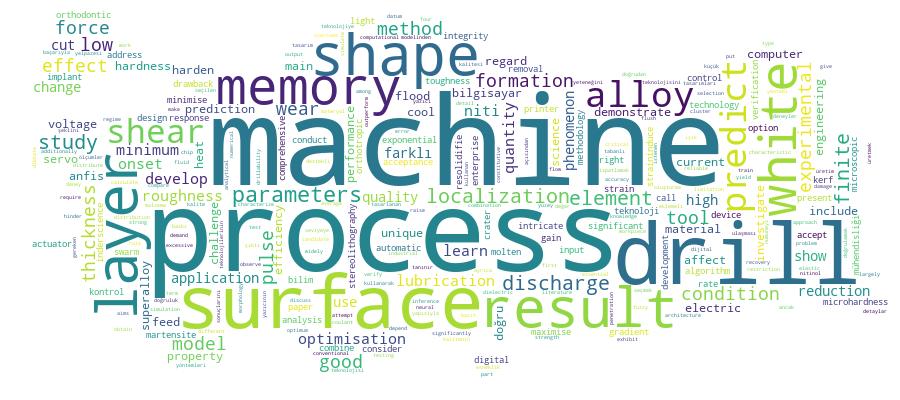
Competency Cloud

GCRIS Competency Cloud

Scholarly Output Search Results

Now showing 1 - 2 of 2
  • Master Thesis
    Dijital Işık İşleme Tabanlı Stereolitografi 3b Yazıcı Tasarlama ve Geliştirme
    (2020) Sahıb, Mohammed; Tirkeş, Güzin; Akar, Samet
    Dijital Işık İşleme tabanlı 3B yazıcı, Eklemeli İmalat (AM) teknolojisini kullanarak doğrudan CAD modelinden bir 3B model üretmek için Bilgisayar Destekli Tasarım (CAD) kullanan bir cihazdır. 3B baskı teknolojilerinin materyal , numuneyi oluşturma yöntemleri, hız ve doğruluk gibi birçok farklı yöntemi bulunmaktadır. Doğru üretim şeklini seçmek, malzeme ve kalitenin gereken seviyeye ulaşması, seçilen teknolojiye bağlıdır. DLP teknolojisi basit yapısıyla tanınır, ancak dikkate değer bir kalite ve esneklik yelpazesi sunar. Tasarlanan 3B yazıcının yeteneğini ispatlamak için farklı CAD tasarımları ile üç tip deney yapılmıştır. Bu deneyler yüzey kalitesi, küçük detaylar ve doğru ölçümler açısından başarıyla uygulanmıştır. Ayrıca, istenen çıktı sonuçlarını doğrulamak için iki farklı test yapılmıştır.
  • Article
    Citation - WoS: 7
    Citation - Scopus: 10
    Combined Use of Ultrasonic-Assisted Drilling and Minimum Quantity Lubrication for Drilling of Niti Shape Memory Alloy
    (Taylor & Francis inc, 2023) Namlu, Ramazan Hakki; Lotfi, Bahram; Kilic, S. Engin; Yilmaz, Okan Deniz; Akar, Samet
    The drilling of shape-memory alloys based on nickel-titanium (Nitinol) is challenging due to their unique properties, such as high strength, high hardness and strong work hardening, which results in excessive tool wear and damage to the material. In this study, an attempt has been made to characterize the drillability of Nitinol by investigating the process/cooling interaction. Four different combinations of process/cooling have been studied as conventional drilling with flood cooling (CD-Wet) and with minimum quantity lubrication (CD-MQL), ultrasonic-assisted drilling with flood cooling (UAD-Wet) and with MQL (UAD-MQL). The drill bit wear, drilling forces, chip morphology and drilled hole quality are used as the performance measures. The results show that UAD conditions result in lower feed forces than CD conditions, with a 31.2% reduction in wet and a 15.3% reduction in MQL on average. The lowest feed forces are observed in UAD-Wet conditions due to better coolant penetration in the cutting zone. The UAD-Wet yielded the lowest tool wear, while CD-MQL exhibited the most severe. UAD demonstrated a & SIM;50% lower tool wear in the wet condition than CD and a 38.7% in the MQL condition. UAD is shown to outperform the CD process in terms of drilled-hole accuracy.