
Ostrovska, Sofiya
Loading...
Profile URL
Name Variants
Ostrovska, Sofıya
Ostrovska,S.
Ostrovska, Sofia
S., Ostrovska
S.,Ostrovska
O., Sofiya
Ostrovska, S
Sofiya, Ostrovska
Ostrovska, S.
Ostrovska, Sofiya
Ostrovska S.
O.,Sofiya
Ostrovska,S.
Ostrovska, Sofia
S., Ostrovska
S.,Ostrovska
O., Sofiya
Ostrovska, S
Sofiya, Ostrovska
Ostrovska, S.
Ostrovska, Sofiya
Ostrovska S.
O.,Sofiya
Job Title
Profesor Doktor
Email Address
sofia.ostrovska@atilim.edu.tr
Main Affiliation
Mathematics
Status
Website
ORCID ID
Scopus Author ID
Turkish CoHE Profile ID
Google Scholar ID
WoS Researcher ID
Sustainable Development Goals
 1
1NO POVERTY
0
Research Products
 2
2ZERO HUNGER
0
Research Products
 3
3GOOD HEALTH AND WELL-BEING
1
Research Products
 4
4QUALITY EDUCATION
0
Research Products
 5
5GENDER EQUALITY
1
Research Products
 6
6CLEAN WATER AND SANITATION
0
Research Products
 7
7AFFORDABLE AND CLEAN ENERGY
0
Research Products
 8
8DECENT WORK AND ECONOMIC GROWTH
0
Research Products
 9
9INDUSTRY, INNOVATION AND INFRASTRUCTURE
0
Research Products
 10
10REDUCED INEQUALITIES
0
Research Products
 11
11SUSTAINABLE CITIES AND COMMUNITIES
0
Research Products
 12
12RESPONSIBLE CONSUMPTION AND PRODUCTION
0
Research Products
 13
13CLIMATE ACTION
0
Research Products
 14
14LIFE BELOW WATER
0
Research Products
 15
15LIFE ON LAND
0
Research Products
 16
16PEACE, JUSTICE AND STRONG INSTITUTIONS
0
Research Products
 17
17PARTNERSHIPS FOR THE GOALS
1
Research Products

Documents
102
Citations
939
h-index
14

Documents
89
Citations
833

Scholarly Output
112
Articles
104
Views / Downloads
123/129
Supervised MSc Theses
3
Supervised PhD Theses
0
WoS Citation Count
845
Scopus Citation Count
949
Patents
0
Projects
0
WoS Citations per Publication
7.54
Scopus Citations per Publication
8.47
Open Access Source
45
Supervised Theses
3
| Journal | Count |
|---|---|
| Journal of Mathematical Analysis and Applications | 8 |
| Mediterranean Journal of Mathematics | 4 |
| Results in Mathematics | 4 |
| Journal of Approximation Theory | 4 |
| Statistics & Probability Letters | 4 |
Current Page: 1 / 14
Scopus Quartile Distribution
Competency Cloud
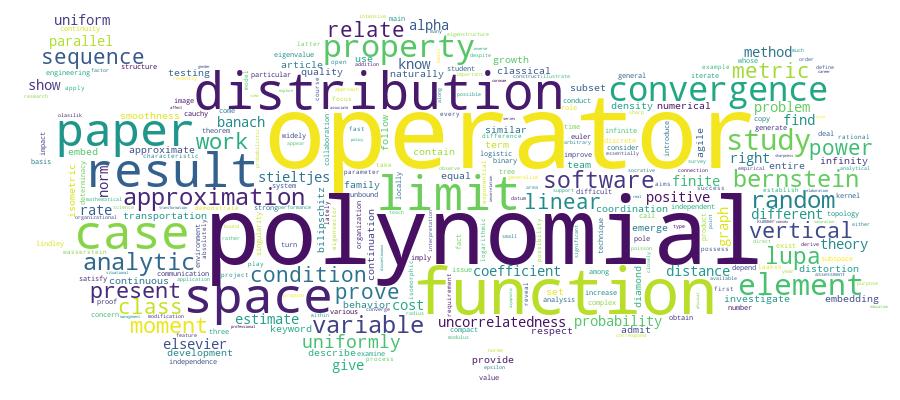
112 results
Scholarly Output Search Results
Now showing 1 - 10 of 112
Article Citation - WoS: 9Citation - Scopus: 9The Approximation of Logarithmic Function by q-bernstein Polynomials in the Case q > 1(Springer, 2007) Ostrovska, SofiyaSince in the case q > 1, q-Bernstein polynomials are not positive linear operators on C[ 0, 1], the study of their approximation properties is essentially more difficult than that for 0 < q < 1. Despite the intensive research conducted in the area lately, the problem of describing the class of functions in C[ 0, 1] uniformly approximated by their q-Bernstein polynomials ( q > 1) remains open. It is known that the approximation occurs for functions admitting an analytic continuation into a disc {z : | z| < R}, R > 1. For functions without such an assumption, no general results on approximation are available. In this paper, it is shown that the function f ( x) = ln( x + a), a > 0, is uniformly approximated by its q-Bernstein polynomials ( q > 1) on the interval [ 0, 1] if and only if a >= 1.Article Citation - WoS: 2Citation - Scopus: 2On the q-bernstein Polynomials of the Logarithmic Function in the Case q > 1(Walter de Gruyter Gmbh, 2016) Ostrovska, SofiyaThe q-Bernstein basis used to construct the q-Bernstein polynomials is an extension of the Bernstein basis related to the q-binomial probability distribution. This distribution plays a profound role in the q-boson operator calculus. In the case q > 1, q-Bernstein basic polynomials on [0, 1] combine the fast increase in magnitude with sign oscillations. This seriously complicates the study of q-Bernstein polynomials in the case of q > 1. The aim of this paper is to present new results related to the q-Bernstein polynomials B-n,B- q of discontinuous functions in the case q > 1. The behavior of polynomials B-n,B- q(f; x) for functions f possessing a logarithmic singularity at 0 has been examined. (C) 2016 Mathematical Institute Slovak Academy of SciencesArticle Citation - WoS: 4Citation - Scopus: 4On the Powers of the Kummer Distribution(Academic Publication Council, 2017) Ostrovska, Sofiya; Turan, Mehmet; MathematicsThe Kummer distribution is a probability distribution, whose density is given by f (x) = cx (alpha-1)(1 + delta x)(-gamma) e(-beta x), X > 0, where alpha, beta, delta > 0, gamma is an element of R and C is a normalizing constant. In this paper, the distributions of random variable X-P, p > 0, where X has the Kummer distribution, are considered with the conditions being IFR/DFR, some properties of moments depending on the parameters and the moment-(in) determinacy. In the case of moment-indeterminacy, exemplary Stieltjes classes are constructed.Article Citation - WoS: 1Citation - Scopus: 1The Distance Between Two Limit q-bernstein Operators(Rocky Mt Math Consortium, 2020) Ostrovska, Sofiya; Turan, MehmetFor q is an element of (0, 1), let B-q denote the limit q-Bernstein operator. The distance between B-q and B-r for distinct q and r in the operator norm on C[0, 1] is estimated, and it is proved that 1 <= parallel to B-q - B-r parallel to <= 2, where both of the equalities can be attained. Furthermore, the distance depends on whether or not r and q are rational powers of each other. For example, if r(j) not equal q(m) for all j, m is an element of N, then parallel to B-q - B-r parallel to = 2, and if r = q(m) for some m is an element of N, then parallel to B-q - B-r parallel to = 2(m - 1)/m.Article Citation - WoS: 11Citation - Scopus: 13The Convergence of q-bernstein Polynomials (0 < q < 1) in the Complex Plane(Wiley-v C H verlag Gmbh, 2009) Ostrovska, SofiyaThe paper focuses at the estimates for the rate of convergence of the q-Bernstein polynomials (0 < q < 1) in the complex plane. In particular, a generalization of previously known results on the possibility of analytic continuation of the limit function and an elaboration of the theorem by Wang and Meng is presented. (C) 2009 WILEY-VCH Verlag GmbH & Co. KGaA, WeinheimMaster Thesis Q-bernstein Polinomlarının Özellikleri Üzerine(2017) Almesbahı, Manal Mastafa; Turan, Mehmet; Ostrovska, SofıyaBu tezin amacı Bernstein polinomları teorisini ve son genişletmesi olan q-kalkülüsü çalışmaktır. Bu çalışmanın temel odak noktası 20 yıl önce ortaya çıkan ve kısa sürede birçok araştırmacının dikkatini çeken q-Bernstein polinomlarıdır. Bu tez Bernstein polinomlarına dair bilinen bazı sonuçların derlemesinden, q-Bernstein polinomları teorisine kısa bir giriş ve bazı yeni gelişmelerden oluşmaktadır. Yeni gelişmeler kısmında; limit q-Bernstein operatör dizisinin kuvvetli operatör limiti ve q-Bernstein operatörlerinin zayıf Picard operatörler oldukları ifade edilmiştir.Article Fedja’s Proof of Deepti’s Inequality(Tubitak Scientific & Technological Research Council Turkey, 2018) Ostrovska, Sofiya; Turan, MehmetThe paper aims to present, in a systematic way, an elegant proof of Deepti’s inequality. Both the inequalityand various ideas concerning the issue were discussed on the Mathoverflow website by a number of users, but none haveappeared in the literature thus far. In this work, suggestions pertaining to users ‘Deepti’ and ‘fedja’ are traced, whencethe title. The results or the paper are new, and the proof is divided into a series of statements, many of which are ofinterest in themselves.Article Citation - WoS: 11Citation - Scopus: 13Exploring and Expanding Students' Success in Software Testing(Emerald Group Publishing Ltd, 2017) Mishra, Deepti; Ostrovska, Sofiya; Hacaloglu, TunaPurpose - Testing is one of the indispensable activities in software development and is being adopted as an independent course by software engineering (SE) departments at universities worldwide. The purpose of this paper is to carry out an investigation of the performance of learners about testing, given the tendencies in the industry and motivation caused by the unavailability of similar studies in software testing field. Design/methodology/approach - This study is based on the data collected over three years (between 2012 and 2014) from students taking the software testing course. The course is included in the second year of undergraduate curriculum for the bachelor of engineering (SE). Findings - It has been observed that, from the performance perspective, automated testing outperforms structural and functional testing techniques, and that a strong correlation exists among these three approaches. Moreover, a strong programming background does help toward further success in structural and automated testing, but has no effect on functional testing. The results of different teaching styles within the course are also presented together with an analysis exploring the relationship between students' gender and success in the software testing course, revealing that there is no difference in terms of performance between male and female students in the course. Moreover, it is advisable to introduce teaching concepts one at a time because students find it difficult to grasp the ideas otherwise. Research limitations/implications - These findings are based on the analysis conducted using three years of data collected while teaching a course in testing. Obviously, there are some limitations to this study. For example, student's strength in programming is calculated using the score of C programming courses taken in previous year/semester. Such scores may not reflect their current level of programming knowledge. Furthermore, attempt was made to ensure that the exercises given for different testing techniques have similar difficulty level to guarantee that the difference in success between these testing techniques is due to the inherent complexity of the technique itself and not because of different exercises. Still, there is small probability that a certain degree of change in success may be due to the difference in the difficulty levels of the exercises. As such, it is obviously premature to consider the present results as final since there is a lack of similar type of studies, with which the authors can compare the results. Therefore, more work needs to be done in different settings to draw sound conclusions in this respect. Originality/value - Although there are few studies (see e.g. Chan et al., 2005; Garousi and Zhi, 2013; Ng et al., 2004) exploring the preference of testers over distinct software testing techniques in the industry, there appears to be no paper comparing the preferences and performances of learners in terms of different testing techniques.Editorial Citation - Scopus: 1Approximation Theory and Numerical Analysis(Hindawi Publishing Corporation, 2014) Ostrovska,S.; Berdysheva,E.; Nowak,G.; Özban,A.Y.[No abstract available]Article Citation - WoS: 15Citation - Scopus: 14Generalized Transportation Cost Spaces(Springer Basel Ag, 2019) Ostrovska, Sofiya; Ostrovskii, Mikhail I.The paper is devoted to the geometry of transportation cost spaces and their generalizations introduced by Melleray et al. (Fundam Math 199(2):177-194, 2008). Transportation cost spaces are also known as Arens-Eells, Lipschitz-free, or Wasserstein 1 spaces. In this work, the existence of metric spaces with the following properties is proved: (1) uniformly discrete metric spaces such that transportation cost spaces on them do not contain isometric copies of l(1), this result answers a question raised by Cuth and Johanis (Proc Am Math Soc 145(8):3409-3421, 2017); (2) locally finite metric spaces which admit isometric embeddings only into Banach spaces containing isometric copies of l(1); (3) metric spaces for which the double-point norm is not a norm. In addition, it is proved that the double-point norm spaces corresponding to trees are close to l(infinity)(d) of the corresponding dimension, and that for all finite metric spaces M, except a very special class, the infimum of all seminorms for which the embedding of M into the corresponding seminormed space is isometric, is not a seminorm.
