
Alkan, Neşe
Loading...
Profile URL
Name Variants
Neşe, Alkan
Neşe Alkan
A., Nese
Alkan, Neşe
Alkan,Nese
N., Alkan
Alkan N.
A.,Nese
N.,Alkan
Alkan, Nese
A., Neşe
Alkan,N.
Nese, Alkan
A.,Neşe
Alkan, N.
Neşe Alkan
A., Nese
Alkan, Neşe
Alkan,Nese
N., Alkan
Alkan N.
A.,Nese
N.,Alkan
Alkan, Nese
A., Neşe
Alkan,N.
Nese, Alkan
A.,Neşe
Alkan, N.
Job Title
Doçent Doktor
Email Address
nese.alkan@atilim.edu.tr
Main Affiliation
Department of Psychology
Status
Website
ORCID ID
Scopus Author ID
Turkish CoHE Profile ID
Google Scholar ID
WoS Researcher ID
Sustainable Development Goals
 1
1NO POVERTY
0
Research Products
 2
2ZERO HUNGER
0
Research Products
 3
3GOOD HEALTH AND WELL-BEING
0
Research Products
 4
4QUALITY EDUCATION
1
Research Products
 5
5GENDER EQUALITY
0
Research Products
 6
6CLEAN WATER AND SANITATION
0
Research Products
 7
7AFFORDABLE AND CLEAN ENERGY
0
Research Products
 8
8DECENT WORK AND ECONOMIC GROWTH
0
Research Products
 9
9INDUSTRY, INNOVATION AND INFRASTRUCTURE
0
Research Products
 10
10REDUCED INEQUALITIES
0
Research Products
 11
11SUSTAINABLE CITIES AND COMMUNITIES
0
Research Products
 12
12RESPONSIBLE CONSUMPTION AND PRODUCTION
0
Research Products
 13
13CLIMATE ACTION
0
Research Products
 14
14LIFE BELOW WATER
0
Research Products
 15
15LIFE ON LAND
0
Research Products
 16
16PEACE, JUSTICE AND STRONG INSTITUTIONS
0
Research Products
 17
17PARTNERSHIPS FOR THE GOALS
0
Research Products

Documents
6
Citations
74
h-index
4

Documents
6
Citations
88

Scholarly Output
12
Articles
10
Views / Downloads
82/69
Supervised MSc Theses
1
Supervised PhD Theses
0
WoS Citation Count
63
Scopus Citation Count
74
Patents
0
Projects
0
WoS Citations per Publication
5.25
Scopus Citations per Publication
6.17
Open Access Source
6
Supervised Theses
1
| Journal | Count |
|---|---|
| Buildings | 1 |
| E3S Web of Conferences -- 11th International Conference on Indoor Air Quality, Ventilation and Energy Conservation in Buildings, IAQVE C2023 -- 20 May 2023 through 23 May 2023 -- Tokyo -- 189404 | 1 |
| Indoor Air | 1 |
| Journal of Eye Movement Research | 1 |
| Nigerian Journal of Clinical Practice | 1 |
Current Page: 1 / 2
Scopus Quartile Distribution
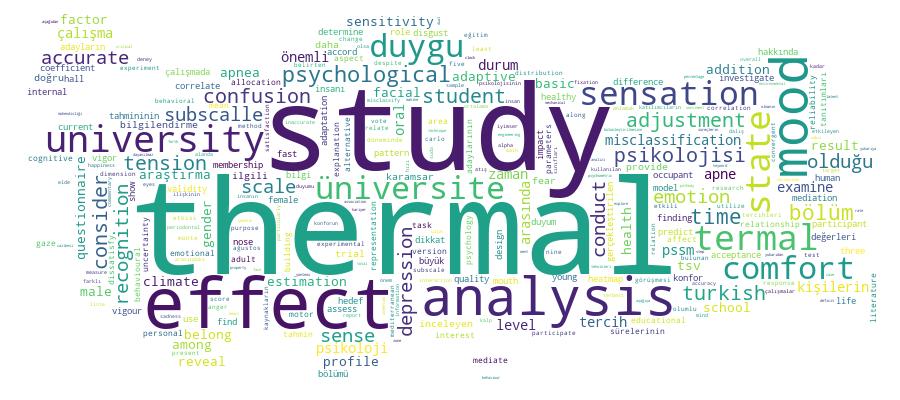
Competency Cloud
7 results
Scholarly Output Search Results
Now showing 1 - 7 of 7
Article Dikkat mi Nabız Mı: Apne Sürelerinin Tahmin Edilmesinde Yukarıdan Aşağıya ve Aşağıdan Yukarıya Süreçlerin Bütünleştirilmesine Yönelik Bir Ön Çalışma(2023) Alkan, Neşe; Akış, TolgaSerbest dalış performansı gibi bazı aktivitelerde zamanın doğru algılanması hayati önem taşımaktadır. Saniyeler ile ifade edilebilecek görece uzun zaman aralıklarının doğru tahmininin altında yatan kesin mekanizmaların anlaşılması, psikolojide çözülmesi gereken konulardan biridir. Bu amaçla, mevcut çalışmada, prospektif bir paradigma kullanılarak, 25, 50 ve 75 saniyelik apne sürelerinin yordayıcıları incelenmiştir. Çalışmanın verileri, iki deneysel koşulda, on bir serbest dalış sporcusunun hedef apne tahminlerini havada ve suda (daldırılmış) yapmaları yolu ile elde edilmiştir. Katılımcıların kalp atış hızı değerleri, dikkat kontrol kapasiteleri ve duygu durumlarının üç farklı hedef apne tahminindeki doğruluğunun incelendiği bu çalışmada: zaman tahminini etkileyen tek faktörün kalp atış hızı olmadığı; dikkat kapasitesi ve olumlu duygudurumun lineer olmayan bir tarzda zaman tahmininin doğruluğuna etki ettiği; yordayıcı olarak kullanılan bu üç değişkenin, deney koşuluna ve hedef aralığın süresine göre farklı şekilde etkili olduğu ve son olarak, katılımcıların en doğru zaman tahmininin, bu çalışmada kullanılan en uzun zaman aralığı olan 75 saniye suda apne olduğu bulunmuştur.Article Citation - WoS: 1Recognition and Misclassification Patterns of Basic Emotional Facial Expressions: An Eye-Tracking Study in Young Healthy Adults(MDPI, 2025) Alkan, NeşeAccurate recognition of basic facial emotions is well documented, yet the mechanisms of misclassification and their relation to gaze allocation remain under-reported. The present study utilized a within-subjects eye-tracking design to examine both accurate and inaccurate recognition of five basic emotions (anger, disgust, fear, happiness, and sadness) in healthy young adults. Fifty participants (twenty-four women) completed a forced-choice categorization task with 10 stimuli (female/male poser x emotion). A remote eye tracker (60 Hz) recorded fixations mapped to eyes, nose, and mouth areas of interest (AOIs). The analyses combined accuracy and decision-time statistics with heatmap comparisons of misclassified versus accurate trials within the same image. Overall accuracy was 87.8% (439/500). Misclassification patterns depended on the target emotion, but not on participant gender. Fear male was most often misclassified (typically as disgust), and sadness female was frequently labeled as fear or disgust; disgust was the most incorrectly attributed response. For accurate trials, decision time showed main effects of emotion (p < 0.001) and participant gender (p = 0.033): happiness was categorized fastest and anger slowest, and women responded faster overall, with particularly fast response times for sadness. The AOI results revealed strong main effects and an AOI x emotion interaction (p < 0.001): eyes received the most fixations, but fear drew relatively more mouth sampling and sadness more nose sampling. Crucially, heatmaps showed an upper-face bias (eye AOI) in inaccurate trials, whereas accurate trials retained eye sampling and added nose and mouth AOI coverage, which aligned with diagnostic cues. These findings indicate that the scanpath strategy, in addition to information availability, underpins success and failure in basic-emotion recognition, with implications for theory, targeted training, and affective technologies.Article Citation - WoS: 21Citation - Scopus: 22Sensitivity Analysis of the Effect of Current Mood States on the Thermal Sensation in Educational Buildings(Wiley-hindawi, 2022) Ozbey, Mehmet Furkan; Ceter, Aydin Ege; Orfioglu, Sevval; Alkan, Nese; Turhan, CihanAdaptive thermal comfort is a model which considers behavioral and psychological adjustments apart from Fanger's Predicted Mean Vote (PMV)/Percentage of Dissatisfied (PPD) method. In the literature, the differences between the PMV/PPD method and adaptive thermal comfort were mainly considered in aspects of behavioral adjustments in an environment. Conversely, limited studies related to psychological adjustments were considered in detail for thermal comfort. This study purposes to investigate the effects of current mood state subscales on thermal sensation of the occupants for the first time in the literature. To this aim, the Profile of Mood States (POMS) questionnaire is used to determine the mood state of the occupants with six different subscales: Anger, Confusion, Vigor, Tension, Depression, and Fatigue. The experiments were conducted in a university study hall in Ankara, Turkey, which is in warm-summer Mediterranean climate (Csb) according to Koppen-Geiger Climate Classification. The distributions of each subscale were examined via Anderson Darling and Shapiro-Wilk tests accordingly given responses from the occupants. The sensitivity analysis was applied to the six subscales of the POMS with Monte Carlo simulation method by considering the distributions of each subscale. The results revealed that the current mood state has a crucial effect on the thermal sensation of the occupants. The subscales of the Depression and Vigor were found as the most vital ones among the six subscales. Only the pure effects of the Vigor and Depression would change the thermal sensation of the occupants 0.31 and 0.30, respectively. The Confusion was determined as the least effective subscale to the thermal sensation of the occupants. Moreover, with the combination of all the six subscales, the thermal sensation might change up to 1.32. Findings in this study would help researchers to develop the personalized thermal comfort systems.Article Citation - WoS: 3Citation - Scopus: 4Latent Psychological Pathways in Thermal Comfort Perception: The Mediating Role of Cognitive Uncertainty on Depression and Vigour(MDPI, 2025) Ozbey, Mehmet Furkan; Turhan, Cihan; Alkan, Nese; Akkurt, Gulden GokcenThermal comfort is the condition of mind that expresses satisfaction with the thermal environment, and it is assessed through subjective evaluation, according to the American Society of Heating, Refrigerating, and Air-Conditioning Engineers. While research has traditionally emphasised physical factors, growing evidence highlights the role of the state of mind in shaping thermal perception. In a prior Monte Carlo sensitivity analysis, six mood subscales-Anger, Confusion, Vigour, Tension, Depression, and Fatigue-were examined for how they affect the absolute difference between actual and predicted thermal sensation. Depression and vigour were found to be the most influential, while confusion appeared least impactful. However, to accurately assess the role of confusion, it is necessary to consider its potential interactions with other mood subscales. To this end, a mediation analysis was conducted using Hayes' PROCESS tool. The mediation analyses revealed that confusion partially mediated depression's effect in males and vigour's effect in females. These results suggest that, despite a weak direct impact, confusion critically influences thermal perception by altering the effects of key mood states. Accounting for the indirect effects of mood states may lead to more accurate predictions of human sensory experiences and improve the design of occupant-centred environments.Master Thesis Kullanıcıların Isıl Konforu ile Duygu Durumları Arasındaki İlişkinin Belirlenmesi ve Deneysel Veri Odaklı Modellenmesi(2022) Çeter, Aydın Ege; Turhan, Cihan; Alkan, NeşeKişiler yaşamları boyunca zamanlarının %90'ını iç mekanlarda geçirmektedir. Bu sebeple iç ortamlarda kişilerin termal konforunun sağlanması büyük önem taşımaktadır. Bununla beraber termal konforun sağlanabilmesi termal konforun doğru ölçülmesi ile mümkündür. Ancak termal konfor ölçümünün doğruluğu büyük bir sorun teşkil etmektedir. Bu alanda gerçekleştirilen çalışmalar ölçülen termal konfor değerleri ile kişilerin termal duyumu arasında önemli farkların bulunduğunu ortaya koymuştur. Buna ek olarak araştırmacılar çalışmalarında, bu farkın önemli nedenleri arasında olduğu düşünülen, kişilerin psikolojisinin termal duyum üzerindeki etkisini araştırmışlardır. Çalışmalar bu alanda önemli mesafeler kat etmiş olsa da yalnızca insan bedeninin psikolojik etkenler altındaki fiziksel tepkilerini incelemekten ve aradaki bağlantının varlığını kanıtlamaktan öteye gidememişlerdir. Öte yandan kişinin duygu durumunun insan psikolojisinin önemli göstergeleri arasında olduğu bilinmektedir. Bu nedenle bu tez, kişilerin duygu durumları ile termal duyumu arasındaki ilişkiyi araştırma ve Duygu-durum Düzeltme Faktörü (DDF) adı verilen yeni bir metot sunmayı amaçlamaktadır. Bu ilişkinin açığa çıkarılması için Atılım Üniversitesi'nde bulunan bir çalışma salonunda 16 Ağustos 2021 ve 15 Nisan 2022 tarihleri arasında bir dizi deney gerçekleştirilmiştir. Duygu durum ve termal duyum arasındaki ilişkinin belirlenebilmesi için deneyler süresince Tahmini Ortalama Oy (PMV) ölçümleri ile birlikte Gerçek Ortalama Oy (AMV) ve Duygu Durum Profili (POMS) anketi kullanılmıştır. Elde edilen sonuçlar kişilerin termal duyumlarını en fazla etkileyen duygu durum sınıflarının çok karamsar, çok iyimser ve karamsar duygu durum sınıfları olduğunu ortaya çıkartmış ve ölçüm sonuçlarından daha sıcak hissettikleri ortaya koymuştur. Ayrıca DDF değerleri çok karamsar, çok iyimser ve karamsar duygu durum sınıfları için sırasıyla -0.125, -0.114 ve -0.075 olarak hesaplanmıştır.Article Recognition and Misclassification Patterns of Basic Emotional Facial Expressions: An Eye-Tracking Study in Young Healthy Adults(MDPI, 2023) Alkan, NeşeAccurate recognition of basic facial emotions is well documented, yet the mechanisms of misclassification and their relation to gaze allocation remain under-reported. The present study utilized a within-subjects eye-tracking design to examine both accurate and inaccurate recognition of five basic emotions (anger, disgust, fear, happiness, and sadness) in healthy young adults. Fifty participants (twenty-four women) completed a forced-choice categorization task with 10 stimuli (female/male poser x emotion). A remote eye tracker (60 Hz) recorded fixations mapped to eyes, nose, and mouth areas of interest (AOIs). The analyses combined accuracy and decision-time statistics with heatmap comparisons of misclassified versus accurate trials within the same image. Overall accuracy was 87.8% (439/500). Misclassification patterns depended on the target emotion, but not on participant gender. Fear male was most often misclassified (typically as disgust), and sadness female was frequently labeled as fear or disgust; disgust was the most incorrectly attributed response. For accurate trials, decision time showed main effects of emotion (p < 0.001) and participant gender (p = 0.033): happiness was categorized fastest and anger slowest, and women responded faster overall, with particularly fast response times for sadness. The AOI results revealed strong main effects and an AOI x emotion interaction (p < 0.001): eyes received the most fixations, but fear drew relatively more mouth sampling and sadness more nose sampling. Crucially, heatmaps showed an upper-face bias (eye AOI) in inaccurate trials, whereas accurate trials retained eye sampling and added nose and mouth AOI coverage, which aligned with diagnostic cues. These findings indicate that the scanpath strategy, in addition to information availability, underpins success and failure in basic-emotion recognition, with implications for theory, targeted training, and affective technologies.Conference Object Citation - Scopus: 3Investigation of the Relationship Between Tension Level and Thermal Sensation. a Case Study of University Study Hall(EDP Sciences, 2023) Özbey,M.F.; Alkan,N.; Turhan,C.The adaptive thermal comfort model steps forth against Fanger's Predicted Mean Vote/ Percentage of Dissatisfied model because of considering the psychological and behavioural adjustments in addition to environmental and personal parameters in mixed-mode and non-air-conditioned buildings. Among behavioural and psychological adjustments, human behaviour is more investigated than psychological adjustments in aspects of thermal sensation and comfort in the studies. To meet the deficit in the literature on how psychological adjustments affect thermal sensation, an experimental investigation was conducted to explore the effects of tension level on the Thermal Sensation Votes (TSV) of the students. Profile of Mood States (POMS) questionnaire was used to determine the tension level of the students. Experiments were conducted in a university study hall which is in the warm-summer Mediterranean climate (Csb) zone according to Köppen-Geiger Climate Classification. A total of 1159 students participated in the study, and the relation between the tension level and TSVs of the students were investigated for each gender. To test the associations between the nine quantitative subscales of tension level and the TSV, Pearson's correlation coefficient was computed. Based on results, "anxious"were considerable for the TSVs of both genders where the p-values were <0,001 for male and 0,044 for female students. In addition, while "shaky"(p=0,001) and "uneasy"(p<0,001) were found significant for the TSVs of male, "nervous"(p=0,013) were discovered noteworthy for the TSVs of the female students. © The Authors, published by EDP Sciences, 2023.
