
Azad, Saeıd Kazemzadeh
Loading...

Profile URL
Name Variants
Azad, S. Kazemzadeh
Saeid Kazemzadeh, Azad
S.K.Azad
Azad, Saeid Kazemzadeh
S., Azad
Azad, Saeıd Kazemzadeh
A., Saeid Kazemzadeh
S.,Azad
Azad,S.K.
A.,Saeid Kazemzadeh
Saeıd Kazemzadeh, Azad
A.,Saeıd Kazemzadeh
Saeid Kazemzadeh, Azad
S.K.Azad
Azad, Saeid Kazemzadeh
S., Azad
Azad, Saeıd Kazemzadeh
A., Saeid Kazemzadeh
S.,Azad
Azad,S.K.
A.,Saeid Kazemzadeh
Saeıd Kazemzadeh, Azad
A.,Saeıd Kazemzadeh
Job Title
Doçent Doktor
Email Address
saeid.azad@atilim.edu.tr
Main Affiliation
Department of Civil Engineering
Status
Former Staff
Website
ORCID ID
Scopus Author ID
Turkish CoHE Profile ID
Google Scholar ID
WoS Researcher ID
Sustainable Development Goals
SDG data is not available

This researcher does not have a Scopus ID.

This researcher does not have a WoS ID.

Scholarly Output
23
Articles
21
Views / Downloads
23/41
Supervised MSc Theses
2
Supervised PhD Theses
0
WoS Citation Count
469
Scopus Citation Count
524
Patents
0
Projects
0
WoS Citations per Publication
20.39
Scopus Citations per Publication
22.78
Open Access Source
3
Supervised Theses
2
| Journal | Count |
|---|---|
| Structural and Multidisciplinary Optimization | 6 |
| Structures | 4 |
| Iranian Journal of Science and Technology, Transactions of Mechanical Engineering | 3 |
| Computers & Structures | 2 |
| Periodica Polytechnica Civil Engineering | 1 |
Current Page: 1 / 2
Scopus Quartile Distribution
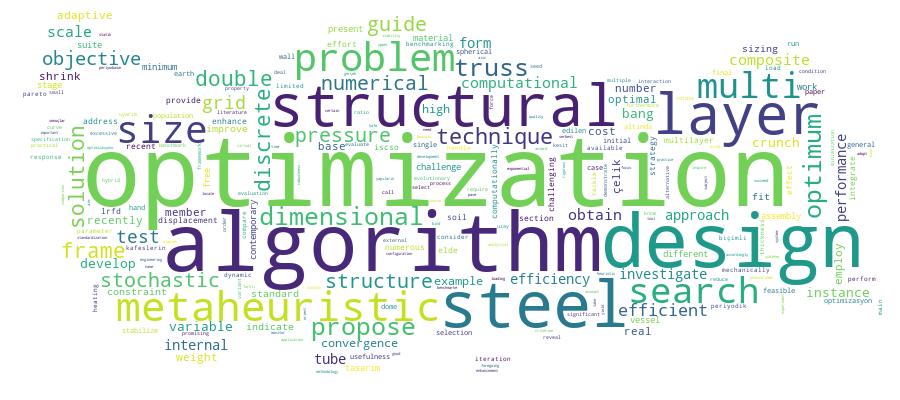
Competency Cloud
13 results
Scholarly Output Search Results
Now showing 1 - 10 of 13
Master Thesis Çelik Kafeslerin Dinamik Uyarımlar Altında Şekil ve Boyut Optimizasyonu(2018) Jawad, Farqad Kamıl Jawad; Azad, Saeıd KazemzadehGeçmiş yıllarda, çelik kafes optimizasyonu konusundaki araştırmaların ana odağı, statik yükleme koşulları altında optimum tasarımı elde etmeye yönelik olup, dinamik uyarımlar altında yapılan optimum yapısal tasarım araştırılmaları sınırlı sayıdadır. Bu tez, dinamik uyarımlara maruz kalan çelik kafes yapıların eş zamanlı şekil ve boyutlandırma optimizasyon problemini ele almaktadır. Modern bir evrimsel algoritma kullanarak, çelik kafeslerin minimum ağırlık tasarımı, hem periyodik hem de periyodik olmayan uyarımlar altında gerçekleştirilmiştir. Periyodik uyarımlarda, dinamik yükün uyarım periyodunun sonuçlar üzerindeki etkisini incelemek için tasarım örnekleri farklı uyarım periyotları altında optimize edilmiş ve elde edilen sonuçlar karşılaştırılmıştır. Kullanılan sinüzoidal yüklemenin periyodunun ve periyodik olmayan adım kuvvetinin yükselme süresinin arttırılmasıyla, optimizasyon sonuçlarının statik yükleme altında elde edilen sonuçlara yaklaştığı gözlenmiştir. Ancak, incelenen dikdörtgen periyodik uyarım durumunda elde edilen sonuçlar, uyarım periyodunun yüksek değerleri için bile statik yükleme altında elde edilen optimum tasarım ağırlıklarına yaklaşamamıştır.Article Citation - WoS: 11Citation - Scopus: 13Automated Selection of Optimal Material for Pressurized Multi-Layer Composite Tubes Based on an Evolutionary Approach(Springer London Ltd, 2018) Azad, Saeid Kazemzadeh; Akis, Tolga; Kazemzadeh Azad, SaeidDecision making on the configuration of material layers as well as thickness of each layer in composite assemblies has long been recognized as an optimization problem. Today, on the one hand, abundance of industrial alloys with different material properties and costs facilitates fabrication of more economical or light weight assemblies. On the other hand, in the design stage, availability of different alternative materials apparently increases the complexity of the design optimization problem and arises the need for efficient optimization techniques. In the present study, the well-known big bang-big crunch optimization algorithm is reformulated for optimum design of internally pressurized tightly fitted multi-layer composite tubes with axially constrained ends. An automated material selection and thickness optimization approach is employed for both weight and cost minimization of one-, two-, and three-layer tubes, and the obtained results are compared. The numerical results indicate the efficiency of the proposed approach in practical optimum design of multi-layer composite tubes under internal pressure and quantify the optimality of different composite assemblies compared to one-layer tubes.Article Citation - WoS: 60Citation - Scopus: 64Seeding the Initial Population With Feasible Solutions in Metaheuristic Optimization of Steel Trusses(Taylor & Francis Ltd, 2018) Azad, Saeid Kazemzadeh; Kazemzadeh Azad, SaeidIn spite of considerable research work on the development of efficient algorithms for discrete sizing optimization of steel truss structures, only a few studies have addressed non-algorithmic issues affecting the general performance of algorithms. For instance, an important question is whether starting the design optimization from a feasible solution is fruitful or not. This study is an attempt to investigate the effect of seeding the initial population with feasible solutions on the general performance of metaheuristic techniques. To this end, the sensitivity of recently proposed metaheuristic algorithms to the feasibility of initial candidate designs is evaluated through practical discrete sizing of real-size steel truss structures. The numerical experiments indicate that seeding the initial population with feasible solutions can improve the computational efficiency of metaheuristic structural optimization algorithms, especially in the early stages of the optimization. This paves the way for efficient metaheuristic optimization of large-scale structural systems.Article Citation - WoS: 17Citation - Scopus: 17Discrete Sizing of Steel Frames Using Adaptive Dimensional Search Algorithm(Budapest Univ Technology Economics, 2019) Hasancebi, Oguzhan; Azad, Saeid KazemzadehAdaptive dimensional search (ADS) algorithm is a recently proposed metaheuristic optimization technique for discrete structural optimization problems. In this study, discrete sizing optimization problem of steel frames is tackled using the ADS algorithm. An important feature of the algorithm is that it does not use any metaphor as an underlying principle for its implementation. Instead, the algorithm employs an efficient performance-oriented methodology at each iteration for convergence to the optimum or a near optimum solution. The performance of the ADS is investigated through optimum design of five real-size steel frame structures and the results are compared versus several contemporary metaheuristic techniques. The comparison of the obtained numerical results with those of available designs in the literature reveals the reliability and efficiency of the ADS in optimum design of steel frames.Article Citation - WoS: 47Citation - Scopus: 46Enhanced Hybrid Metaheuristic Algorithms for Optimal Sizing of Steel Truss Structures With Numerous Discrete Variables(Springer, 2017) Azad, Saeid Kazemzadeh; Kazemzadeh Azad, SaeidThe advent of modern computing technologies paved the way for development of numerous efficient structural design optimization tools in the recent decades. In the present study sizing optimization problem of steel truss structures having numerous discrete variables is tackled using combined forms of recently proposed metaheuristic techniques. Three guided, and three guided hybrid metaheuristic algorithms are developed by integrating a design oriented strategy to the stochastic search properties of three recently proposed metaheuristic optimization techniques, namely adaptive dimensional search, modified big bang-big crunch, and exponential big bang-big crunch algorithms. The performances of the proposed guided, and guided hybrid metaheuristic algorithms are compared to those of standard variants through optimum design of real-size steel truss structures with up to 728 design variables according to AISC-LRFD specification. The numerical results reveal that the hybrid form of adaptive dimensional search and exponential big bang-big crunch algorithm is the most promising algorithm amongst the other investigated techniques.Article Citation - WoS: 33Citation - Scopus: 37Discrete Sizing Optimization of Steel Trusses Under Multiple Displacement Constraints and Load Cases Using Guided Stochastic Search Technique(Springer, 2015) Azad, S. Kazemzadeh; Hasancebi, O.The guided stochastic search (GSS) is a computationally efficient design optimization technique, which is originally developed for discrete sizing optimization problems of steel trusses with a single displacement constraint under a single load case. The present study aims to investigate the GSS in a more general class of truss sizing optimization problems subject to multiple displacement constraints and load cases. To this end, enhancements of the GSS are proposed in the form of two alternative approaches that enable the technique to deal with multiple displacement/load cases. The first approach implements a methodology in which the most critical displacement direction is considered only when guiding the search process. The second approach, however, takes into account the cumulative effect of all the critical displacement directions in the course of optimization. Advantage of the integrated force method of structural analysis is also utilized for further reduction of the computational effort in these approaches. The proposed enhancements of GSS are investigated and compared with some selected techniques of design optimization through six truss structures that are sized for minimum weight. The numerical results reveal that both enhancements generally provide promising solutions with an insignificant computational effort.Article Citation - WoS: 34Citation - Scopus: 37Monitored Convergence Curve: a New Framework for Metaheuristic Structural Optimization Algorithms(Springer, 2019) Azad, Saeid KazemzadehMetaheuristic optimization algorithms, by nature, depend on random processes, and therefore, performing numerous algorithm runs is inevitable to locate a reasonably good solution. Although executing the algorithms for small-size or trivial structural optimization problems could be computationally affordable, when dealing with challenging optimization problems, there is almost no chance of performing numerous independent runs of metaheuristics in a timely manner. This difficulty is basically due to the limitations in computational technologies as well as the excessive computational cost of such problems. In such cases that the number of independent runs is limited to a small number, each optimization run becomes highly valuable and, therefore, the stability of results becomes much more significant. In the present study, it is attempted to monitor the convergence curve of each succeeding run of the algorithm with respect to the information obtained in the previous runs. An easy-to-implement yet efficient framework is proposed for metaheuristic structural optimization algorithms where every succeeding run is monitored at certain intervals named as solution monitoring period. The solution monitoring period is selected such that, at each run, on the one hand, the algorithm could explore the search space to improve the solution quality, and on the other hand, the algorithm is occasionally forced to return to the previously visited more promising solutions if it is not able to improve the solution after a certain number of iterations. The numerical experiments using challenging test instances with up to 354 design variables indicate that, in general, the proposed approach helps to improve the solution quality as well as the robustness or stability of results in metaheuristic structural optimization.Article Citation - WoS: 25Citation - Scopus: 29Optimum Design of Steel Braced Frames Considering Dynamic Soil-Structure Interaction(Springer, 2019) Bybordiani, Milad; Azad, Saeid Kazemzadeh; Kazemzadeh Azad, SaeidRecent studies on design optimization of steel frames considering soil-structure interaction have focused on static loading scenarios, and limited work has been conducted to address the design optimization under dynamic soil-structure interaction. In the present work, first, a platform is developed to perform optimization of steel frames under seismic loading considering dynamic soil-structure interaction (SSI) in order to quantify the effects of earthquake records on the optimum design. Next, verification of the adopted modeling technique is conducted using comparison of the results with the reference solution counterparts in frequency domain. For time history analyses, records from past events are selected and scaled to a target spectrum using simple scaling approach as well as spectrum matching technique. For sizing of the steel frames, a recently developed metaheuristic optimization algorithm, namely exponential big bang-big crunch optimization method, is employed. To alleviate the computational burden of the optimization process, the metaheuristic algorithm is integrated with the so-called upper bound strategy. Effects of factors such as the building height, presence of soil domain, and the utilized ground motion scaling technique are investigated and discussed. The numerical results obtained based on 5- and 10-story steel braced frame dual systems reveal that, although dynamic SSI reduced the seismic demands to some extent, given the final design pertains to different load combinations, the optimum weight difference is not considerable.Article Citation - WoS: 6Citation - Scopus: 8Improving Computational Efficiency of Bat-Inspired Algorithm in Optimal Structural Design(Sage Publications inc, 2015) Hasanebi, O.; Azad, S. Kazemzadeh; Hasançebi, O.Bat-inspired (BI) algorithm is a recent metaheuristic optimization technique that simulates echolocation behavior of bats in seeking a design space. Along the same line with almost all metaheuristics, this algorithm also entails a large number of time-consuming structural analyses in structural design optimization applications. This study is focused on improving computational efficiency of the BI algorithm in optimum structural design. The number of structural analyses required by BI algorithm in the course of design optimization is reduced considerably by incorporating an upper bound strategy (UBS) into the solution procedure. The performance of the resulting algorithm, i.e. UBS integrated BI algorithm (UBI), is evaluated in discrete sizing optimization of large-scale steel skeletal structures designed for minimum weight according to American Institute of Steel Construction-Allowable Stress Design provisions. The numerical results verify that the UBI results in a significant gain in the computational efficiency of the standard algorithm.Article Citation - WoS: 2Citation - Scopus: 2Structural Design Optimization of Multi-Layer Spherical Pressure Vessels: a Metaheuristic Approach(Springer, 2019) Akis, Tolga; Azad, Saeid Kazemzadeh; Kazemzadeh Azad, SaeidThis study addresses the optimum design problem of multi-layer spherical pressure vessels based on von Mises yield criterion. In order to compute the structural responses under internal pressure, analytical solutions for one-, two-, and three-layer spherical pressure vessels are provided. A population-based metaheuristic algorithm is reformulated for optimum material selection as well as thickness optimization of multi-layer spherical pressure vessels. Furthermore, in order to enhance the computational efficiency of the optimization algorithm, upper bound strategy is also integrated with the algorithm for reducing the total number of structural response evaluations during the optimization iterations. The performance of the algorithm is investigated through weight and cost minimization of one-, two- and three-layer spherical pressure vessels and the results are presented in detail. The obtained numerical results, based on different internal pressures as well as vessel sizes, indicate the usefulness and efficiency of the employed methodology in optimum design of multi-layer spherical pressure vessels.
