Namlu, Ramazan Hakkı

Loading...
Profile Picture
Name Variants
Ramazan Hakki, Namlu
Ramazan Hakkı Namlu
N., Ramazan Hakkı
Namlu,R.H.
R.H.Namlu
N.,Ramazan Hakkı
Namlu, Ramazan Hakki
Ramazan Hakkı, Namlu
R. H. Namlu
R.,Namlu
Namlu R.
N., Ramazan Hakki
N.,Ramazan Hakki
Namlu, Ramazan Hakkı
R., Namlu
Namlu,Ramazan Hakki
Job Title
Doktor Öğretim Üyesi
Email Address
ramazan.namlu@atilim.edu.tr
Main Affiliation
Mechanical Engineering
Status
Scopus Author ID
Turkish CoHE Profile ID
Google Scholar ID
WoS Researcher ID

Sustainable Development Goals

2

ZERO HUNGER
ZERO HUNGER Logo

0

Research Products

14

LIFE BELOW WATER
LIFE BELOW WATER Logo

0

Research Products

17

PARTNERSHIPS FOR THE GOALS
PARTNERSHIPS FOR THE GOALS Logo

0

Research Products

5

GENDER EQUALITY
GENDER EQUALITY Logo

0

Research Products

16

PEACE, JUSTICE AND STRONG INSTITUTIONS
PEACE, JUSTICE AND STRONG INSTITUTIONS Logo

0

Research Products

8

DECENT WORK AND ECONOMIC GROWTH
DECENT WORK AND ECONOMIC GROWTH Logo

0

Research Products

4

QUALITY EDUCATION
QUALITY EDUCATION Logo

0

Research Products

6

CLEAN WATER AND SANITATION
CLEAN WATER AND SANITATION Logo

0

Research Products

7

AFFORDABLE AND CLEAN ENERGY
AFFORDABLE AND CLEAN ENERGY Logo

0

Research Products

10

REDUCED INEQUALITIES
REDUCED INEQUALITIES Logo

0

Research Products

11

SUSTAINABLE CITIES AND COMMUNITIES
SUSTAINABLE CITIES AND COMMUNITIES Logo

0

Research Products

9

INDUSTRY, INNOVATION AND INFRASTRUCTURE
INDUSTRY, INNOVATION AND INFRASTRUCTURE Logo

8

Research Products

1

NO POVERTY
NO POVERTY Logo

0

Research Products

3

GOOD HEALTH AND WELL-BEING
GOOD HEALTH AND WELL-BEING Logo

2

Research Products

12

RESPONSIBLE CONSUMPTION AND PRODUCTION
RESPONSIBLE CONSUMPTION AND PRODUCTION Logo

3

Research Products

13

CLIMATE ACTION
CLIMATE ACTION Logo

0

Research Products

15

LIFE ON LAND
LIFE ON LAND Logo

1

Research Products
Documents

19

Citations

208

h-index

8

Documents

15

Citations

174

Scholarly Output

22

Articles

13

Views / Downloads

14/0

Supervised MSc Theses

2

Supervised PhD Theses

1

WoS Citation Count

173

Scopus Citation Count

208

WoS h-index

7

Scopus h-index

8

Patents

0

Projects

1

WoS Citations per Publication

7.86

Scopus Citations per Publication

9.45

Open Access Source

6

Supervised Theses

3

Google Analytics Visitor Traffic

JournalCount
Procedia CIRP4
Machining Science and Technology3
Cirp Annals-Manufacturing Technology1
International Journal of Advanced Manufacturing Technology1
International Journal of Machining and Machinability of Materials1
Current Page: 1 / 3

Scopus Quartile Distribution

Competency Cloud

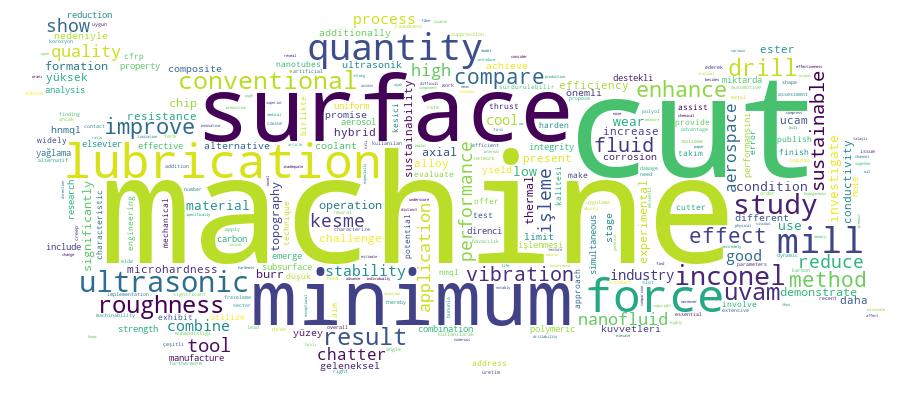
GCRIS Competency Cloud

Scholarly Output Search Results

Now showing 1 - 5 of 5
  • Conference Object
    Citation - WoS: 5
    Citation - Scopus: 6
    Investigation of the Effects of Axial Ultrasonic Vibrations on Chatter Stability in Milling with Bull Nose Cutters
    (Elsevier Science BV, 2023) Namlu, Ramazan Hakki; Kilic, Zekai Murat; Lorain, Raphael; Kilic, Sadik Engin
    Ultrasonic vibrations-assisted machining has positive effects on the chatter stability and surface integrity of the process. Radial vibration-assisted milling is effective but it needs an advanced control of vibration trajectory hence is not easy to implement. The aim of this paper is to investigate the effects of axial ultrasonic vibrations on stability through disturbing the chip regeneration. A simple way of predicting the stability increase is proposed using missed-cut effect that reduces the effective number of teeth in cut. The axial vibrations are shown to introduce radial runout such that a regular cutter will show the characteristics of a serrated tool. For a 2-tooth bull nose cutter, the proposed method was verified by milling of Ti-6Al-4V material. The results showed that the axial ultrasonic vibrations increased limit axial depth of cut by more than 40%. Therefore, applying axial vibrations would be a simple solution to improve chatter resistance in machining difficult-to-cut materials while avoiding the cost and complexity of serrated rounded edges. The attention on using axial ultrasonic vibrations in milling is increasing, hence further research on modelling the machining dynamics combined with the velocity effects will be needed following this study. (c) 2023 The Authors. Published by Elsevier B.V. This is an open access article under the CC BY-NC-ND license (https://creativecommons.org/licenses/by-nc-nd/4.0)
  • Conference Object
    Effect of Tool Cavity Conditions on Damping, Chatter Mitigation, and Surface Quality in Internally Cooled Milling Tools
    (Elsevier B.V., 2025) Namlu, R.H.; Dogan, H.; Ozsoy, M.
    Chatter is a critical factor limiting productivity and efficiency in machining processes. Cutting tools significantly impact chatter stability, as they often serve as the most flexible component. The influence of cutting tools on chatter varies depending on their design and cooling mechanisms. Internally cooled cutting tools, commonly used in industrial applications, have the potential to exhibit distinct damping characteristics due to the presence of internal cavities, differentiating them from conventional solid tools. This study explores the effects of internally cooled milling cutting comparing an empty cavity cutting tool with a tool filled with viscous fluid. The primary objective is to evaluate how these conditions influence the damping of the machining system and their subsequent impact on surface quality, a key outcome sensitive to chatter. Surface topography and roughness measurements were taken after the experiments to assess changes in surface quality. The findings offer valuable insights into the role of internal cooling and fluid properties in not only chatter but also vibration suppressions in milling operations, highlighting their potential to enhance machining performance. © 2025 The Author(s).
  • Conference Object
    Citation - WoS: 20
    Citation - Scopus: 26
    An Experimental Study on Surface Quality of Al6061-T6 in Ultrasonic Vibration-Assisted Milling with Minimum Quantity Lubrication
    (Elsevier Science BV, 2022) Namlu, Ramazan Hakki; Yilmaz, Okan Deniz; Lotfisadigh, Bahram; Kilic, S. Engin
    Al6061-T6 is frequently used in the automotive and aerospace industries, where milling is an essential process, due to its high strength-to-weight ratio. In order to achieve improved surface quality in milling, Ultrasonic Vibration-Assisted Milling (UVAM) has been introduced recently. Besides, Minimum Quantity Lubrication (MQL) is another advanced method to enhance the surface properties of the cutting by improving the coolant performance. However, the effects of simultaneous implementation of UVAM and MQL methods has not yet been studied sufficiently. This paper investigates the effects of applying UVAM in tandem with MQL in cutting of Al6061-T6. The results showed that surface quality enhanced with this combination. (c) 2022 The Authors. Published by Elsevier B.V. This is an open access article under the CC BY-NC-ND license (https://creativecommons.org/licenses/by-nc-nd/4.0)
  • Conference Object
    Citation - WoS: 12
    Citation - Scopus: 12
    Multi-Axial Ultrasonic Vibration-Assisted Machining of Inconel 718 Using Al2O3-CuO Hybrid Nanofluid MQL
    (Elsevier Science BV, 2024) Namlu, Ramazan Hakki; Lotfi, Bahram; Kilic, Sadik Engin
    Inconel 718 is a widely used superalloy in the aerospace industry, owing to its exceptional creep and corrosion resistance, as well as its ability to retain strength at elevated temperatures. However, its machinability presents challenges due to its low thermal conductivity and high work hardening rate during conventional machining, resulting in inadequate surface quality. To address this issue, a recent technique known as Ultrasonic Vibration-Assisted Machining (UVAM) has emerged. UVAM involves applying high-frequency, low-amplitude vibrations to the cutting tool or workpiece. Additionally, Minimum Quantity Lubrication (MQL) has been considered as an alternative cooling technique to enhance machining performance. Optimizing the performance of UVAM can be achieved by employing various vibration axes. Additionally, the effectiveness of MQL can be enhanced through the utilization of nanofluids. This study investigates the combined application of multi-axis UVAM and Al2O3-CuO added Hybrid Nanofluid MQL (HNMQL) during the milling of Inconel 718. The evaluation parameters include surface roughness, topography, burr formations, and cutting forces. The results demonstrate that the simultaneous use of multi-axis UVAM and HNMQL significantly improves the machining performance of Inconel 718. This combination leads to better surface quality and overall process efficiency, offering promising prospects for the aerospace industry and other applications involving difficult-to-cut materials. (c) 2024 The Authors. Published by Elsevier B.V.
  • Conference Object
    Citation - Scopus: 2
    Enhancing Sustainable Machining of Inconel 718 Using Multi-Walled Carbon Nanotubes and TiO2based Nanofluid Minimum Quantity Lubrication
    (Elsevier B.V., 2025) Namlu, Ramazan Hakkı; Kaftanoĝlu, Bılgın
    Inconel 718 is extensively utilized especially in the aerospace sector due to its outstanding resistance to creep and corrosion, along with its capability to maintain strength at high temperatures. However, its high work hardening rate and low thermal conductivity present significant challenges in machining processes, including the need for extensive use of coolants, shortened tool life, and the necessity for post-processing operations for adequate surface quality, all of which hinder sustainable manufacturing. To address these issues, an innovative cooling/lubrication method, Nanofluid Minimum Quantity Lubrication (NMQL), aims to enhance the sustainable machining of Inconel 718 by minimizing these problems. NMQL involves the aerosolized delivery of nanoparticle-enriched nanofluid oil with compressed air to the cutting zone. In this way, NMQL utilizes the nanoparticles' cooling and lubrication abilities, resulting in lower cutting forces, reduced surface roughness, and decreased tool wear compared to other cooling/lubrication conditions, thereby improving machining performance. This study compares the performance of NMQL in terms of cutting forces, surface roughness and topography, and subsurface microhardness, using Multi-Walled Carbon Nanotubes (MWCNT) and TiO2nanoparticles, with Conventional Cutting Fluids (CCF), aiming to achieve more sustainable machining of Inconel 718. Also, a sustainability assessment was done using Pugh Matrix Approach in order to find the most sustainable cooling option. © 2025 Elsevier B.V., All rights reserved.