Ekinci, Mehmet Fatih

Loading...
Profile Picture
Name Variants
Ekinci, Mehmet Fatih
Ekinci M.
Ekinci,M.F.
Mehmet Fatih Ekinci
M.,Ekinci
M. F. Ekinci
E.,Mehmet Fatih
E., Mehmet Fatih
Ekinci,Mehmet Fatih
M.F.Ekinci
M., Ekinci
Mehmet Fatih, Ekinci
Ekinci, M. Fatih
Job Title
Doçent Doktor
Email Address
fatih.ekinci@atilim.edu.tr
Main Affiliation
Economics
Status
Scopus Author ID
Turkish CoHE Profile ID
Google Scholar ID
WoS Researcher ID

Sustainable Development Goals

1

NO POVERTY
NO POVERTY Logo

1

Research Products

8

DECENT WORK AND ECONOMIC GROWTH
DECENT WORK AND ECONOMIC GROWTH Logo

1

Research Products

9

INDUSTRY, INNOVATION AND INFRASTRUCTURE
INDUSTRY, INNOVATION AND INFRASTRUCTURE Logo

1

Research Products

10

REDUCED INEQUALITIES
REDUCED INEQUALITIES Logo

4

Research Products

11

SUSTAINABLE CITIES AND COMMUNITIES
SUSTAINABLE CITIES AND COMMUNITIES Logo

1

Research Products

14

LIFE BELOW WATER
LIFE BELOW WATER Logo

1

Research Products

17

PARTNERSHIPS FOR THE GOALS
PARTNERSHIPS FOR THE GOALS Logo

3

Research Products
Documents

11

Citations

38

h-index

3

Documents

10

Citations

46

Scholarly Output

14

Articles

6

Views / Downloads

86/621

Supervised MSc Theses

5

Supervised PhD Theses

0

WoS Citation Count

12

Scopus Citation Count

15

WoS h-index

2

Scopus h-index

2

Patents

0

Projects

1

WoS Citations per Publication

0.86

Scopus Citations per Publication

1.07

Open Access Source

4

Supervised Theses

5

Google Analytics Visitor Traffic

JournalCount
Applied Economics1
Applied Operations Research and Ficial Modelling in Energy: Practical Applications and Implications1
Business and Economics Research Journal1
Economic Analysis and Policy1
Economic Growth and Ficial Development: Effects of Capital Flight in Emerging Economies1
Current Page: 1 / 2

Scopus Quartile Distribution

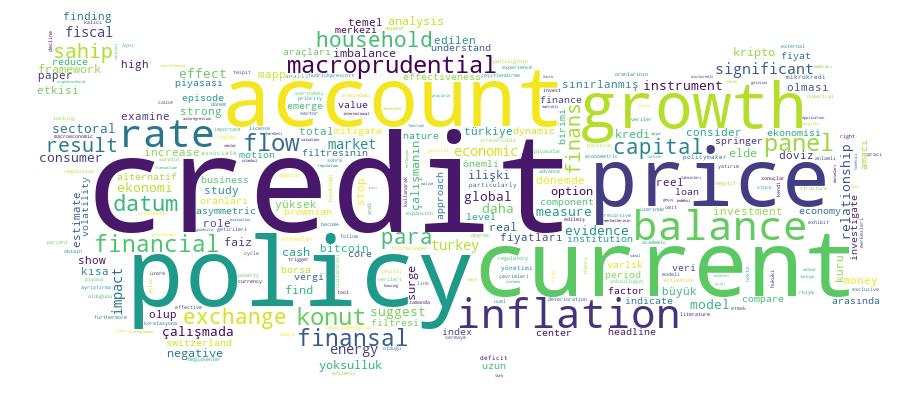
Competency Cloud

GCRIS Competency Cloud

Scholarly Output Search Results

Now showing 1 - 5 of 5
  • Article
    Oil Price Pass-Through on Sector-Level Prices: Evidence From Turkey
    (2023) Ekinci, Mehmet Fatih; Saygılı, Hülya
    As energy dependency is one of the main drivers of rising global inflation, understanding the sectoral outlook for the effects of oil prices on inflation is crucial. This paper investigates oil price pass-through to consumer prices in Turkey utilizing a Phillips Curve estimation approach. Extending the results in the literature, we estimate Brent crude petroleum price pass-through coefficients for the 2-digit sectoral components of the consumer price index. Then, we compare the sector-level pass-through rates to the ones obtained from the headline and core inflation. We also apply a recursive estimation modeling to track pass-through behavior over time for each inflation series. The paper has several conclusions. First, the long-run oil price pass-through to headline inflation is around 7%. Second, pass-through to the core and sectoral inflation rates exhibit a significant amount of variation from headline inflation. Results with core inflation rates depend on whether energy prices are included or excluded from the consumer basket. Third, the sectoral pass-through rate depends on the weight of the energy-related items in that sector. Our findings suggest that the transport sector has the highest degree of pass-through. Fourth, the rate of pass-through to all prices increases following the hikes in inflation rates in September 2018 and October 2021.
  • Article
    Citation - WoS: 8
    Citation - Scopus: 10
    Current Account and Credit Growth: the Role of Household Credit and Financial Depth
    (Elsevier Science inc, 2020) Ekinci, Mehmet Fatih; Ekinci, Mehmet Fatih; Omay, Tolga; Omay, Tolga; Ekinci, Mehmet Fatih; Omay, Tolga; Economics; Economics
    Understanding the impact of financial variables on the current account balance is one of the priorities of academic literature and policymakers. Evidence from a broad panel of advanced and emerging countries shows that an increase in credit growth is associated with a significant deterioration in the current account balance. When we examine the roles of the components of credit, we find that an increase in household credit causes a significant decline in the current account balance, whereas an increase in business loans has no significant effect. Therefore, our findings indicate that the significant negative impact of credit growth on the current account balance is driven by household credit. Furthermore, we show that total and household credit growth rates have a stronger negative effect on the current account balance for lower levels of financial depth. Our results suggest that targeted policy measures that curb household credit growth might be more effective to reduce external imbalances particularly at the early stages of financial deepening.
  • Article
    Fiscal Policy and Long-Run Inflation Dynamics: Evidence From a Major Emerging Market Economy
    (Routledge Journals, Taylor & Francis Ltd, 2025) Ekinci, Mehmet Fatih; Saygili, Huelya; Yilmaz, Hakki Hakan
    This study examines the long-run aspects of fiscal policy on inflation in T & uuml;rkiye, using a multivariate co-integration approach with quarterly data from 2006Q1 to 2024Q2. A key contribution of the study lies in its emphasis on the long-run dynamics between various budgetary policy instruments and inflation. We find no significant long-run relationship between inflation and fiscal policy measured at the aggregate level such as budget balance, total expenditures, and revenues. However, examining the specific components, we find statistically significant long-run positive relationships between inflation and indirect taxes - particularly the special consumption tax - and operational government expenditures. Recursive estimates suggest that the relationship between inflation and fiscal instruments has strengthened since 2021 when T & uuml;rkiye started to experience a high inflation episode diverging from global inflation trends with a deterioration in public finance performance. These findings align with the fiscal theory of price level, as the theory implies that persistent fiscal deficits without credible plans for future surpluses can lead to sustained inflationary pressures.
  • Article
    Citation - WoS: 3
    Citation - Scopus: 3
    Macroprudential Policies and Current Account Balance
    (Elsevier, 2022) Ozcan, Guelserim; Ekinci, Mehmet Fatih
    Macroprudential policies have become essential tools for policymakers to maintain financial stability. We investigate the impact of macroprudential policies on the current account balance, considering the link between external imbalances and financial stability. Building on a panel VAR model, we further document that usage of a macroprudential instrument is associated with an improvement in the current account balance. Our findings suggest that the positive impact of macroprudential policy measures on the current account balance is more substantial in the deficit countries. (c) 2022 Economic Society of Australia, Queensland. Published by Elsevier B.V. All rights reserved.
  • Article
    Citation - WoS: 1
    Citation - Scopus: 1
    Effectiveness of Macroprudential Policies on Credit Surge and Stop Episodes
    (Springer, 2024) Ekinci, Mehmet Fatih; Kenc, Turalay; Tezcan, Unay Tamgac
    When faced with capital flow and credit growth waves in recent years, policymakers have relied upon macroprudential regulation. This paper sheds light on a relatively less-analyzed policy issue: how macroprudential regulatory measures mitigate extreme credit growth episodes. We use a dynamic panel data approach to estimate the impact of MaPPs on credit growth volatility and the likelihood of credit growth boom and bust episodes. We find that MaPPs reduce credit growth volatility in both advanced economies (AEs) and emerging market economies (EMEs). In addition, MaPPs help to prevent credit surges in EMEs and stops in AEs. Our results show that there is a strong link between net capital flows and credit growth stop episodes. Net capital flow surges trigger a credit surge for EMEs. This suggests that policymakers should consider both MaPPs and capital flow management measures when designing policies to mitigate the risks associated with these phenomena.