Şaşmazel, Hilal Türkoğlu

Loading...
Profile Picture
Name Variants
S.,Hilal Turkoglu
Sasmazel, Hilal Tuerkoglu
Sasmazel, Hilal Turkoglu
H. T. Şaşmazel
Turkoglu Sasmazel H.
Sasmazel,H.T.
Şaşmazel,H.T.
Hilal Türkoğlu, Şaşmazel
H., Sasmazel
Şasmazel H.
S., Hilal Turkoglu
Ş.,Hilal Türkoğlu
Ş., Hilal Türkoğlu
Turkoğlu Şaşmazel H.
Hilal Turkoglu, Sasmazel
H.T.Sasmazel
H.T.Şaşmazel
Sasmazel H.
Sasmazel, H. T.
Türkoglu, H
Turkoglu, Hilal
Sasmazel, H. Turkoglu
Sasmazel, Hilal T.
H. T. Sasmazel
Şaşmazel, Hilal Türkoğlu
H.,Şaşmazel
Şaşmazel H.
Sasmazel, H. Tuerkodlu
Türkoǧlu Şaşmazel,H.
Şaşmazel, Hilal
Job Title
Profesor Doktor
Email Address
hilal.sasmazel@atilim.edu.tr
Main Affiliation
Metallurgical and Materials Engineering
Status
Website
Scopus Author ID
Turkish CoHE Profile ID
Google Scholar ID
WoS Researcher ID

Sustainable Development Goals

14

LIFE BELOW WATER
LIFE BELOW WATER Logo

1

Research Products

2

ZERO HUNGER
ZERO HUNGER Logo

0

Research Products

11

SUSTAINABLE CITIES AND COMMUNITIES
SUSTAINABLE CITIES AND COMMUNITIES Logo

0

Research Products

1

NO POVERTY
NO POVERTY Logo

0

Research Products

12

RESPONSIBLE CONSUMPTION AND PRODUCTION
RESPONSIBLE CONSUMPTION AND PRODUCTION Logo

0

Research Products

7

AFFORDABLE AND CLEAN ENERGY
AFFORDABLE AND CLEAN ENERGY Logo

0

Research Products

5

GENDER EQUALITY
GENDER EQUALITY Logo

0

Research Products

3

GOOD HEALTH AND WELL-BEING
GOOD HEALTH AND WELL-BEING Logo

27

Research Products

9

INDUSTRY, INNOVATION AND INFRASTRUCTURE
INDUSTRY, INNOVATION AND INFRASTRUCTURE Logo

0

Research Products

13

CLIMATE ACTION
CLIMATE ACTION Logo

0

Research Products

6

CLEAN WATER AND SANITATION
CLEAN WATER AND SANITATION Logo

1

Research Products

10

REDUCED INEQUALITIES
REDUCED INEQUALITIES Logo

0

Research Products

4

QUALITY EDUCATION
QUALITY EDUCATION Logo

0

Research Products

15

LIFE ON LAND
LIFE ON LAND Logo

0

Research Products

16

PEACE, JUSTICE AND STRONG INSTITUTIONS
PEACE, JUSTICE AND STRONG INSTITUTIONS Logo

0

Research Products

17

PARTNERSHIPS FOR THE GOALS
PARTNERSHIPS FOR THE GOALS Logo

0

Research Products

8

DECENT WORK AND ECONOMIC GROWTH
DECENT WORK AND ECONOMIC GROWTH Logo

0

Research Products
Documents

45

Citations

1391

h-index

20

Documents

50

Citations

1279

Scholarly Output

55

Articles

38

Views / Downloads

9/0

Supervised MSc Theses

10

Supervised PhD Theses

0

WoS Citation Count

971

Scopus Citation Count

1024

WoS h-index

18

Scopus h-index

18

Patents

0

Projects

0

WoS Citations per Publication

17.65

Scopus Citations per Publication

18.62

Open Access Source

11

Supervised Theses

10

Google Analytics Visitor Traffic

JournalCount
Journal of Nanoscience and Nanotechnology4
Bio-Medical Materials and Engineering3
International Journal of Biological Macromolecules2
Molecules2
Nanomaterials2
Current Page: 1 / 7

Scopus Quartile Distribution

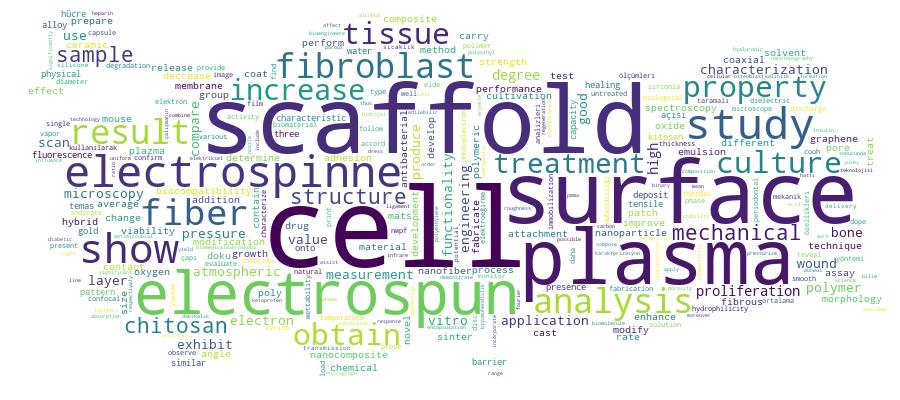
Competency Cloud

GCRIS Competency Cloud

Scholarly Output Search Results

Now showing 1 - 3 of 3
  • Article
    Citation - WoS: 37
    Citation - Scopus: 45
    Study on the Cytocompatibility, Mechanical and Antimicrobial Properties of 3d Printed Composite Scaffolds Based on Pva/ Gold Nanoparticles (aunp)/ Ampicillin (amp) for Bone Tissue Engineering
    (Elsevier, 2021) Topsakal, Aysenur; Midha, Swati; Yuca, Esra; Tukay, Ari; Sasmazel, Hilal Turkoglu; Kalaskar, Deepak M.; Gunduz, Oguzhan
    Over the years, gold nanoparticles (AuNP) have been widely used in several biomedical applications related to the diagnosis, drug delivery, bio-imaging, photo-thermal therapy and regenerative medicine, owing to their unique features such as surface plasmon resonance, fluorescence and easy surface functionality. Recent studies showed that gold nanoparticles display positive effect on osteogenic differentiation. In line with this effect, 3-Dimesional (3D) scaffolds that can be used in bone tissue were produced by exploiting the properties of gold nanoparticles that increase biocompatibility and support bone tissue development. In addition, ampicillin was added to the scaffolds containing gold nanoparticles as a model drug to improve its antimicrobial properties. The scaffolds were produced as composites of polyvinyl alcohol (PVA) main matrix as PVA, PVA/AuNP, PVA/Ampicillin (AMP) and PVA/AuNP/AMP. Scanning Electron Microscopy (SEM) Fourier Transform Infrared Spectroscopy (FTIR), tensile measurement tests, and in vitro applications of 3D scaffolds were performed. As depicted by SEM, scaffolds were produced at pore sizes appropriate for bone tissue regeneration. According to FTIR results, there was no modification observed in the AMP, PVA and gold nanoparticles due to mixing in the resultant scaffolds. In vitro results show that 3D printed composite scaffold based on PVA/AuNP/AMP are biocompatible, osteo-inductive and exhibit antimicrobial properties, compared to PVA scaffolds. This study has implications for addressing infections during orthopedic surgeries. The PVA-based gold nanoparticle 3D tissue scaffold study containing ampicillin covers a new study compared to other articles based on gold nanoparticles.
  • Article
    Citation - WoS: 3
    Citation - Scopus: 3
    Physical and Biological Characteristics of Electrospun Poly (vinyl Alcohol) and Reduced Graphene Oxide Nanofibrous Structure
    (Taylor & Francis Ltd, 2024) Sasmazel, Hilal Turkoglu; Alazzawi, Marwa; Gozutok, Melike; Sadhu, Veera
    The fabrication of graphene-based nanocomposites has been a topic of increasing interest due to graphene's exceptional physical properties and the ability to enhance the properties of various polymeric materials. Evaluating the biocompatibility of these nanocomposites is crucial to ensure their safe and effective use in biomedical applications. This study characterized and assessed the biocompatibility of previously fabricated electrospun polyvinyl alcohol (PVA)/reduced graphene oxide rGO fibrous structures by conducting a comprehensive assessment of their physical and biological characteristics. Contact angle measurements revealed that adding rGO to electrospun PVA fibers enhanced the surface wettability, improving the fibrous structure's PBS absorption capacity and degradation behavior. Including the rGO content resulted in a higher water vapor transmission rate, reaching similar to 48 g/m2day for PVA + 0.5 wt.% rGO and similar to 45 g/m2day for PVA + 1.0 wt.% rGO, compared to similar to 40 g/m2day for electrospun PVA fibers. Cell culture studies, including MTT assay, alkaline phosphatase (ALP) activity analysis, alizarin red staining, fluorescence microscopy, and SEM analyses, demonstrated that electrospun PVA + 1.0 wt.% rGO nanocomposites exhibited superior cell viability, proliferation, and growth compared to other samples, due to the improved physical properties of the PVA + 1.0 wt.% rGO fibrous structure.
  • Article
    Development of Electrospun We43 Magnesium Alloy-Like Compound
    (Amer Scientific Publishers, 2020) Ozkan, Ozan; Sasmazel, Hilal Turkoglu; Biskin, Erhan
    Metallic structures are conventionally fabricated with high temperature/deformation processes resulting the smallest possible microscopic structures in the order of several hundreds of micrometer. Therefore, to obtain structures with fibers smaller than 100 Am, those are unsuitable. In this study, electrospinning, a fiber fabrication technique commonly used for polymers, was adopted to fabricate a WE43 magnesium alloy-like fibrous structure. The aim is to adopt metallic WE43 alloy to regenerative medicine using tissue engineering approach by mimicking its composition inside of a fibrous structure. The solution required for electrospinning was obtained with water soluble nitrates of elements in WE43 alloy, and PVP or PVA were added to obtain a spinnable viscosity which was pyrolised away during heat treatment. Electrospinning parameters were optimized with naked-eye observations and SEM as 1.5 g salts and 5 wt.% PVA containing solution prepared at 90 degrees C and electrospun under 30 kV from a distance of 12-15 cm with a feeding rate of 5 mu l/min. Then the samples were subjected to a multi-step heat treatment under argon to remove the polymer and calcinate the nitrates into oxides which was designed based on thermal analyses and reaction kinetics calculations as 6 h at 230 degrees C, 8.5 h at 390 degrees C, 5 h at 465 degrees C, 80 h at 500 degrees C and 10 h at 505 degrees C, consecutively. The characterizations conducted in terms of structure, composition and crystallinity with XRD, XPS, EDX and SEM showed that it is possible to obtain MgaYbNdcZrdOx), (empirical) fibers with the same composition as WE43 in sub-millimeter sizes using this approach.