Şaşmazel, Hilal Türkoğlu

Loading...
Profile Picture
Name Variants
S.,Hilal Turkoglu
Sasmazel, Hilal Tuerkoglu
Sasmazel, Hilal Turkoglu
H. T. Şaşmazel
Turkoglu Sasmazel H.
Sasmazel,H.T.
Şaşmazel,H.T.
Hilal Türkoğlu, Şaşmazel
H., Sasmazel
Şasmazel H.
S., Hilal Turkoglu
Ş.,Hilal Türkoğlu
Ş., Hilal Türkoğlu
Turkoğlu Şaşmazel H.
Hilal Turkoglu, Sasmazel
H.T.Sasmazel
H.T.Şaşmazel
Sasmazel H.
Sasmazel, H. T.
Türkoglu, H
Turkoglu, Hilal
Sasmazel, H. Turkoglu
Sasmazel, Hilal T.
H. T. Sasmazel
Şaşmazel, Hilal Türkoğlu
H.,Şaşmazel
Şaşmazel H.
Sasmazel, H. Tuerkodlu
Türkoǧlu Şaşmazel,H.
Şaşmazel, Hilal
Job Title
Profesor Doktor
Email Address
hilal.sasmazel@atilim.edu.tr
Main Affiliation
Metallurgical and Materials Engineering
Status
Website
Scopus Author ID
Turkish CoHE Profile ID
Google Scholar ID
WoS Researcher ID

Sustainable Development Goals

14

LIFE BELOW WATER
LIFE BELOW WATER Logo

1

Research Products

2

ZERO HUNGER
ZERO HUNGER Logo

0

Research Products

11

SUSTAINABLE CITIES AND COMMUNITIES
SUSTAINABLE CITIES AND COMMUNITIES Logo

0

Research Products

1

NO POVERTY
NO POVERTY Logo

0

Research Products

12

RESPONSIBLE CONSUMPTION AND PRODUCTION
RESPONSIBLE CONSUMPTION AND PRODUCTION Logo

0

Research Products

7

AFFORDABLE AND CLEAN ENERGY
AFFORDABLE AND CLEAN ENERGY Logo

0

Research Products

5

GENDER EQUALITY
GENDER EQUALITY Logo

0

Research Products

3

GOOD HEALTH AND WELL-BEING
GOOD HEALTH AND WELL-BEING Logo

27

Research Products

9

INDUSTRY, INNOVATION AND INFRASTRUCTURE
INDUSTRY, INNOVATION AND INFRASTRUCTURE Logo

0

Research Products

13

CLIMATE ACTION
CLIMATE ACTION Logo

0

Research Products

6

CLEAN WATER AND SANITATION
CLEAN WATER AND SANITATION Logo

1

Research Products

10

REDUCED INEQUALITIES
REDUCED INEQUALITIES Logo

0

Research Products

4

QUALITY EDUCATION
QUALITY EDUCATION Logo

0

Research Products

15

LIFE ON LAND
LIFE ON LAND Logo

0

Research Products

16

PEACE, JUSTICE AND STRONG INSTITUTIONS
PEACE, JUSTICE AND STRONG INSTITUTIONS Logo

0

Research Products

17

PARTNERSHIPS FOR THE GOALS
PARTNERSHIPS FOR THE GOALS Logo

0

Research Products

8

DECENT WORK AND ECONOMIC GROWTH
DECENT WORK AND ECONOMIC GROWTH Logo

0

Research Products
Documents

45

Citations

1389

h-index

20

Documents

50

Citations

1279

Scholarly Output

55

Articles

38

Views / Downloads

9/0

Supervised MSc Theses

10

Supervised PhD Theses

0

WoS Citation Count

971

Scopus Citation Count

1024

WoS h-index

18

Scopus h-index

18

Patents

0

Projects

0

WoS Citations per Publication

17.65

Scopus Citations per Publication

18.62

Open Access Source

11

Supervised Theses

10

Google Analytics Visitor Traffic

JournalCount
Journal of Nanoscience and Nanotechnology4
Bio-Medical Materials and Engineering3
International Journal of Biological Macromolecules2
Molecules2
Nanomaterials2
Current Page: 1 / 7

Scopus Quartile Distribution

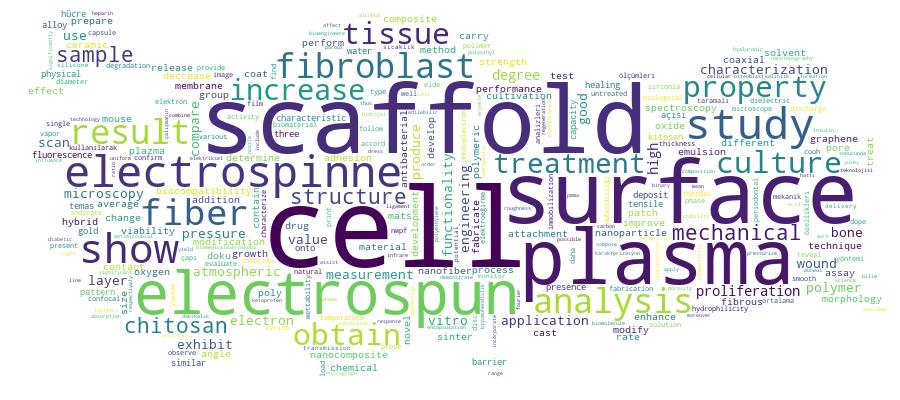
Competency Cloud

GCRIS Competency Cloud

Scholarly Output Search Results

Now showing 1 - 3 of 3
  • Article
    Citation - WoS: 23
    Citation - Scopus: 25
    Comparison of Cellular Proliferation on Dense and Porous Pcl Scaffolds
    (Ios Press, 2008) Sasmazel, Hilal Tuerkoglu; Gumusderelioglu, Menemse; Gurpinar, Aylin; Onur, Mehmet Ali
    In this contribution, PCL (poly-e caprolactone) scaffolds were prepared by solvent-casting/particle-leaching technique in the presence of two pore formers, PEG(4000) or sucrose molecules in different quantities (0, 10, 20, 30, 40, 50, 55 w/w% PEG(4000)/PCL; 10, 20 w/w% Sucrose/ PCL). The surface and bulk properties of the resulting scaffolds were studied by SEM, DSC and FTIR. SEM photographs showed that, macroporosity was obtained in the PCL structures prepared with sucrose crystals while microporous structure was obtained in the presence of PEG(4000) molecules. Average pore diameters calculated from SEM photographs were 40.1 and 191.2 mu m for 40% PEG(4000)/PCL and 10% Sucrose/PCL scaffolds, respectively. The DSC and FTIR results confirmed that there is no any interaction between pore formers and PCL during structural formation, and both pore formers, PEG(4000) and sucrose, remained independently in the scaffolds. L929 mouse fibroblast cells were seeded onto PCL structures and maintained during 7 days to evaluate cell proliferation. Cell culture results showed that, 10% Sucrose/ PCL scaffold was the most promising substrate for L929 cell growth due to 3-D architecture and macroporous structure of the scaffold.
  • Correction
    Influence of Water/O2 Plasma Treatment on Cellular Responses of Pcl and Pet Surfaces (vol 21, Pg 123, 2011)
    (Ios Press, 2011) Sasmazel, Hilal Turkoglu; Aday, Sezin; Manolache, Sorin; Gumusderelioglu, Menemse
    [No Abstract Available]
  • Article
    Citation - WoS: 10
    Citation - Scopus: 11
    Functionalization of Nonwoven Pet Fabrics by Water/O2< Plasma for Biomolecule Mediated Cell Cultivation
    (Wiley-v C H verlag Gmbh, 2010) Sasmazel, Hilal Turkoglu; Manolache, Sorin; Gumusderelioglu, Menemse
    The main target of this study was to obtain COOH functionalities on the surface of 3D, nonwoven polyethylene terephthalate fabrics (NWPFs) by using low pressure water/O-2 plasma assisted treatment. The plasma treatments were performed in a cylindrical, capacitively coupled RF-plasma-reactor and then following steps were performed: in situ (oxalyl chloride vapors) gas/solid reaction to convert -OH functionalities into COCl groups; and hydrolysis under open laboratory conditions using air moisture for final-COOH functionalities. COOH and OH functionalities on the surfaces were detected quantitatively by fluorescent labeling techniques. The COOH-functionalized samples were biologically activated with insulin or heparin molecules by using spacer polyoxyethylene bis-amine (PEO). Successful immobilization was checked qualitatively using electron spectroscopy for chemical analysis (ESCA). The average amount of immobilized insulin and heparin onto NWPF surfaces were determined as 146.09 and 4.81 nmol.cm(-2), respectively. Our results showed that water/O-2 plasma assisted treatment worked very well for functionalization and biofunctionalization of 3D NWPF disks comparing with wet-chemistry methods. Cell culture experiments indicated that functionalization of NWPF disks and/or nanotopographies on the disk surfaces were effective on adhesion and proliferation of L929 mouse fibroblasts.