
Tank, Fatih
Loading...
Profile URL
Name Variants
Tank, Fatih
T., Fatih
T., F.
Tank, F.
F. Tank
Fatih Tank
T., Fatih
T., F.
Tank, F.
F. Tank
Fatih Tank
Job Title
Profesör Doktor
Email Address
fatih.tank@atilim.edu.tr
Main Affiliation
Status
Current Staff
Website
ORCID ID
Scopus Author ID
Turkish CoHE Profile ID
Google Scholar ID
WoS Researcher ID
Sustainable Development Goals
 1
1NO POVERTY
0
Research Products
 2
2ZERO HUNGER
0
Research Products
 3
3GOOD HEALTH AND WELL-BEING
1
Research Products
 4
4QUALITY EDUCATION
0
Research Products
 5
5GENDER EQUALITY
0
Research Products
 6
6CLEAN WATER AND SANITATION
0
Research Products
 7
7AFFORDABLE AND CLEAN ENERGY
0
Research Products
 8
8DECENT WORK AND ECONOMIC GROWTH
0
Research Products
 9
9INDUSTRY, INNOVATION AND INFRASTRUCTURE
0
Research Products
 10
10REDUCED INEQUALITIES
0
Research Products
 11
11SUSTAINABLE CITIES AND COMMUNITIES
0
Research Products
 12
12RESPONSIBLE CONSUMPTION AND PRODUCTION
0
Research Products
 13
13CLIMATE ACTION
0
Research Products
 14
14LIFE BELOW WATER
0
Research Products
 15
15LIFE ON LAND
0
Research Products
 16
16PEACE, JUSTICE AND STRONG INSTITUTIONS
0
Research Products
 17
17PARTNERSHIPS FOR THE GOALS
0
Research Products

Documents
23
Citations
173
h-index
7

Documents
22
Citations
136

Scholarly Output
8
Articles
7
Views / Downloads
37/0
Supervised MSc Theses
0
Supervised PhD Theses
0
WoS Citation Count
72
Scopus Citation Count
88
Patents
0
Projects
0
WoS Citations per Publication
9.00
Scopus Citations per Publication
11.00
Open Access Source
1
Supervised Theses
0
| Journal | Count |
|---|---|
| Journal of Computational and Applied Mathematics | 2 |
| Insurance: Mathematics and Economics | 1 |
| Japanese Journal of Statistics and Data Science | 1 |
| Applied Mathematics and Computation | 1 |
| Statistical Papers | 1 |
Current Page: 1 / 2
Scopus Quartile Distribution
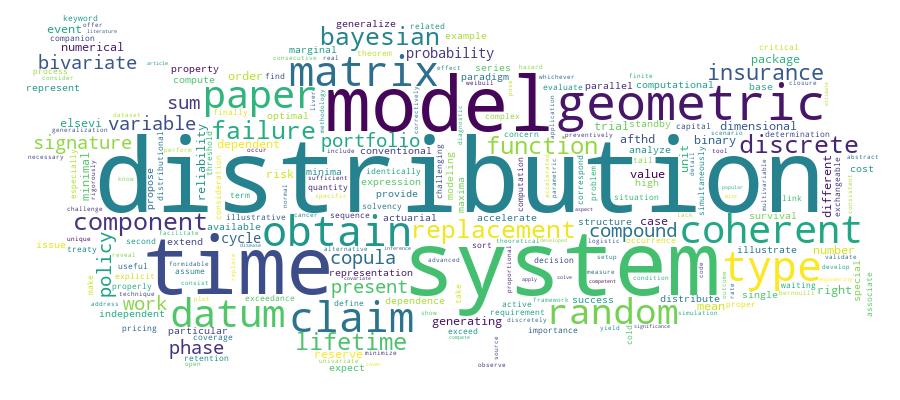
Competency Cloud
8 results
Scholarly Output Search Results
Now showing 1 - 8 of 8
Article Citation - WoS: 27Citation - Scopus: 30The Distributions of Sum, Minima and Maxima of Generalized Geometric Random Variables(Springer, 2015) Tank, Fatih; Eryilmaz, SerkanGeometric distribution of order as one of the generalization of well known geometric distribution is the distribution of the number of trials until the first consecutive successes in Bernoulli trials with success probability . In this paper, it is shown that this generalized distribution can be represented as a discrete phase-type distribution. Using this representation along with closure properties of phase-type distributions, the distributions of sum, minima and maxima of two independent random variables having geometric distribution of order are obtained. Numerical results are presented to illustrate the computational details.Article Citation - WoS: 11Citation - Scopus: 10Modeling of Claim Exceedances Over Random Thresholds for Related Insurance Portfolios(Elsevier, 2011) Eryilmaz, Serkan; Gebizlioglu, Omer L.; Tank, FatihLarge claims in an actuarial risk process are of special importance for the actuarial decision making about several issues like pricing of risks, determination of retention treaties and capital requirements for solvency. This paper presents a model about claim occurrences in an insurance portfolio that exceed the largest claim of another portfolio providing the same sort of insurance coverages. Two cases are taken into consideration: independent and identically distributed claims and exchangeable dependent claims in each of the portfolios. Copulas are used to model the dependence situations. Several theorems and examples are presented for the distributional properties and expected values of the critical quantities under concern. (C) 2011 Elsevier B.V. All rights reserved.Article Citation - WoS: 1Citation - Scopus: 2On Bivariate Compound Sums(Elsevier, 2020) Tank, Fatih; Eryilmaz, SerkanThe study of compound sums have always been very popular in the literature. Many models in insurance and engineering have been represented and solved by compound sums. In this paper, two different bivariate compound sums are proposed and studied. The phase-type distribution is applied to obtain the probability generating function of the bivariate sum. (C) 2019 Elsevier B.V. All rights reserved.Article Citation - WoS: 21Citation - Scopus: 29On Reliability Analysis of a Two-Dependent Series System With a Standby Unit(Elsevier Science inc, 2012) Eryilmaz, Serkan; Tank, FatihIn this paper we study a series system with two active components and a single cold standby unit. The two simultaneously working components are assumed to be dependent and this dependence is modeled by a copula function. In particular, we obtain an explicit expression for the mean time to failure of the system in terms of the copula function and marginal lifetime distributions. We also provide illustrative numerical results for different copula functions and marginal lifetime distributions. (c) 2012 Elsevier Inc. All rights reserved.Article Citation - WoS: 1Citation - Scopus: 2Computing Minimal Signature of Coherent Systems Through Matrix-Geometric Distributions(Cambridge Univ Press, 2021) Eryilmaz, Serkan; Eryılmaz, Serkan; Tank, Fatih; Eryılmaz, Serkan; Industrial Engineering; Industrial EngineeringSignatures are useful in analyzing and evaluating coherent systems. However, their computation is a challenging problem, especially for complex coherent structures. In most cases the reliability of a binary coherent system can be linked to a tail probability associated with a properly defined waiting time random variable in a sequence of binary trials. In this paper we present a method for computing the minimal signature of a binary coherent system. Our method is based on matrix-geometric distributions. First, a proper matrix-geometric random variable corresponding to the system structure is found. Second, its probability generating function is obtained. Finally, the companion representation for the distribution of matrix-geometric distribution is used to obtain a matrix-based expression for the minimal signature of the coherent system. The results are also extended to a system with two types of components.Article Citation - WoS: 11Citation - Scopus: 15Optimal Age Replacement Policy for Discrete Time Parallel Systems(Springer, 2023) Eryilmaz, Serkan; Tank, FatihIn the case of discrete age replacement policy, a system whose lifetime is measured by the number cycles is replaced preventively after a specific number of cycles or correctively at failure, whichever occurs first. Under the discrete setup, the policy has been mostly considered for single unit systems. In this paper, a discrete time age replacement policy is studied for a parallel system that consists of components having discretely distributed lifetimes. In particular, the necessary conditions for the unique and finite replacement cycle that minimize the expected cost rate are obtained. The theoretical results are illustrated with numerical examples to observe the effect of the cost values and the mean lifetime of the components on the optimal replacement cycle.Editorial Special Issue: Computational Methods in System Reliability(Elsevier B.V., 2024) Tank F., Professor,; Eryilmaz S., Professor,; Tank, Fatih; Eryilmaz, Serkan[No abstract available]Article Afthd: Bayesian Accelerated Failure Time Model for High-Dimensional Time-To Data(Springernature, 2025) Kumari, Pragya; Bhattacharjee, Atanu; Vishwakarma, Gajendra K.; Tank, FatihAnalyzing high-dimensional (HD) data with time-to-event outcomes poses a formidable challenge. The accelerated failure time (AFT) model, an alternative to the Cox proportional hazard model in survival analysis, lacks sufficient R packages for HD time-to-event data under the Bayesian paradigm. To address this gap, we develop the R package afthd. This tool facilitates advanced AFT modeling, offering Bayesian analysis for univariate and multivariable scenarios. This work includes diagnostic plots and an open-source R code for working with HD data, extending the conventional AFT model to the Bayesian framework of log-normal, Weibull, and log-logistic AFT models. The methodology is rigorously validated through simulation techniques, yielding consistent results across parametric AFT models. The application part is also performed on two different real HD liver cancer datasets, which reveals the proposed method's significance by obtaining inferences for survival estimates for the disease. Our developed package afthd is competent in working with HD time-to-event data using the conventional AFT model along with the Bayesian paradigm. Other aspects, like missing values in covariates within HD data and competing risk analysis, are also covered in this article.
