Sait, Ferit

Loading...
Profile Picture
Name Variants
F.,Sait
F., Sait
Sait,F.
S., Ferit
Sait, Ferit
S.,Ferit
Ferit, Sait
Job Title
Doktor Öğretim Üyesi
Email Address
ferit.sait@atilim.edu.tr
Main Affiliation
Aerospace Engineering
Status
Former Staff
Website
ORCID ID
Scopus Author ID
Turkish CoHE Profile ID
Google Scholar ID
WoS Researcher ID

Sustainable Development Goals

SDG data is not available
This researcher does not have a Scopus ID.
This researcher does not have a WoS ID.
Scholarly Output

3

Articles

3

Views / Downloads

0/0

Supervised MSc Theses

0

Supervised PhD Theses

0

WoS Citation Count

28

Scopus Citation Count

30

WoS h-index

2

Scopus h-index

2

Patents

0

Projects

0

WoS Citations per Publication

9.33

Scopus Citations per Publication

10.00

Open Access Source

0

Supervised Theses

0

Google Analytics Visitor Traffic

JournalCount
Advances in Materials and Processing Technologies1
International Journal of Plasticity1
SSRN Electronic Journal1
Current Page: 1 / 1

Scopus Quartile Distribution

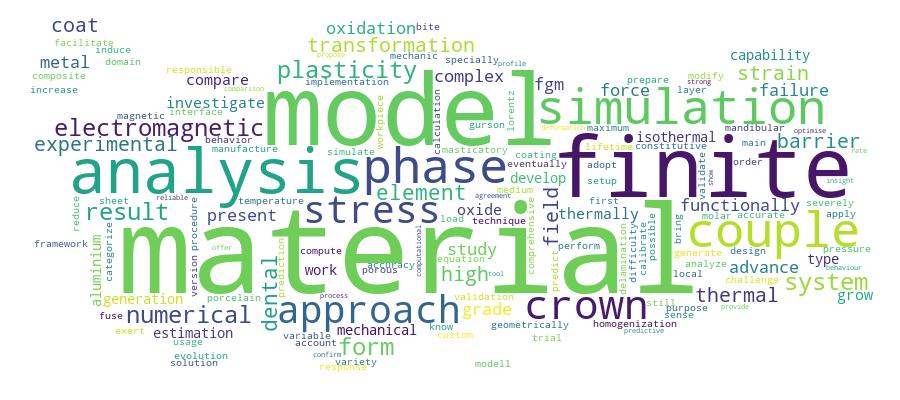
Competency Cloud

GCRIS Competency Cloud

Scholarly Output Search Results

Now showing 1 - 1 of 1
  • Article
    A Coupled Modelling and Simulation Approach to Electromagnetic Sheet Metal Forming
    (Taylor & Francis Ltd, 2025) Aslan, Ozgur; Kabakci, Gamze Cakir; Sait, Ferit; Camalan, Caner; Baranoglu, Besim; Bayraktar, Emin
    This study presents a coupled numerical and experimental investigation of electromagnetic forming (EMF) for aluminium sheets. A custom simulation framework is developed in ABAQUS/Standard using user-defined material (UMAT) and load (DLOAD) subroutines. The magnetic pressure exerted on the workpiece is computed through a finite difference-based solution of Maxwell's equations and applied to the mechanical solver. The mechanical response of the material is modelled using a strain-rate-sensitive plasticity law calibrated for aluminium 7075-O. Experimental forming trials are performed using a custom-built EMF setup, and the results are compared with numerical predictions to validate the model. The comparison shows strong agreement in deformation profiles, confirming the predictive capability of the proposed simulation strategy. This work offers a reliable computational tool for optimising EMF processes and provides insights into material behaviour under high strain rate electromagnetic loading.