Pekmen, Bengisen

Loading...
Profile Picture
Name Variants
Pekmen,B.
B., Pekmen
P.,Bengisen
Pekmen, Bengisen
B.,Pekmen
P., Bengisen
Bengisen, Pekmen
Pekmen, B.
Job Title
Araştırma Görevlisi
Email Address
Main Affiliation
Mathematics
Status
Former Staff
Website
ORCID ID
Scopus Author ID
Turkish CoHE Profile ID
Google Scholar ID
WoS Researcher ID

Sustainable Development Goals

SDG data is not available
This researcher does not have a Scopus ID.
This researcher does not have a WoS ID.
Scholarly Output

10

Articles

9

Views / Downloads

0/0

Supervised MSc Theses

0

Supervised PhD Theses

0

WoS Citation Count

127

Scopus Citation Count

148

WoS h-index

5

Scopus h-index

6

Patents

0

Projects

0

WoS Citations per Publication

12.70

Scopus Citations per Publication

14.80

Open Access Source

1

Supervised Theses

0

Google Analytics Visitor Traffic

JournalCount
International Journal of Heat and Mass Transfer2
CMES - Computer Modeling in Engineering and Sciences2
Lecture Notes in Computational Science and Engineering2
Journal of Applied Mathematics1
Computers & Fluids1
Current Page: 1 / 2

Scopus Quartile Distribution

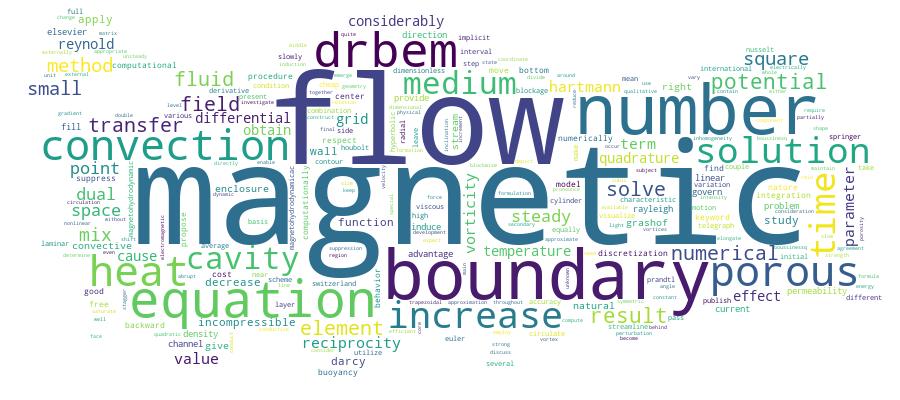
Competency Cloud

GCRIS Competency Cloud

Scholarly Output Search Results

Now showing 1 - 2 of 2
  • Article
    Citation - WoS: 12
    Citation - Scopus: 13
    Numerical Solution of Buoyancy Mhd Flow With Magnetic Potential
    (Pergamon-elsevier Science Ltd, 2014) Pekmen, B.; Tezer-Sezgin, M.
    In this study, dual reciprocity boundary element method (DRBEM) is applied for solving the unsteady flow of a viscous, incompressible, electrically conducting fluid in channels under the effect of an externally applied magnetic field and buoyancy force. Magnetohydrodynamics (MHD) equations are coupled with the energy equation due to the heat transfer by means of the Boussinessq approximation. Then, the 20 non-dimensional full MHD equations in terms of stream function, temperature, magnetic potential, current density and vorticity are solved by using DRBEM with implicit backward Euler time integration scheme. Numerical results are obtained utilizing linear boundary elements and linear radial basis functions approximation for the inhomogeneities, in a double lid-driven staggered cavity and in a channel with backward facing step. The results are given for several values of problem parameters as Reynolds number (Re), magnetic Reynolds number (Rem), Hartmann number (Ha) and Rayleigh number (Ra). With the increase in Rem, both magnetic potential and current density circulate near the abrupt changes of the walls. The increase in Ha suppresses this perturbation, and forces the magnetic potential lines to be in the direction of the applied magnetic field. The boundary layer formation through the walls emerge in the flow and current density for larger values of Ha. (C) 2013 Elsevier Ltd. All rights reserved.
  • Article
    Citation - WoS: 43
    Citation - Scopus: 48
    Mhd Flow and Heat Transfer in a Lid-Driven Porous Enclosure
    (Pergamon-elsevier Science Ltd, 2014) Pekmen, B.; Tezer-Sezgin, M.
    The mixed convection flow in a lid-driven square cavity filled with a porous medium under the effect of a magnetic field is studied numerically using the dual reciprocity boundary element method (DRBEM) with Houbolt time integration scheme. Induced magnetic field is also taken into consideration in terms of magnetic potential in solving magnetohydrodynamic (MHD) flow and temperature equations. Effects of the characteristic dimensionless parameters as Darcy (Da), Magnetic Reynolds (Rem), Grashof (Gr) and Hartmann (Ha) numbers, on the flow and heat transfer in the cavity are investigated at the final steady-state. It is found that the decrease in the permeability of porous medium and the increase in the intensity of the applied magnetic field cause the fluid to flow slowly. The convective heat transfer is reduced with an increase in Hartmann number. Magnetic potential circulates throughout the cavity with high magnetic permeability of the fluid. The combination of DRBEM with the Houbolt scheme has the advantage of using considerably small number of boundary elements and large time increments which results in small computational cost for solving the mixed convection MHD flow in a porous cavity. (C) 2013 Elsevier Ltd. All rights reserved.