Park, Jongee

Loading...
Profile Picture
Name Variants
Jongee Park
P.,Jongee
P., Jongee
J.,Park
Park J.
Park, Jongee
Park,J.
J., Park
Park,Jongee
Jongee, Park
Park, J
Job Title
Profesör Doktor
Email Address
jongee.park@atilim.edu.tr
Main Affiliation
Metallurgical and Materials Engineering
Status
Website
Scopus Author ID
Turkish CoHE Profile ID
Google Scholar ID
WoS Researcher ID

Sustainable Development Goals

2

ZERO HUNGER
ZERO HUNGER Logo

0

Research Products

14

LIFE BELOW WATER
LIFE BELOW WATER Logo

0

Research Products

17

PARTNERSHIPS FOR THE GOALS
PARTNERSHIPS FOR THE GOALS Logo

0

Research Products

5

GENDER EQUALITY
GENDER EQUALITY Logo

0

Research Products

16

PEACE, JUSTICE AND STRONG INSTITUTIONS
PEACE, JUSTICE AND STRONG INSTITUTIONS Logo

0

Research Products

8

DECENT WORK AND ECONOMIC GROWTH
DECENT WORK AND ECONOMIC GROWTH Logo

0

Research Products

4

QUALITY EDUCATION
QUALITY EDUCATION Logo

0

Research Products

6

CLEAN WATER AND SANITATION
CLEAN WATER AND SANITATION Logo

0

Research Products

7

AFFORDABLE AND CLEAN ENERGY
AFFORDABLE AND CLEAN ENERGY Logo

12

Research Products

10

REDUCED INEQUALITIES
REDUCED INEQUALITIES Logo

0

Research Products

11

SUSTAINABLE CITIES AND COMMUNITIES
SUSTAINABLE CITIES AND COMMUNITIES Logo

1

Research Products

9

INDUSTRY, INNOVATION AND INFRASTRUCTURE
INDUSTRY, INNOVATION AND INFRASTRUCTURE Logo

0

Research Products

1

NO POVERTY
NO POVERTY Logo

0

Research Products

3

GOOD HEALTH AND WELL-BEING
GOOD HEALTH AND WELL-BEING Logo

2

Research Products

12

RESPONSIBLE CONSUMPTION AND PRODUCTION
RESPONSIBLE CONSUMPTION AND PRODUCTION Logo

0

Research Products

13

CLIMATE ACTION
CLIMATE ACTION Logo

0

Research Products

15

LIFE ON LAND
LIFE ON LAND Logo

0

Research Products
Documents

53

Citations

927

h-index

19

Documents

50

Citations

891

Scholarly Output

57

Articles

45

Views / Downloads

21/0

Supervised MSc Theses

3

Supervised PhD Theses

0

WoS Citation Count

819

Scopus Citation Count

855

WoS h-index

19

Scopus h-index

19

Patents

0

Projects

1

WoS Citations per Publication

14.37

Scopus Citations per Publication

15.00

Open Access Source

7

Supervised Theses

3

Google Analytics Visitor Traffic

JournalCount
Ceramics International10
Journal of Nanoscience and Nanotechnology3
Applied Surface Science2
3rd International Conference on NANOCON -- SEP 21-23, 2011 -- Brno, CZECH REPUBLIC2
Advanced Materials Research -- 2012 International Conference on Advances in Materials Science and Engineering, AMSE 2012 -- 9 December 2012 through 10 December 2012 -- Seoul -- 954882
Current Page: 1 / 7

Scopus Quartile Distribution

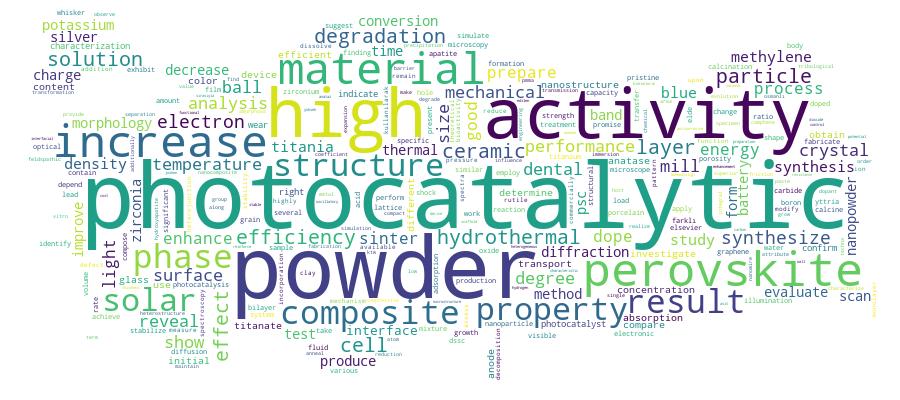
Competency Cloud

GCRIS Competency Cloud

Scholarly Output Search Results

Now showing 1 - 4 of 4
  • Article
    Citation - WoS: 10
    Alkaline Hydrothermal Synthesis, Characterization, and Photocatalytic Activity of Tio2 Nanostructures: the Effect of Initial Tio2 Phase
    (Amer Scientific Publishers, 2019) Erdogan, Nursev; Park, Jongee; Choi, Woohyuk; Kim, Soo Young; Ozturk, Abdullah
    One-dimensional (1D) titanate nanostructures were synthesized by hydrothermal route, using commercially available TiO2 (P25) and anatase powders as precursor materials and strong NaOH solution as catalyzer. The prepared titanates were calcined, followed by protonation to produce TiO2 nanostructures having enhanced photocatalytic and photovoltaic properties. The synthesized TiO2 1D nanostructures were characterized using field-emission scanning electron microscope, high-resolution electron microscope, X-ray diffraction analysis, and UV-Vis photospectroscopy to understand the effect of initial TiO2 phase on morphological and crystallographic features, and bandgap. Methylene blue degradation test was applied to evaluate the photoactivity of the products obtained after different stages of the process. The findings indicate that 1D TiO2 nanostructures form by different mechanisms from dissolved aggregates during hydrothermal process, depending on the crystal structure of the initial precursor used. Photocatalytic test results reveal that protonated titanates have considerable adsorption capability, while photocatalytic degradation depends on TiO2 transformation.
  • Article
    Citation - WoS: 28
    Citation - Scopus: 27
    Hydrothermal Synthesis of 3d Tio2 Nanostructures Using Nitric Acid: Characterization and Evolution Mechanism
    (Elsevier Sci Ltd, 2016) Erdogan, Nursev; Ozturk, Abdullah; Park, Jongee
    Various morphologies of TiO2 nanostructures were synthesized by HNO3 assisted hydrothermal treatment with respect to the acid molarity (1 M, 3 M, and 8 M), temperature (110, 140, and 180 degrees C), and time (1, 3, and 6 h). An additional sample was synthesized inside the protonated titanate nanoribbon coated vessel with the acid molarity of 8M at 140 degrees C for 3 h. The crystal structure and morphology of the nanostructures synthesized were investigated using X-Ray diffractometer, scanning electron microscope, and transmission electron microscope. The results revealed that lower acid concentrations, longer synthesis durations and higher temperatures favored anatase phase formation. Meanwhile, a phase pure 3D lotus structure ruffle TiO2 could be obtained by hydrothermal synthesis at 8M HNO3 concentration at 140 degrees C for 3 h using protonated Htitanate nanoribbons. A probable mechanism for the evolution of 3D ruffle lotus structure was highlighted. (C) 2016 Elsevier Ltd and Techna Group S.r.l. All rights reserved.
  • Article
    Citation - WoS: 18
    Citation - Scopus: 19
    Synthesis and Enhanced Photocatalytic Activity of Nitrogen-Doped Triphasic Tio2 Nanoparticles
    (Elsevier Science Sa, 2019) Erdogan, Nursev; Bouziani, Asmae; Park, Jongee; Micusik, Matej; Kim, Soo Young; Majkova, Eva; Ozturk, Abdullah
    TiO2 nanoparticles of the single anatase phase, binary anatase-brookite phases, and ternary anatase-brookite-rutile phases were synthesized using an HNO3-catalyzed hydrothermal process. The types and amounts of phases varied depending on the hydrothermal synthesis conditions. The results revealed that N dissolves in different amounts and chemical states, depending on the phases present and their proportions in the nano particles. Brookite and rutile nanoparticles oriented through one direction were found to be crystallized by the surface transformation from anatase. Photocatalytic activity tests, evaluated by degradation of methylene blue (MB) under ultraviolet (UV) and visible light illumination, revealed that the N-doped TiO2 nanoparticles containing a ternary-phase mixture had the best photocatalytic activity. The MB degradation of the visible light-active nanoparticles was three times better than that of a commercially available well-known TiO2 powder, P25 under UV illumination. The enhanced photoactivity was attributed to the following: i) a high surface area, ii) suppression of the recombination of electron-hole pairs with ternary-phase mixture crystallized in heterojunctions, iii) larger anatase phase content, and iv) narrower band gap and facilitation of charge separation by dissolved N atoms.
  • Article
    Citation - WoS: 18
    Citation - Scopus: 19
    Synthesis and Enhanced Photocatalytic Activity of Molybdenum, Iron, and Nitrogen Triple-Doped Titania Nanopowders
    (Elsevier Sci Ltd, 2016) Erdogan, Nursev; Park, Jongee; Ozturk, Abdullah
    A novel Mo, Fe, and N triple-doped rutile TiO2 nanopowder was synthesized with simple HNO3 assisted hydrothermal treatment. Powders synthesized were characterized by using x-ray diffraction (XRD), x-ray photoelectron spectroscopy (XPS), inductively coupled plasma mass spectrometry (ICP-MS), scanning electron microscopy (FESEM), high resolution transmission electron microscopy (HRTEM), and Brunauer-Emmett-Teller (BET) surface area analysis techniques. Mo doping initiated the formation of a structure composed of a mixture of anatase and rutile with some modifications in morphology; but Mo, Fe, and N triple-doped titania powders are composed of entirely rutile structures. XPS analysis confirmed that Mo dissolved in the structure, replacing Ti atoms and forming some MoO3 partially crystallized nano regions on the surface. Existence of Fe in the TiO2 crystal lattice was confirmed by ICP analysis. Fe doping had an influence on the crystal structure and morphology. N was found to be dissolved in the co-doped structure by HNO3 catalyzer autogenously. Methylene blue degradation testing and band gap measurements were performed by using UV-vis photospectroscopy and diffuse reflector apparatus in order to evaluate the photocatalytic performance of the powders. Dopant elements decreased band gap energy steadily. An enhanced photoactivity was reached by Mo, Fe, and N triple-doping as compared with that of undoped, and mono doped TiO2 powders under UV-light irradiation. Possible reasons for the enhancement in photocatalytic activity are outlined. (C) 2016 Elsevier Ltd and Techna Group S.r.l. All rights reserved.