Albostan, Ayhan

Loading...
Profile Picture
Name Variants
A., Ayhan
Albostan, Ayhan
A., Albostan
A.,Albostan
Ayhan, Albostan
A.,Ayhan
Albostan,A.
Job Title
Profesor Doktor
Email Address
ayhan.albostan@atilim.edu.tr
Main Affiliation
Energy Systems Engineering
Status
Website
ORCID ID
Scopus Author ID
Turkish CoHE Profile ID
Google Scholar ID
WoS Researcher ID

Sustainable Development Goals

NO POVERTY1
NO POVERTY
0
Research Products
ZERO HUNGER2
ZERO HUNGER
0
Research Products
GOOD HEALTH AND WELL-BEING3
GOOD HEALTH AND WELL-BEING
0
Research Products
QUALITY EDUCATION4
QUALITY EDUCATION
0
Research Products
GENDER EQUALITY5
GENDER EQUALITY
0
Research Products
CLEAN WATER AND SANITATION6
CLEAN WATER AND SANITATION
0
Research Products
AFFORDABLE AND CLEAN ENERGY7
AFFORDABLE AND CLEAN ENERGY
9
Research Products
DECENT WORK AND ECONOMIC GROWTH8
DECENT WORK AND ECONOMIC GROWTH
1
Research Products
INDUSTRY, INNOVATION AND INFRASTRUCTURE9
INDUSTRY, INNOVATION AND INFRASTRUCTURE
1
Research Products
REDUCED INEQUALITIES10
REDUCED INEQUALITIES
0
Research Products
SUSTAINABLE CITIES AND COMMUNITIES11
SUSTAINABLE CITIES AND COMMUNITIES
2
Research Products
RESPONSIBLE CONSUMPTION AND PRODUCTION12
RESPONSIBLE CONSUMPTION AND PRODUCTION
0
Research Products
CLIMATE ACTION13
CLIMATE ACTION
3
Research Products
LIFE BELOW WATER14
LIFE BELOW WATER
1
Research Products
LIFE ON LAND15
LIFE ON LAND
0
Research Products
PEACE, JUSTICE AND STRONG INSTITUTIONS16
PEACE, JUSTICE AND STRONG INSTITUTIONS
0
Research Products
PARTNERSHIPS FOR THE GOALS17
PARTNERSHIPS FOR THE GOALS
0
Research Products
Documents

14

Citations

768

h-index

10

Documents

11

Citations

658

Scholarly Output

10

Articles

4

Views / Downloads

66/0

Supervised MSc Theses

0

Supervised PhD Theses

0

WoS Citation Count

635

Scopus Citation Count

729

Patents

0

Projects

0

WoS Citations per Publication

63.50

Scopus Citations per Publication

72.90

Open Access Source

0

Supervised Theses

0

JournalCount
4th International Conference on Nuclear and Renewable Energy Resources (NURER) -- OCT 26-29, 2014 -- Antalya, TURKEY3
2nd International Symposium on Materials for Energy Storage and Conversion (mESC-IS) -- SEP 26-28, 2017 -- TURKEY1
3rd International Conference on Nuclear and Renewable Energy Resources (NURER) -- MAY 20-23, 2012 -- Istanbul, TURKEY1
12th International Symposium on Hydrogen Power Theoretical and Engineering Solutions (HYPOTHESIS) -- JUN 28-30, 2017 -- Syracuse, ITALY1
Energy Conversion and Management1
Current Page: 1 / 2

Scopus Quartile Distribution

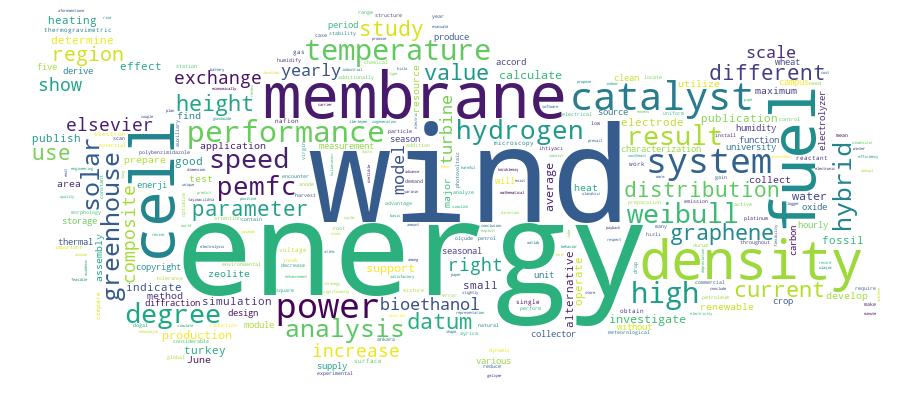
Competency Cloud

GCRIS Competency Cloud

Scholarly Output Search Results

Now showing 1 - 2 of 2
  • Conference Object
    Citation - WoS: 68
    Citation - Scopus: 81
    Seasonal and Yearly Wind Speed Distribution and Wind Power Density Analysis Based on Weibull Distribution Function
    (Pergamon-elsevier Science Ltd, 2015) Bilir, Levent; Imir, Mehmet; Devrim, Yilser; Albostan, Ayhan
    Wind energy, which is among the most promising renewable energy resources, is used throughout the world as an alternative to fossil fuels. In the assessment of wind energy for a region, the use of two-parameter Weibull distribution is an important tool. In this study, wind speed data, collected for a one year period between June 2012 and June 2013, were evaluated. Wind speed data, collected for two different heights (20 m and 30 m) from a measurement station installed in Atihm University campus area (Ankara, Turkey), were recorded using a data logger as one minute average values. Yearly average hourly wind speed values for 20 m and 30 m heights were determined as 2.9859 m/s and 3.3216 m/s, respectively. Yearly and seasonal shape (k) and scale (c) parameter of Weibull distribution for wind speed were calculated for each height using five different methods. Additionally, since the hub height of many wind turbines is higher than these measurement heights, Weibull parameters were also calculated for 50 m height. Root mean square error values of Weibull distribution functions for each height, derived using five different methods, show that a satisfactory representation of wind data is achieved for all methods. Yearly and seasonal wind power density values of the region were calculated using the best Weibull parameters for each case. As a conclusion, the highest wind power density value was found to be in winter season while the lowest value was encountered in autumn season. Yearly wind power densities were calculated as 39.955 (W/m(2)), 51.282 (W/m(2)) and 72.615 (W/m(2)) for 20 m, 30 m and 50 m height, respectively. The prevailing wind direction was also determined as southeast for the region. It can be concluded that the wind power density value at the region is considerable and can be exploited using small scale wind turbines. Copyright (C) 2015, Hydrogen Energy Publications, LLC. Published by Elsevier Ltd. All rights reserved.
  • Article
    Citation - WoS: 102
    Citation - Scopus: 122
    An Investigation on Wind Energy Potential and Small Scale Wind Turbine Performance at Incek Region - Ankara, Turkey
    (Pergamon-elsevier Science Ltd, 2015) Bilir, Levent; Imir, Mehmet; Devrim, Yilser; Albostan, Ayhan
    Renewable energy resources increased their importance in the last decades due to environmental pollution problems. Additionally, the fact that fossil fuels such as oil, coal, and natural gas will be depleted in near future encourages researchers to make investigations on alternative energy resources. Wind energy, which is one of the most used alternative resources, has a great potential. In this study, Weibull parameters at Incek region of Ankara (the capital city of Turkey), where /intim University campus is located, were determined for four different seasons and for twelve months in order to accomplish wind speed characterization at the region. Wind speed data at 20 m and 30 m heights were collected from. a measurement station installed at Atilim University campus area. The data were taken as 1 min average values for a one year period between June 2012 and June 2013. Hourly average wind speed values for each height were derived using the collected wind data. Weibull parameters were calculated with five different methods using the derived hourly average wind speed values. According to root mean square error analyses, the best methods for which Weibull distribution fits the actual wind data were determined as power density and empirical methods. The power and energy density values for the region were also calculated for each season and each month. It was revealed that the maximum power density is encountered in March with about 98 (W/m(2)). Since this power density indicates that large scale wind turbine use is not a good option at the region, the performances of three different small scale wind turbines were evaluated. According to the results, two of the investigated wind turbines were found to be capable to generate all yearly energy need of an average household in Turkey. (C) 2015 Elsevier Ltd. All rights reserved.