Kaftanoğlu, Bilgin

Loading...
Profile Picture
Name Variants
Bilgin, Kaftanoğlu
Kaftanoglu, Bilgin
Bilgin Kaftanoğlu
K., Bilgin
Kaftanoğlu,B.
Kaftanoğlu, Bilgin
K.,Bilgin
B.,Kaftanoglu
KAFTANOGLU B.
Kaftanoğlu B.
B.,Kaftanoğlu
Kaftanoglu,B.
Bilgin, Kaftanoglu
Kaftanoglu B.
Kaftanoglu,Bilgin
B., Kaftanoğlu
B., Kaftanoglu
Kaftanoglu, B.
Job Title
Profesör Doktor
Email Address
bilgin.kaftanoglu@atilim.edu.tr
Main Affiliation
Manufacturing Engineering
Status
Website
Scopus Author ID
Turkish CoHE Profile ID
Google Scholar ID
WoS Researcher ID

Sustainable Development Goals

NO POVERTY1
NO POVERTY
0
Research Products
ZERO HUNGER2
ZERO HUNGER
0
Research Products
GOOD HEALTH AND WELL-BEING3
GOOD HEALTH AND WELL-BEING
1
Research Products
QUALITY EDUCATION4
QUALITY EDUCATION
0
Research Products
GENDER EQUALITY5
GENDER EQUALITY
0
Research Products
CLEAN WATER AND SANITATION6
CLEAN WATER AND SANITATION
0
Research Products
AFFORDABLE AND CLEAN ENERGY7
AFFORDABLE AND CLEAN ENERGY
3
Research Products
DECENT WORK AND ECONOMIC GROWTH8
DECENT WORK AND ECONOMIC GROWTH
0
Research Products
INDUSTRY, INNOVATION AND INFRASTRUCTURE9
INDUSTRY, INNOVATION AND INFRASTRUCTURE
6
Research Products
REDUCED INEQUALITIES10
REDUCED INEQUALITIES
0
Research Products
SUSTAINABLE CITIES AND COMMUNITIES11
SUSTAINABLE CITIES AND COMMUNITIES
1
Research Products
RESPONSIBLE CONSUMPTION AND PRODUCTION12
RESPONSIBLE CONSUMPTION AND PRODUCTION
1
Research Products
CLIMATE ACTION13
CLIMATE ACTION
1
Research Products
LIFE BELOW WATER14
LIFE BELOW WATER
0
Research Products
LIFE ON LAND15
LIFE ON LAND
0
Research Products
PEACE, JUSTICE AND STRONG INSTITUTIONS16
PEACE, JUSTICE AND STRONG INSTITUTIONS
0
Research Products
PARTNERSHIPS FOR THE GOALS17
PARTNERSHIPS FOR THE GOALS
0
Research Products
Scopus data could not be loaded because of an error. Please refresh the page or try again later.
This researcher does not have a WoS ID.
Scholarly Output

55

Articles

29

Views / Downloads

122/191

Supervised MSc Theses

10

Supervised PhD Theses

5

WoS Citation Count

758

Scopus Citation Count

877

Patents

0

Projects

0

WoS Citations per Publication

13.78

Scopus Citations per Publication

15.95

Open Access Source

9

Supervised Theses

15

JournalCount
Makina Tasarım ve Imalat Dergisi3
International Journal of Mechatronics and Manufacturing Systems3
Applied Energy2
International Journal of Refrigeration2
The International Journal of Advanced Manufacturing Technology2
Current Page: 1 / 6

Scopus Quartile Distribution

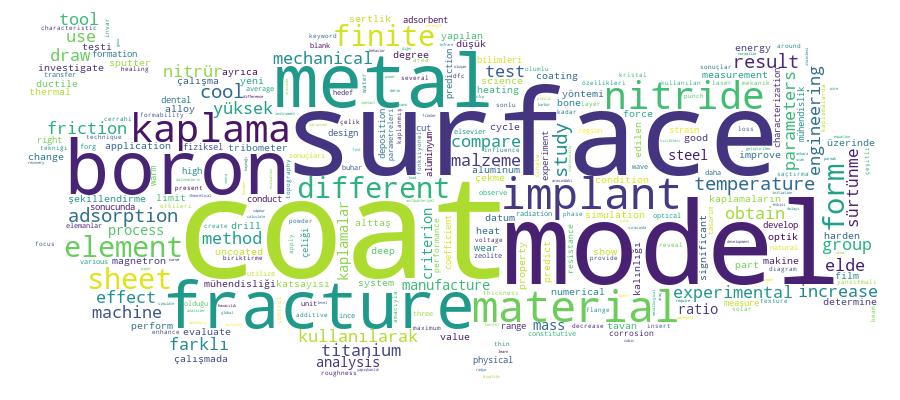
Competency Cloud

GCRIS Competency Cloud

Scholarly Output Search Results

Now showing 1 - 4 of 4
  • Article
    Citation - WoS: 43
    Numerical Investigation of Coupled Heat and Mass Transfer Inside the Adsorbent Bed of an Adsorption Cooling Unit
    (Elsevier Sci Ltd, 2012) Solmus, Ismail; Rees, D. Andrew S.; Yamali, Cemil; Baker, Derek; Kaftanoglu, Bilgin
    In this study, the influence of several design parameters on the transient distributions of temperature, pressure and amount adsorbed in the radial direction of a cylindrical adsorbent bed of an adsorption cooling unit using silica gel/water have been investigated numerically. For this purpose, a transient one-dimensional local thermal non-equilibrium model that accounts for both internal and external mass transfer resistances has been developed using the local volume averaging method. For the conditions investigated, the validity of the local thermal equilibrium and spatially isobaric bed assumptions have been confirmed. To improve the performance of the bed considered, efforts should be focused on reducing heat transfer resistances and intra-particle (interior) mass transfer resistances but not inter-particle (exterior) mass transfer resistances. (C) 2011 Elsevier Ltd and IIR. All rights reserved.
  • Article
    Citation - WoS: 79
    Citation - Scopus: 92
    Adsorption properties of a natural zeolite-water pair for use in adsorption cooling cycles
    (Elsevier Sci Ltd, 2010) Solmus, Ismail; Yamali, Cemil; Kaftanoglu, Bilgin; Baker, Derek; Caglar, Ahmet
    The equilibrium adsorption capacity of water on a natural zeolite has been experimentally determined at different zeolite temperatures and water vapor pressures for use in an adsorption cooling system. The Dubinin-Astakhov adsorption equilibrium model is fitted to experimental data with an acceptable error limit. Separate correlations are obtained for adsorption and desorption processes as well as a single correlation to model both processes. The isosteric heat of adsorption of water on zeolite has been calculated using the Clausius-Clapeyron equation as a function of adsorption capacity. The cyclic adsorption capacity swing for different condenser, evaporator and adsorbent temperatures is compared with that for the following adsorbent-refrigerant pairs: activated carbon-methanol; silica gel-water; and, zeolite 13X-water. Experimental results show that the maximum adsorption capacity of natural zeolite is nearly 0.12 kg(w)/kg(ad) for zeolite temperatures and water vapor pressures in the range 40-150 degrees C and 0.87-738 kPa. (C) 2009 Elsevier Ltd. All rights reserved.
  • Article
    Citation - WoS: 58
    Citation - Scopus: 66
    Experimental Investigation of a Natural Zeolite-Water Adsorption Cooling Unit
    (Elsevier Sci Ltd, 2011) Solmus, Ismail; Kaftanoglu, Bilgin; Yamali, Cemil; Baker, Derek
    In this study, a thermally driven adsorption cooling unit using natural zeolite-water as the adsorbent-refrigerant pair has been built and its performance investigated experimentally at various evaporator temperatures. The primary components of the cooling unit are a shell and tube adsorbent bed, an evaporator, a condenser, heating and cooling baths, measurement instruments and supplementary system components. The adsorbent bed is considered to enhance the bed's heat and mass transfer characteristics; the bed consists of an inner vacuum tube filled with zeolite (zeolite tube) inserted into a larger tubular shell. Under the experimental conditions of 45 degrees C adsorption, 150 degrees C desorption, 30 degrees C condenser and 22.5 degrees C, 15 degrees C and 10 degrees C evaporator temperatures, the COP of the adsorption cooling unit is approximately 0.25 and the maximum average volumetric cooling power density (SCR,) and mass specific cooling power density per kg adsorbent (SCP) of the cooling unit are 5.2 kW/m(3) and 7 W/kg, respectively. (C) 2011 Elsevier Ltd. All rights reserved.
  • Conference Object
    Citation - Scopus: 1
    Parametric Study and Seasonal Simulations of a Solar Powered Adsorption Cooling System
    (Brazilian Society of Mechanical Sciences and Engineering, 2009) Taylan,O.; Baker,D.K.; Kaftanoʇlu,B.
    Models of solar-thermal powered adsorption cooling systems with and without heat recovery developed in TRNSYS and results from steady-periodic and seasonal simulations are presented. A normalized model is presented and used to process the seasonal TRNSYS results to investigate the coincidence between the solar-supplied cooling power and cooling load as the relative sizes of the cooling system and storage are varied. The normalized model yields a seasonal solar fraction and seasonal loss fraction (the excess solar-supplied cooling lost to the environment due to insufficient storage). Simulations were run for a zeolite-water adsorbent-refrigerant pair. Hourly weather data for Antalya, Turkey, were used for the transient simulations. Basic trends in performance were investigated as the following parameters were varied: system type (with or without heat recovery); incident radiation; maximum and minimum bed temperatures; condensation temperature; difference between condensation and minimum bed temperatures (bed excess temperature); bed's dead mass; collector type (flat plate vs. evacuated tube); cooling tower type (wet vs. dry); cooling system size; and, storage size. Results for the conditions explored include the following. Steady-periodic simulations show that the system's COP decreases with decreases in radiation and increases with minimum bed and condensation temperatures. Increasing the excess bed temperature increases the system's COP. Systems with an evacuated tube collector and wet cooling tower give higher system COP's than systems with a flat plate collector and dry cooling tower. The increase in system's COP due to decreasing the bed's dead mass and adding heat recovery is quantified. The solar fraction increases and the loss fraction decreases with increases in storage capacity, and both fractions decrease with increases in maximum bed temperature. The required evacuated tube collector area is smaller than the flat plate collector area while the required mass of adsorbent is independent of collector and adsorption cycle types. © 2009 by ABCM.