
Kaftanoğlu, Bilgin
Loading...
Profile URL
Name Variants
Bilgin, Kaftanoğlu
Kaftanoglu, Bilgin
Bilgin Kaftanoğlu
K., Bilgin
Kaftanoğlu,B.
Kaftanoğlu, Bilgin
K.,Bilgin
B.,Kaftanoglu
KAFTANOGLU B.
Kaftanoğlu B.
B.,Kaftanoğlu
Kaftanoglu,B.
Bilgin, Kaftanoglu
Kaftanoglu B.
Kaftanoglu,Bilgin
B., Kaftanoğlu
B., Kaftanoglu
Kaftanoglu, B.
Kaftanoglu, Bilgin
Bilgin Kaftanoğlu
K., Bilgin
Kaftanoğlu,B.
Kaftanoğlu, Bilgin
K.,Bilgin
B.,Kaftanoglu
KAFTANOGLU B.
Kaftanoğlu B.
B.,Kaftanoğlu
Kaftanoglu,B.
Bilgin, Kaftanoglu
Kaftanoglu B.
Kaftanoglu,Bilgin
B., Kaftanoğlu
B., Kaftanoglu
Kaftanoglu, B.
Job Title
Profesör Doktor
Email Address
bilgin.kaftanoglu@atilim.edu.tr
Main Affiliation
Manufacturing Engineering
Status
Website
ORCID ID
Scopus Author ID
Turkish CoHE Profile ID
Google Scholar ID
WoS Researcher ID
Sustainable Development Goals
 1
1NO POVERTY
0
Research Products
 2
2ZERO HUNGER
0
Research Products
 3
3GOOD HEALTH AND WELL-BEING
1
Research Products
 4
4QUALITY EDUCATION
0
Research Products
 5
5GENDER EQUALITY
0
Research Products
 6
6CLEAN WATER AND SANITATION
0
Research Products
 7
7AFFORDABLE AND CLEAN ENERGY
3
Research Products
 8
8DECENT WORK AND ECONOMIC GROWTH
0
Research Products
 9
9INDUSTRY, INNOVATION AND INFRASTRUCTURE
6
Research Products
 10
10REDUCED INEQUALITIES
0
Research Products
 11
11SUSTAINABLE CITIES AND COMMUNITIES
1
Research Products
 12
12RESPONSIBLE CONSUMPTION AND PRODUCTION
1
Research Products
 13
13CLIMATE ACTION
1
Research Products
 14
14LIFE BELOW WATER
0
Research Products
 15
15LIFE ON LAND
0
Research Products
 16
16PEACE, JUSTICE AND STRONG INSTITUTIONS
0
Research Products
 17
17PARTNERSHIPS FOR THE GOALS
0
Research Products

Scopus data could not be loaded because of an error. Please refresh the page or try again later.

This researcher does not have a WoS ID.

Scholarly Output
55
Articles
29
Views / Downloads
121/174
Supervised MSc Theses
10
Supervised PhD Theses
5
WoS Citation Count
758
Scopus Citation Count
876
Patents
0
Projects
0
WoS Citations per Publication
13.78
Scopus Citations per Publication
15.93
Open Access Source
9
Supervised Theses
15
| Journal | Count |
|---|---|
| Makina Tasarım ve Imalat Dergisi | 3 |
| International Journal of Mechatronics and Manufacturing Systems | 3 |
| Applied Energy | 2 |
| International Journal of Refrigeration | 2 |
| The International Journal of Advanced Manufacturing Technology | 2 |
Current Page: 1 / 6
Scopus Quartile Distribution
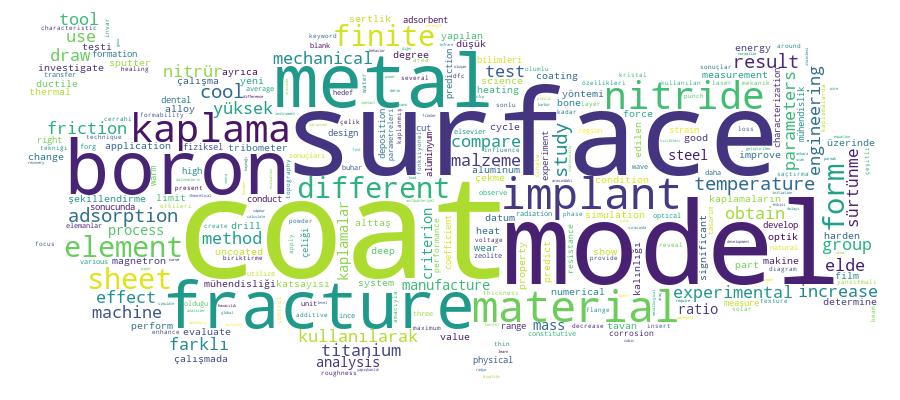
Competency Cloud
30 results
Scholarly Output Search Results
Now showing 1 - 10 of 30
Article Citation - Scopus: 21Micro Textured Cutting Tool Effects on Cutting Forces, Volumetric Wear and Adhesion in Dry Turning of Titanium Alloy(Inderscience Publishers, 2019) Patel,K.; Kaftanoǧlu,B.; Özel,T.There are several distinct advantages offered by micro-textures applied to cutting tool surfaces to reduce forces, friction, and wear. This study provides investigations on micro-grooves fabricated on the rake face of tungsten carbide inserts (WC/Co) that were used in turning titanium alloy Ti-6Al-4V under dry conditions. Tool inserts included varying micro-groove width (50∼100 μm), depth (10∼30 μm) and spacing (15∼100 μm). In the experiments, a constant depth of cut and a cutting speed were used. The effect of micro-textured tool surfaces on cutting force and tool wear was found to be significant. © 2019 Inderscience Enterprises Ltd.Article Citation - WoS: 5Measurement of Solar Radiation in Ankara, Turkey(Turkish Soc thermal Sciences Technology, 2013) Caglar, Ahmet; Yamali, Cemil; Baker, Derek K.; Kaftanoglu, BilginThe solar energy potential of Ankara, Turkey, (39.89 degrees N, 32.78 degrees E) has been investigated using the measurements of global and beam radiation over the period May 2008 to May 2009. Surface air temperature was also measured and variation in clearness index evaluated over this period. Global and beam radiations have been analyzed using hourly, daily and monthly averages obtained from 1-minute averages of recorded data. Results show that annual average daily global and beam radiations were 17.04 and 15.72 MJ/m(2)/day, respectively, for this period. The results are compared with the data available for several other cities in Turkey. The study shows that Ankara has a large solar potential. The consistency of these data with that from the State Meteorological Service (SMS) weather station in Ankara was analyzed. Significant differences between these 2 stations were found and are attributed to measurement error at the SMS station. New radiation-measurement stations should be established to create a better national radiation database for Turkey.Article Citation - WoS: 58Citation - Scopus: 66Experimental Investigation of a Natural Zeolite-Water Adsorption Cooling Unit(Elsevier Sci Ltd, 2011) Solmus, Ismail; Kaftanoglu, Bilgin; Yamali, Cemil; Baker, DerekIn this study, a thermally driven adsorption cooling unit using natural zeolite-water as the adsorbent-refrigerant pair has been built and its performance investigated experimentally at various evaporator temperatures. The primary components of the cooling unit are a shell and tube adsorbent bed, an evaporator, a condenser, heating and cooling baths, measurement instruments and supplementary system components. The adsorbent bed is considered to enhance the bed's heat and mass transfer characteristics; the bed consists of an inner vacuum tube filled with zeolite (zeolite tube) inserted into a larger tubular shell. Under the experimental conditions of 45 degrees C adsorption, 150 degrees C desorption, 30 degrees C condenser and 22.5 degrees C, 15 degrees C and 10 degrees C evaporator temperatures, the COP of the adsorption cooling unit is approximately 0.25 and the maximum average volumetric cooling power density (SCR,) and mass specific cooling power density per kg adsorbent (SCP) of the cooling unit are 5.2 kW/m(3) and 7 W/kg, respectively. (C) 2011 Elsevier Ltd. All rights reserved.Conference Object Citation - WoS: 7Citation - Scopus: 7Effect of Hardening Models on Different Ductile Fracture Criteria in Sheet Metal Forming(Springer France, 2016) Dizaji, Shahram Abbasnejad; Darendeliler, Haluk; Kaftanoglu, Bilgin; Abbasnejad Dizaji, ShahramPrediction of the fracture is one of the challenging issues which gains attention in sheet metal forming as numerical analyses are being extensively used to simulate the process. To have better results in predicting the sheet metal fracture, appropriate ductile fracture criterion (DFC), yield criterion and hardening rule should be chosen. In this study, the effects of different hardening models namely isotropic, kinematic and combined hardening rules on the various uncoupled ductile fracture criteria are investigated using experimental and numerical methods. Five different ductile fracture criteria are implemented to a finite element code by the user subroutines. The criterion constants of DFCs are obtained by the related experimental tests. The in-plane principle strains obtained by the finite element analyses for different DFCs are compared with the experimental results. Also, the experimental results are used to evaluate the principle strain values calculated by the finite element analysis for different combinations of DFCs and hardening rules. It is shown that some DFCs give better predictions if the appropriate hardening model is employed.Article Citation - WoS: 46Citation - Scopus: 50Investigations on Microstructural Changes in Machining of Inconel 100 Alloy Using Face Turning Experiments and 3d Finite Element Simulations(Pergamon-elsevier Science Ltd, 2016) Arisoy, Yigit M.; Guo, Changsheng; Kaftanoglu, Bilgin; Oezel, Tugrul; Ozel, Tugrul; Kaftanoʇlu, BilginNickel-base IN100 alloy is a choice of material for components requiring high strength at elevated temperatures. Machining processes applied to these components affect the microstructure, grain size, and microhardness of the finished surface. This research investigates the effects of tool micro-geometry, coating, and cutting speed on the microstructural changes during machining. 3D customized finite element simulations have been performed to predict the average grain size by implementing modified temperature dependent flow softening based material and Johnson-Mehl-Avrami-Kolmogorov crystallization models. Simulation predictions on the average grain sizes, phase fractions, and resultant microhardness are compared against experimental measurements revealing good agreements. (C) 2016 Elsevier Ltd. All rights reserved.Article Normalized thermodynamic model for intermittent energy systems and application to solar-powered adsorption cooling systems(2011) Taylan, Onur; Baker, Derek K.; Kaftanoğlu, BilginGenel kesildi enerji sistemlerinin tasanm ve işletmedeki kilit parametreleri değişirken ara ve talep eşzamanlılığını nicelleştirmek ve açıklığa kavuşturmak için bir normalleştirilmiş model geliştirildi. Bu yeni model, güneş ısısı ile beslenen, iç ısı değiştiricin ve iç ısı değiştiricisiz adsorpsiyonlu sistemin mevsimsel değişimlerinin benzetişimin de güneş ısısıyla sağlanan soğutmanın ve soğutma talebinin eşzamanlılığını mevsimsel güneşle besleme payı faktörü ve kayıp faktörü yardımıyla İncelemek için uygulandı. İlaveten sistemin bir grup parametrelerinin değişimiyle temel başarımmdaki değişim eğilimleri incelendi. İnceleme şartlanndaki sonuçlar şunları içermektedir: Depo sığası (kapasitesi) artınca güneş payı faktörü artmakta ve kayıp faktörü azalmaktadır, ve maksimum yatak sıcaklığı artınca her iki faktör de küçülmektedir. Vakum tüplü toplaç için gerekli alan düz levha toplaç için gerekli alandan daha azdır, bunun yam sıra adsorbsiyon için gerekli malzeme kütlesi toplacın ve adsorbsiyon çevriminin tipinden bağımsızdır. Benzetişim sonuçları çalışma şartlarının ve değişik tasanm parametrelerinin sistem C.O.P si (başarım katsayısı) üzerine etkilerini de göstermektedir.Article Citation - WoS: 13Citation - Scopus: 13Analysis of Non-Isothermal Warm Deep Drawing of Dual-Phase Dp600 Steel(Springer France, 2019) Pepelnjak, T.; Kayhan, E.; Kaftanoglu, B.Improving the formability of the material is a key issue in the deep drawing process. Heating the material above its recrystallization temperature drastically increases formability, but in the case of dual phase (DP) steels, it results in a loss of their mechanical properties. To improve the drawing ratio, only the heating of the flange region in the warm temperature range up to 573K was studied on DP600 sheet steel by numerical simulation. A thermo-elastic-plastic finite element method (FEM) analysis of deep drawing at several drawing ratios was performed and compared with experimental results. During the experiments, the flange area of the blank was heated by induction heating, and the central part over the punch was cooled with spray water. Experimental results showed that limiting drawing ratio could be increased by 25.58%. The microstructure of the DP 600 steel was analyzed before and after the warm forming process. No significant changes were observed, and the high strength properties of the DP 600 steel remained intact. There was good agreement between numerical and experimental results.Article Citation - WoS: 113Citation - Scopus: 149Experiments and Finite Element Simulations on Micro-Milling of Ti-6al Alloy With Uncoated and Cbn Coated Micro-Tools(Elsevier, 2011) Oezel, T.; Thepsonthi, T.; Ulutan, D.; Kaftanoglu, B.; Ozel, T.; Kaftanolu, B.This paper presents experimental investigations and finite element simulations on micro-milling of Ti-6Al-4V alloy with fine grain uncoated and cBN coated micro-end mills. Micro-milling of Ti-6Al-4V using uncoated and cBN coated tungsten carbide micro-end mills are conducted; surface roughness, burr formation and tool wear are measured. Effects of machining parameters on surface roughness, burr formation, and tool wear for uncoated and cBN coated micro-tools are investigated. Finite element modelling is utilized to predict forces, temperatures, and wear rate for uncoated and cBN coated micro-tools. Predicted temperature and tool wear contours for uncoated and cBN coated micro-tool edges reveal advantages of cBN coatings. Optimization studies on the experimental results are also conducted to identify the optimum process parameters which minimize both surface roughness and burr formation concurrently. (C) 2011 CIRP.Article Citation - WoS: 7Citation - Scopus: 13Experimental Investigation of Non-Isothermal Deep Drawing of Dp600 Steel(Springer London Ltd, 2018) Kayhan, Erdem; Kaftanoglu, BilginTo increase the limiting drawing ratio (LDR) in deep drawing, experiments are conducted on DP600, IF, and HSLA steels. The flange region of blank is heated up to temperatures in the warm range by inductance heating. During heating, the central portion of blank is cooled by water to prevent the reduction of the strength of the material in the central region. The temperature increase of flange region is observed by two infrared sensors focusing on two different points, one on the blank rim and the other near the die radius. An intensive cooling by cold water is applied to the bottom side of a blank during deep drawing. Increases up to 25.58% on LDR are obtained. There is no significant change in the microstructure of the material due to warm forming. Material characterization is obtained by a Gleeble 3800 thermo-mechanical testing machine for the temperature range 150-300 degrees C.Article Citation - WoS: 17Citation - Scopus: 20Prediction of forming limit curve at fracture for sheet metal using new ductile fracture criterion(Elsevier Science Bv, 2018) Dizaji, Shahram Abbasnejad; Darendeliler, Haluk; Kaftanoglu, BilginThe application of ductile fracture criteria (DFCs) in numerical analysis of sheet metal forming processes can lead to the accurate determination of the fracture initiation. In this study, a new uncoupled ductile fracture criterion (DFC) has been developed which considers the effects of material parameters on the forming limit curves (FLCs) and can be easily implemented in the finite element codes. Two different constitutive models have been employed with the new DFC in order to evaluate the results obtained for fracture prediction. Various experimental tests have been utilized to validate the new criterion and its results are also compared with other well-known uncoupled DFCs. It is observed that the new criterion predicts the ductile fracture for all aluminum, steel and stainless steel materials better than the former criteria.

- «
- 1 (current)
- 2
- 3
- »