
Erden, Zühal
Loading...
Profile URL
Name Variants
E.,Zuhal
E., Zühal
E., Zuhal
Zuhal, Erden
Zühal Erden
Erden,Zuhal
E.,Zühal
Erden, Zuhal
Z., Erden
Erden Z.
Erden, Zühal
Zühal, Erden
Erden,Z.
Z.,Erden
E., Zühal
E., Zuhal
Zuhal, Erden
Zühal Erden
Erden,Zuhal
E.,Zühal
Erden, Zuhal
Z., Erden
Erden Z.
Erden, Zühal
Zühal, Erden
Erden,Z.
Z.,Erden
Job Title
Doçent Doktor
Email Address
zuhal.erden@atilim.edu.tr
Main Affiliation
Mechatronics Engineering
Status
Website
ORCID ID
Scopus Author ID
Turkish CoHE Profile ID
Google Scholar ID
WoS Researcher ID
Sustainable Development Goals
 1
1NO POVERTY
0
Research Products
 2
2ZERO HUNGER
0
Research Products
 3
3GOOD HEALTH AND WELL-BEING
0
Research Products
 4
4QUALITY EDUCATION
1
Research Products
 5
5GENDER EQUALITY
0
Research Products
 6
6CLEAN WATER AND SANITATION
0
Research Products
 7
7AFFORDABLE AND CLEAN ENERGY
0
Research Products
 8
8DECENT WORK AND ECONOMIC GROWTH
0
Research Products
 9
9INDUSTRY, INNOVATION AND INFRASTRUCTURE
5
Research Products
 10
10REDUCED INEQUALITIES
0
Research Products
 11
11SUSTAINABLE CITIES AND COMMUNITIES
0
Research Products
 12
12RESPONSIBLE CONSUMPTION AND PRODUCTION
0
Research Products
 13
13CLIMATE ACTION
0
Research Products
 14
14LIFE BELOW WATER
0
Research Products
 15
15LIFE ON LAND
0
Research Products
 16
16PEACE, JUSTICE AND STRONG INSTITUTIONS
0
Research Products
 17
17PARTNERSHIPS FOR THE GOALS
0
Research Products

This researcher does not have a Scopus ID.

This researcher does not have a WoS ID.

Scholarly Output
29
Articles
13
Views / Downloads
137/4243
Supervised MSc Theses
7
Supervised PhD Theses
1
WoS Citation Count
36
Scopus Citation Count
52
Patents
0
Projects
2
WoS Citations per Publication
1.24
Scopus Citations per Publication
1.79
Open Access Source
6
Supervised Theses
8
| Journal | Count |
|---|---|
| Makina Tasarım ve Imalat Dergisi | 2 |
| Control Engineering and Applied Informatics | 2 |
| 20th Annual International Conference on Mechatronics and Machine Vision in Practice, M2VIP 2013 -- 20th Annual International Conference on Mechatronics and Machine Vision in Practice, M2VIP 2013 -- 20 September 2013 through 20 September 2013 -- Ankara -- 102276 | 1 |
| ASME 2010 10th Biennial Conference on Engineering Systems Design and Analysis, ESDA2010 -- ASME 2010 10th Biennial Conference on Engineering Systems Design and Analysis, ESDA2010 -- 12 July 2010 through 14 July 2010 -- Istanbul -- 84828 | 1 |
| Computer Applications in Engineering Education | 1 |
Current Page: 1 / 4
Scopus Quartile Distribution
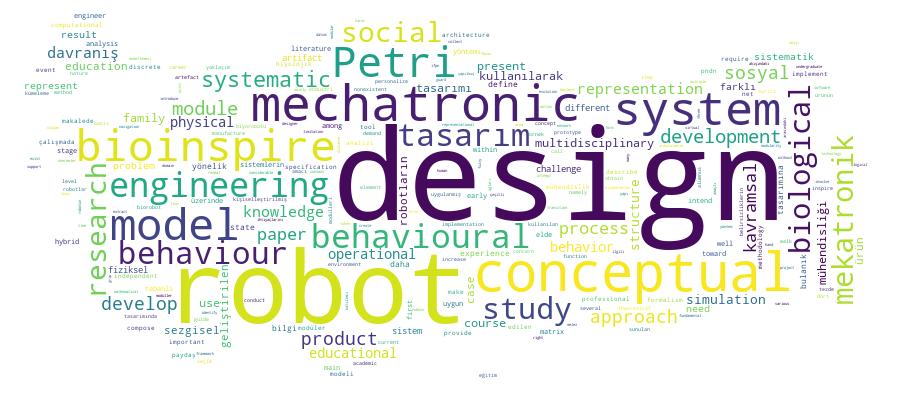
Competency Cloud
7 results
Scholarly Output Search Results
Now showing 1 - 7 of 7
Conference Object Petri Net Modeling and Simulation of Walking Behaviour for Design of a Bioinspired Robot Dog(SciTePress, 2016) Erden,Z.; Araz,M.Research in behavior-based design faces many challenges regarding the AIDS in conceptual design of biorobots, representation of a biological system,s behavior in a well formed modeling tool and therefore providing systematic transformation of this behavior into robot design. This paper reports a research that focuses on the development of a Petri Net model to represent a biological system,s behavior. The model is based on real time data collected from an experiment in which a dog is walking on a treadmill with a speed of 1km/h. The model has the ability of simulating the real time rhythm of dog's walking behavior utilizing colors and numbers as well as the step-by-step simulation. The aim is to observe the behavior of a walking dog in time domain as an early stage of conceptual design of a bioinspired robot dog. Main challenge is to develop a methodology to guide designer towards more creative designs based on bioinspired design ideas. The presented work is an early attempt to initiate a systematic approach towards the stated goal. © Copyright 2016 by SCITEPRESS - Science and Technology Publications, Lda. All rights reserved.Conference Object Citation - Scopus: 3Representation of the Operational Behaviour of an Educational Robot at Conceptual Design Using Petri Nets(Amer Soc Mechanical Engineers, 2010) Erden,Z.Increasing demand for computational support at conceptual design makes behavioural modeling a challenging area for design research. This is mainly because a behavioural model of a nonexistent design artifact at conceptual level is the basis for behavioural simulation and resulting computational design support. Behavioural models are particularly important for top-down design of multidisciplinary products such as mechatronic systems. During the conceptual design of such systems, intended "operational behavior" of the artifact is described without any physical realization. As design stages become more concrete, operational behaviour can be refined so as to represent well defined mathematical descriptions of corresponding physical behaviors. In this study, a model for representing the intended operational behaviour of a nonexistent educational robot, namely a rabbit robot, is presented for conceptual design. The operational behaviour of the robot is defined as composed of states and state transitions independent of any physical embodiment. Discrete Event System Specification (DEVS) and Petri Net formalism are used for the model. This representational model is the first step towards the development of a virtual prototype for the operational behaviour of an educational robot. © 2010 by ASME.Conference Object Citation - Scopus: 4Bioinspired Conceptual Design (bicd): Conceptual Design of a Grasshopper-Like Jumping Mechanism as a Case Study(Design Soc, 2011) Eroglu,A.K.; Erden,Z.; Erden,A.The evolution process of nature creates highly effective, power efficient, and perfectly structured biological systems. These excellent systems provide an inexhaustible source for engineers and scientists who desire to inspire ideas, processes, structures, functions, and behaviors from biological domain and implement them into engineering domain. This approach is called "Bioinspired" and challenging for engineers. However, some problems of the practical approaches are observed. One of the problems is "ad hoc" nature of the process. Each bioinspired design product has resulted in a differing design process and a generalization was not possible. Another problem rises due to the terminology difference between engineers and biologists. To overcome these problems, a need for a systematic bioinspired design (BID) process was realized in early 2000s and since then, considerable research on the BID methodology has been progressed. Within the context of BID, this paper introduces a new approach on bioinspired conceptual design (BICD) procedure for hybrid bioinspired robots which can be inspired from multiple biological systems. An illustrative case study is given in the paper.Conference Object Citation - WoS: 1Representation of the Operational Behaviour of an Educational Robot at Conceptual Design Using Petri Nets(Amer Soc Mechanical Engineers, 2010) Erden, ZuhalIncreasing demand for computational support at conceptual design makes behavioural modeling a challenging area for design research. This is mainly because a behavioural model of a nonexistent design artifact at conceptual level is the basis for behavioural simulation and resulting computational design support. Behavioural models are particularly important for top-down of multidisciplinary products such as mechatronic systems. During the conceptual design of such systems, intended "operational behaviour" of the artifact is described without any physical realization. As design stages become more concrete, operational behaviour can be refined so as to represent well defined mathematical descriptions of corresponding physical behaviours. In this study, a model for representing the intended operational behaviour of a nonexistent educational robot, namely a rabbit robot, is presented for conceptual design. The operational behaviour of the robot is defined as composed of states and state transitions independent of any physical embodiment. Discrete Event System Specification (DEVS) and Petri Net formalism are used for the model. This representational model is the first step towards the development of a virtual prototype for the operational behaviour of an educational robot.Conference Object Developing an Analysis Process for Biological Systems To Design Biorobots - a Case Study of Human Hand Gripping Motion(2013) Eroǧlu,A.K.; Erden,Z.; Erden,A.The fundamental reasoning behind the use of bioinspired design (BID) is to increase creativity (novelty and usefulness) and innovation in engineering. Within the context of BID, development of systematic process for analyzing biological systems and transferring knowledge, which is obtained from the analysis of biological systems, into engineering is compulsory. This paper presents developing a process for the analysis of biological systems for design of biorobots. Preparing, collecting, and organizing are the main steps of this process and applied in a case study which involves gripping motion of a human hand. An experimental set-up with a high-speed camera is constructed to obtain the components of knowledge: morphology, function and behavior. This knowledge will be later used to design a wearable hand in prospective projects.Conference Object Citation - Scopus: 1Systematic Generation of a 3d Dsm by Extracting Social Robot Behaviors From Literature(Cambridge University Press, 2019) Ozer,I.; Erden,Z.Social robots are in direct communication and interaction with people, thus it is important to design these robots for different needs of individuals or small groups. This has revealed the need to develop design methods for personalized or mass-individualized social robots, which are expected to respond to many different needs of people today and in the future. In this paper, a previously developed 3D DSM model is implemented in the systematic conceptual design of social robot families. The model is independent of any physical elements and based on behavioural elements as perception, cognition and motoric action. The data regarding 45 different social robots from 80 articles in the literature is used to identify these three behaviours of the existing social robots and the mutual relationships among these different behaviours are defined in order to develop a 3D DSM structure to be used as a basis for designing social robot families. The resulting novel 3D DSM is a general-purpose, basic model that can be used to identify behavioural modules to design social robot families. © 2019 Design Society. All rights reserved.Conference Object Citation - WoS: 1BIOINSPIRED CONCEPTUAL DESIGN (BICD): CONCEPTUAL DESIGN OF A GRASSHOPPER-LIKE JUMPING MECHANISM AS A CASE STUDY(design Soc, 2011) Eroglu, Aylin Konez; Erden, Zuhal; Erden, AbdulkadirThe evolution process of nature creates highly effective, power efficient, and perfectly structured biological systems. These excellent systems provide an inexhaustible source for engineers and scientists who desire to inspire ideas, processes, structures, functions, and behaviors from biological domain and implement them into engineering domain. This approach is called "Bioinspired" and challenging for engineers. However, some problems of the practical approaches are observed. One of the problems is "ad hoc" nature of the process. Each bioinspired design product has resulted in a differing design process and a generalization was not possible. Another problem rises due to the terminology difference between engineers and biologists. To overcome these problems, a need for a systematic bioinspired design (BID) process was realized in early 2000s and since then, considerable research on the BID methodology has been progressed. Within the context of BID, this paper introduces a new approach on bioinspired conceptual design (BICD) procedure for hybrid bioinspired robots which can be inspired from multiple biological systems. An illustrative case study is given in the paper.
