Eseller, Kemal Efe

Loading...
Profile Picture
Name Variants
Eseller, K. E.
K., Eseller
E.,Kemal Efe
Eseller, Kemal Efe
Eseller,K.E.
Kemal Efe, Eseller
K.E.Eseller
E., Kemal Efe
K.,Eseller
Job Title
Profesör Doktor
Email Address
efe.eseller@atilim.edu.tr
Main Affiliation
Department of Electrical & Electronics Engineering
Status
Former Staff
Website
ORCID ID
Scopus Author ID
Turkish CoHE Profile ID
Google Scholar ID
WoS Researcher ID

Sustainable Development Goals

NO POVERTY1
NO POVERTY
0
Research Products
ZERO HUNGER2
ZERO HUNGER
0
Research Products
GOOD HEALTH AND WELL-BEING3
GOOD HEALTH AND WELL-BEING
0
Research Products
QUALITY EDUCATION4
QUALITY EDUCATION
0
Research Products
GENDER EQUALITY5
GENDER EQUALITY
0
Research Products
CLEAN WATER AND SANITATION6
CLEAN WATER AND SANITATION
0
Research Products
AFFORDABLE AND CLEAN ENERGY7
AFFORDABLE AND CLEAN ENERGY
2
Research Products
DECENT WORK AND ECONOMIC GROWTH8
DECENT WORK AND ECONOMIC GROWTH
1
Research Products
INDUSTRY, INNOVATION AND INFRASTRUCTURE9
INDUSTRY, INNOVATION AND INFRASTRUCTURE
2
Research Products
REDUCED INEQUALITIES10
REDUCED INEQUALITIES
0
Research Products
SUSTAINABLE CITIES AND COMMUNITIES11
SUSTAINABLE CITIES AND COMMUNITIES
1
Research Products
RESPONSIBLE CONSUMPTION AND PRODUCTION12
RESPONSIBLE CONSUMPTION AND PRODUCTION
1
Research Products
CLIMATE ACTION13
CLIMATE ACTION
1
Research Products
LIFE BELOW WATER14
LIFE BELOW WATER
0
Research Products
LIFE ON LAND15
LIFE ON LAND
0
Research Products
PEACE, JUSTICE AND STRONG INSTITUTIONS16
PEACE, JUSTICE AND STRONG INSTITUTIONS
0
Research Products
PARTNERSHIPS FOR THE GOALS17
PARTNERSHIPS FOR THE GOALS
0
Research Products
This researcher does not have a Scopus ID.
This researcher does not have a WoS ID.
Scholarly Output

22

Articles

12

Views / Downloads

29/94

Supervised MSc Theses

5

Supervised PhD Theses

2

WoS Citation Count

363

Scopus Citation Count

449

Patents

0

Projects

0

WoS Citations per Publication

16.50

Scopus Citations per Publication

20.41

Open Access Source

5

Supervised Theses

7

JournalCount
Food Chemistry2
Laser-Induced Breakdown Spectroscopy, Second Edition2
Spectrochimica Acta Part B: Atomic Spectroscopy2
Inventions1
Biomedical Optics Express1
Current Page: 1 / 3

Scopus Quartile Distribution

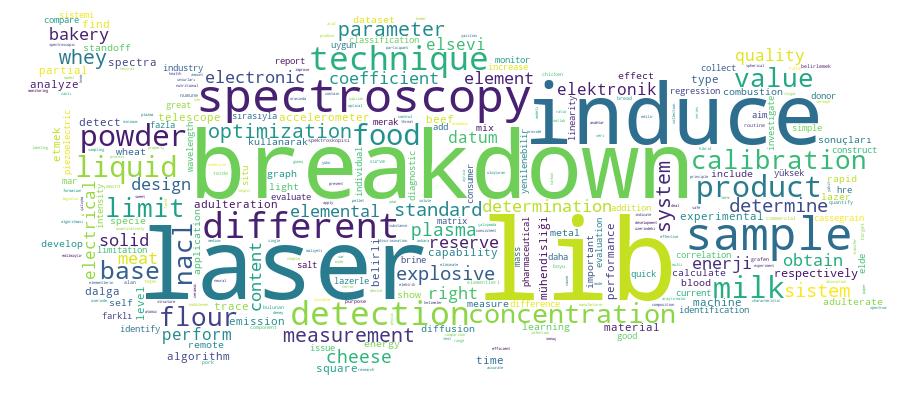
Competency Cloud

GCRIS Competency Cloud

Scholarly Output Search Results

Now showing 1 - 2 of 2
  • Book Part
    Citation - Scopus: 3
    Combustion Applications of Laser-Induced Breakdown Spectroscopy
    (Elsevier, 2020) Yueh,F.Y.; Tripathi,M.M.; Singh,J.P.; Sezer,B.; Eseller,K.E.
    The laser-induced breakdown spectroscopy (LIBS) technique has the capability to perform multielemental, remote, online, in situ analysis with no/minimum sample preparations. LIBS has created a great deal of interest in combustion diagnostic research. In this chapter, LIBS capabilities in combustion diagnostics and monitoring engine and flame characteristics are investigated. © 2020 Elsevier B.V. All rights reserved.
  • Book Part
    Citation - Scopus: 4
    Food Science Application
    (Elsevier, 2020) Eseller,K.E.; Boyaci,I.H.; Sezer,B.; Bilge,G.; Berberoglu,H.
    One of the main issues in the food industry is to determine quality and authenticity, and to detect adulteration, which causes a great deal of concern among consumers and risk in brand reputation for manufacturers. Food quality control is a wide playing field that includes different participants such as consumers, manufacturers, legislative bodies, researchers, etc. with an individual perspective for each participant, including economic and environmental contexts. But the ultimate goal is to produce safe and healthy food products. The preferential choice of food items depends on individuals’ lifestyles, diets, health, religious beliefs, current trends, etc. This brings about the issues of accurate labeling, fair trade, and consumer's health. The analysis of food and capabilities and limitations of laser-induced breakdown spectroscopy (LIBS) on foods have been reported. This chapter provides an overview of applications on food quality and the monitoring of several foods, sampling techniques, and limitations of LIBS. © 2020 Elsevier B.V. All rights reserved.