
Mısra, Sanjay
Loading...

Profile URL
Name Variants
M.,Sanjay
Misra, Sanjay
Mısra,S.
Mısra, Sanjay
Misra,S.
S.,Misra
Sanjay, Mısra
Sanjay, Misra
S., Misra
S.,Mısra
M., Sanjay
Misra, S.
Misra, Sanjay
Mısra,S.
Mısra, Sanjay
Misra,S.
S.,Misra
Sanjay, Mısra
Sanjay, Misra
S., Misra
S.,Mısra
M., Sanjay
Misra, S.
Job Title
Profesör Doktor
Email Address
sanjay.misra@atilim.edu.tr
Main Affiliation
Computer Engineering
Status
Website
ORCID ID
Scopus Author ID
Turkish CoHE Profile ID
Google Scholar ID
WoS Researcher ID
Sustainable Development Goals
 1
1NO POVERTY
3
Research Products
 2
2ZERO HUNGER
5
Research Products
 3
3GOOD HEALTH AND WELL-BEING
2
Research Products
 4
4QUALITY EDUCATION
6
Research Products
 5
5GENDER EQUALITY
2
Research Products
 6
6CLEAN WATER AND SANITATION
1
Research Products
 7
7AFFORDABLE AND CLEAN ENERGY
8
Research Products
 8
8DECENT WORK AND ECONOMIC GROWTH
11
Research Products
 9
9INDUSTRY, INNOVATION AND INFRASTRUCTURE
11
Research Products
 10
10REDUCED INEQUALITIES
2
Research Products
 11
11SUSTAINABLE CITIES AND COMMUNITIES
1
Research Products
 12
12RESPONSIBLE CONSUMPTION AND PRODUCTION
3
Research Products
 13
13CLIMATE ACTION
7
Research Products
 14
14LIFE BELOW WATER
10
Research Products
 15
15LIFE ON LAND
0
Research Products
 16
16PEACE, JUSTICE AND STRONG INSTITUTIONS
4
Research Products
 17
17PARTNERSHIPS FOR THE GOALS
9
Research Products

This researcher does not have a Scopus ID.

This researcher does not have a WoS ID.

Scholarly Output
199
Articles
133
Views / Downloads
63/0
Supervised MSc Theses
3
Supervised PhD Theses
0
WoS Citation Count
2629
Scopus Citation Count
3894
Patents
0
Projects
0
WoS Citations per Publication
13.21
Scopus Citations per Publication
19.57
Open Access Source
53
Supervised Theses
3
| Journal | Count |
|---|---|
| Acta Polytechnica Hungarica | 12 |
| Tehnicki Vjesnik | 8 |
| Lecture Notes in Computer Science (including subseries Lecture Notes in Artificial Intelligence and Lecture Notes in Bioinformatics) -- 2011 International Conference on Computational Science and Its Applications, ICCSA 2011 -- 20 June 2011 through 23 June 2011 -- Santander -- 85480 | 5 |
| Journal of Physics: Conference Series -- 3rd International Conference on Computing and Applied Informatics 2018, ICCAI 2018 -- 18 September 2018 through 19 September 2018 -- Medan, Sumatera Utara -- 149865 | 4 |
| Lecture Notes in Computer Science (including subseries Lecture Notes in Artificial Intelligence and Lecture Notes in Bioinformatics) -- 12th International Conference on Computational Science and Its Applications, ICCSA 2012 -- 18 June 2012 through 21 June 2012 -- Salvador de Bahia -- 90945 | 4 |
Current Page: 1 / 22
Scopus Quartile Distribution
Competency Cloud
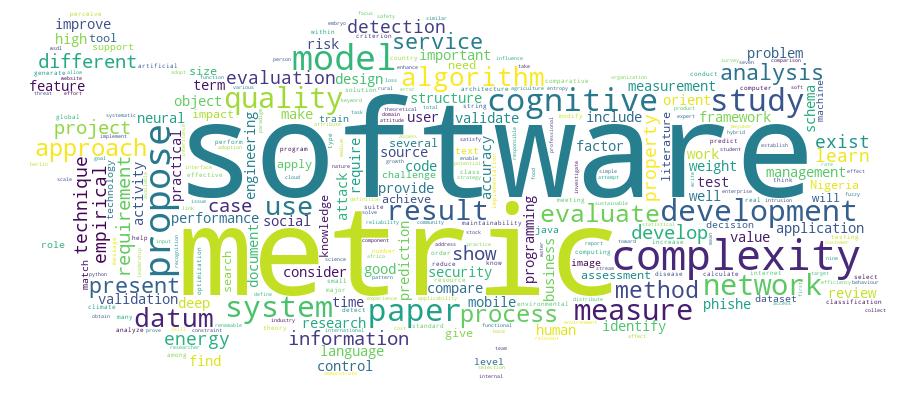
199 results
Scholarly Output Search Results
Now showing 1 - 10 of 199
Article Citation - WoS: 10Citation - Scopus: 18Evaluation Criteria for Object-Oriented Metrics(Budapest Tech, 2011) Misra, Sanjay; Computer EngineeringIn this paper an evaluation model for object-oriented (OO) metrics is proposed. We have evaluated the existing evaluation criteria for OO metrics, and based on the observations, a model is proposed which tries to cover most of the features for the evaluation of OO metrics. The model is validated by applying it to existing OO metrics. In contrast to the other existing criteria, the proposed model is simple in implementation and includes the practical and important aspects of evaluation; hence it suitable to evaluate and validate any OO complexity metric.Conference Object Citation - Scopus: 12Design and Implementation of a Mobile Webcast Application With Google Analytics and Cloud Messaging Functionality(Institute of Physics Publishing, 2019) Jonathan,O.; Misra,S.; Ibanga,E.; Maskeliunas,R.; Damasevicius,R.; Ahuja,R.Church cast is an application developed to bring the messages of ministries closer to their members by harnessing the Internet and mobile devices. Due to the very busy schedules of people and religious restrictions in some countries, people are not usually able to be physically present at their locations of worship to listen to or watch their ministers. Existing applications developed in the past like DOMI radio and Redemption TV Media were limited to only audio, poor and unintuitive user interfaces and not providing the administrator any interactions with the users of the application. In this work, we develop an Android-based application that makes it possible for users to watch live streams and on-demand videos from their ministries using their mobile devices. The application also incorporates sharing and analytics functionalities to enable users to share videos messages with loved ones and help the administrator monitor users' activities on the application respectively. The cloud messaging functionality enables the administrator to send messages such as announcements to user devices as push notifications. This would eventually increase user knowledge and interaction with the activities going on in their respective places of worship. © 2019 Published under licence by IOP Publishing Ltd.Article Citation - WoS: 8Citation - Scopus: 18Featuring Cio: Roles, Skills and Soft Skills(Igi Global, 2013) Cano, Carmen; Fernandez-Sanz, Luis; Misra, SanjayThis paper describes how the CIO (Chief Information Officer) position appears as a key role in the organizations and the requirements for candidates. The authors compare the requirements presented in different studies to know what are the most important skills for a successful performance as a CIO. They stress the importance of non technical skills as key factors for professional performance. The authors have compared soft skills for CIO or equivalent positions and other professional profiles like programmers or analysts using data taken from thousands of job ads. An overview of the most valuable skills (especially soft skills) for CIOS is presented.Conference Object Citation - Scopus: 3Conflict resolution via emerging technologies?(Institute of Physics Publishing, 2019) Yinka-Banjo,C.; Ugot,O.-A.; Misra,S.; Adewumi,A.; Damasevicius,R.; Maskeliunas,R.This paper presents a review of the current techniques and approaches adopted in conflict resolution in Multi-Agent Systems (MAS). The review highlights the strength and weaknesses, and thus, their success in fostering cooperation and collaboration in multi-agent systems. We survey alternative approaches to conflict resolution that rely on emerging technologies such as deep learning. From the survey, we discuss the benefits of using these emerging technologies in the conflict resolution process. © 2019 Published under licence by IOP Publishing Ltd.Article Citation - WoS: 20Citation - Scopus: 28Bug Severity Assessment in Cross Project Context and Identifying Training Candidates(World Scientific Publ Co Pte Ltd, 2017) Singh, V. B.; Misra, Sanjay; Sharma, MeeraThe automatic bug severity prediction will be useful in prioritising the development efforts, allocating resources and bug fixer. It needs historical data on which classifiers can be trained. In the absence of such historical data cross project prediction provides a good solution. In this paper, our objective is to automate the bug severity prediction by using a bug metric summary and to identify best training candidates in cross project context. The text mining technique has been used to extract the summary terms and trained the classifiers using these terms. About 63 training candidates have been designed by combining seven datasets of Eclipse projects to develop the severity prediction models. To deal with the imbalance bug data problem, we employed two approaches of ensemble by using two operators available in RapidMiner: Vote and Bagging. Results show that k-Nearest Neighbour (k-NN) performance is better than the Support Vector Machine (SVM) performance. Naive Bayes f-measure performance is poor, i.e. below 34.25%. In case of k-NN, developing training candidates by combining more than one training datasets helps in improving the performances (f-measure and accuracy). The two ensemble approaches have improved the f-measure performance up to 5% and 10% respectively for the severity levels having less number of bug reports in comparison of major severity level. We have further motivated the paper with a cross project bug severity prediction between Eclipse and Mozilla products. Results show that Mozilla products can be used to build reliable prediction models for Eclipse products and vice versa in case of SVM and k-NN classifiers.Conference Object Citation - Scopus: 10A Model for Measuring Cognitive Complexity of Software(Springer Verlag, 2008) Misra,S.; Akman,I.This paper proposes a model for calculating cognitive complexity of a code. This model considers all major factors responsible for (cognitive) complexity. The practical applicability of the measure is evaluated through experimentation, test cases and comparative study. © 2008 Springer-Verlag Berlin Heidelberg.Article Citation - WoS: 10A DISCUSSION ON ASSURING SOFTWARE QUALITY IN SMALL AND MEDIUM SOFTWARE ENTERPRISES: AN EMPIRICAL INVESTIGATION(Univ Osijek, Tech Fac, 2011) Pusatli, O. Tolga; Misra, SanjayUnder the studies of general core activities including software inspection, review and testing to achieve quality objectives in small-medium size enterprises (SMEs), the paper presents a contemporary view of such companies against quality measures. The results from a local empirical investigation of quality standards in the Turkish software industry are reported. Around 150 software companies have been approached from which 17 detailed feedback inform that in order to ensure software quality, standards including internationally recognized International Standards Organization (ISO) and Capability Maturity Model Integration (CMMI) are given credit. However the substantial workload and resources required to obtain them are also reported as serious; downscaled frameworks of such large models proposed in the literature are not well known by the SMEs either. The paper also discusses "work around" that bypasses such standards to ease delivery of products while keeping certificates as labels just to acquire new jobs for the business.Article Citation - WoS: 25Identifying Phishing Attacks in Communication Networks Using Url Consistency Features(inderscience Enterprises Ltd, 2020) Azeez, Nureni Ayofe; Salaudeen, Balikis Bolanle; Misra, Sanjay; Damasevicius, Robertas; Maskeliunas, RytisPhishing is a fraudulent attempt by cybercriminals, where the target audience is addressed by a text message, phone call or e-mail, requesting classified and sensitive information after presenting himself/herself as a legitimate agent. Successful phishing attack may result into financial loss and identity theft. Identifying forensic characteristics of phishing attack can help to detect the attack and its perpetuators and as well as to enable defence against it. To shield internet users from phishing assaults, numerous anti-phishing models have been proposed. Currently employed techniques to handle these challenges are not sufficient and capable enough. We aim at identifying phishing sites in order to guard internet users from being vulnerable to any form of phishing attacks by verifying the conceptual and literal consistency between the uniform resource locator (URL) and the web content. The implementation of the proposed PhishDetect method achieves an accuracy of 99.1%; indicating that it is effective in detecting various forms of phishing attacks.Conference Object Citation - Scopus: 5A Cognitive Requirement Specification Model(IEEE, 2009) Cafer,F.; Misra,S.Eliciting/Gathering information from the customers in requirement phase is the most crucial task in the development of the software development process, because this phase builds the base for the success or failure of any software product. Requirements specification process highly depends on the knowledge and mental abilities of the customers. In this paper, we are proposing a cognitive requirement specification model based on the cognitive classification of customers. © 2009 IEEE.Article Citation - WoS: 67Citation - Scopus: 90Towards a Social and Context-Aware Mobile Recommendation System for Tourism(Elsevier, 2017) Colomo-Palacios, Ricardo; Jose Garcia-Penalvo, Francisco; Stantchev, Vladimir; Misra, Sanjay; García-Peñalvo, Francisco JoséLoyalty in tourism is one of the main concerns for tourist organizations and researchers alike. Recently, technology in general and CRM and social networks in particular have been identified as important enablers for loyalty in tourism. This paper presents POST-VIA 360, a platform devoted to support the whole life-cycle of tourism loyalty after the first visit. The system is designed to collect data from the initial visit by means of pervasive approaches. Once data is analysed, POST-VIA 360 produces accurate after visit data and, once returned, is able to offer relevant recommendations based on positioning and bio-inspired recommender systems. To validate the system, a case study comparing recommendations from the POST-VIA 360 and a group of experts was conducted. Results show that the accuracy of system's recommendations is remarkable compared to previous efforts in the field. (C) 2016 Elsevier B.V. All rights reserved.
