
Mısra, Sanjay
Loading...

Profile URL
Name Variants
M.,Sanjay
Misra, Sanjay
Mısra,S.
Mısra, Sanjay
Misra,S.
S.,Misra
Sanjay, Mısra
Sanjay, Misra
S., Misra
S.,Mısra
M., Sanjay
Misra, S.
Misra, Sanjay
Mısra,S.
Mısra, Sanjay
Misra,S.
S.,Misra
Sanjay, Mısra
Sanjay, Misra
S., Misra
S.,Mısra
M., Sanjay
Misra, S.
Job Title
Profesör Doktor
Email Address
sanjay.misra@atilim.edu.tr
Main Affiliation
Computer Engineering
Status
Website
ORCID ID
Scopus Author ID
Turkish CoHE Profile ID
Google Scholar ID
WoS Researcher ID
Sustainable Development Goals
 1
1NO POVERTY
3
Research Products
 2
2ZERO HUNGER
5
Research Products
 3
3GOOD HEALTH AND WELL-BEING
2
Research Products
 4
4QUALITY EDUCATION
6
Research Products
 5
5GENDER EQUALITY
2
Research Products
 6
6CLEAN WATER AND SANITATION
1
Research Products
 7
7AFFORDABLE AND CLEAN ENERGY
8
Research Products
 8
8DECENT WORK AND ECONOMIC GROWTH
11
Research Products
 9
9INDUSTRY, INNOVATION AND INFRASTRUCTURE
11
Research Products
 10
10REDUCED INEQUALITIES
2
Research Products
 11
11SUSTAINABLE CITIES AND COMMUNITIES
1
Research Products
 12
12RESPONSIBLE CONSUMPTION AND PRODUCTION
3
Research Products
 13
13CLIMATE ACTION
7
Research Products
 14
14LIFE BELOW WATER
10
Research Products
 15
15LIFE ON LAND
0
Research Products
 16
16PEACE, JUSTICE AND STRONG INSTITUTIONS
4
Research Products
 17
17PARTNERSHIPS FOR THE GOALS
9
Research Products

This researcher does not have a Scopus ID.

This researcher does not have a WoS ID.

Scholarly Output
199
Articles
133
Views / Downloads
686/271
Supervised MSc Theses
3
Supervised PhD Theses
0
WoS Citation Count
2629
Scopus Citation Count
3894
Patents
0
Projects
0
WoS Citations per Publication
13.21
Scopus Citations per Publication
19.57
Open Access Source
53
Supervised Theses
3
| Journal | Count |
|---|---|
| Acta Polytechnica Hungarica | 12 |
| Tehnicki Vjesnik | 8 |
| Lecture Notes in Computer Science (including subseries Lecture Notes in Artificial Intelligence and Lecture Notes in Bioinformatics) -- 2011 International Conference on Computational Science and Its Applications, ICCSA 2011 -- 20 June 2011 through 23 June 2011 -- Santander -- 85480 | 5 |
| Journal of Physics: Conference Series -- 3rd International Conference on Computing and Applied Informatics 2018, ICCAI 2018 -- 18 September 2018 through 19 September 2018 -- Medan, Sumatera Utara -- 149865 | 4 |
| Lecture Notes in Computer Science (including subseries Lecture Notes in Artificial Intelligence and Lecture Notes in Bioinformatics) -- 12th International Conference on Computational Science and Its Applications, ICCSA 2012 -- 18 June 2012 through 21 June 2012 -- Salvador de Bahia -- 90945 | 4 |
Current Page: 1 / 22
Scopus Quartile Distribution
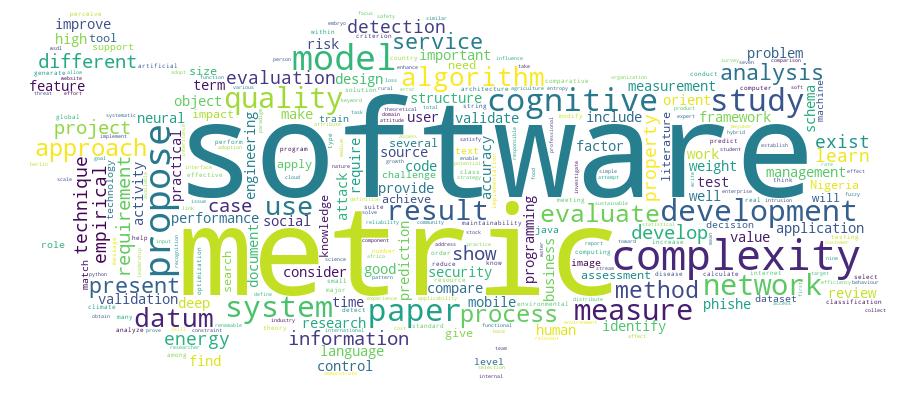
Competency Cloud
160 results
Scholarly Output Search Results
Now showing 1 - 10 of 160
Article Citation - WoS: 33Citation - Scopus: 56Smart irrigation system for environmental sustainability in Africa: An Internet of Everything (IoE) approach(Amer inst Mathematical Sciences-aims, 2019) Adenugba, Favour; Misra, Sanjay; Maskeliunas, Rytis; Damasevicius, Robertas; Kazanavicius, EgidijusWater and food are two of the most important commodities in the world, which makes agriculture crucial to mankind as it utilizes water (irrigation) to provide us with food. Climate change and a rapid increase in population have put a lot of pressure on agriculture which has a snowball effect on the earth's water resource, which has been proven to be crucial for sustainable development. The need to do away with fossil fuel in powering irrigation systems cannot be over emphasized due to climate change. Smart Irrigation systems powered by renewable energy sources (RES) have been proven to substantially improve crop yield and the profitability of agriculture. Here we show how the control and monitoring of a solar powered smart irrigation system can be achieved using sensors and environmental data from an Internet of Everything (IoE). The collected data is used to predict environment conditions using the Radial Basis Function Network (RBFN). The predicted values of water level, weather forecast, humidity, temperature and irrigation data are used to control the irrigation system. A web platform was developed for monitoring and controlling the system remotely.Article Citation - WoS: 35Citation - Scopus: 59A Review of Soft Techniques for Sms Spam Classification: Methods, Approaches and Applications(Pergamon-elsevier Science Ltd, 2019) Abayomi-Alli, Olusola; Misra, Sanjay; Abayomi-Alli, Adebayo; Odusami, ModupeBackground: The easy accessibility and simplicity of Short Message Services (SMS) have made it attractive to malicious users thereby incurring unnecessary costing on the mobile users and the Network providers' resources. Aim: The aim of this paper is to identify and review existing state of the art methodology for SMS spam based on some certain metrics: AI methods and techniques, approaches and deployed environment and the overall acceptability of existing SMS applications. Methodology: This study explored eleven databases which include IEEE, Science Direct, Springer, Wiley, ACM, DBLP, Emerald, SU, Sage, Google Scholar, and Taylor and Francis, a total number of 1198 publications were found. Several screening criteria were conducted for relevant papers such as duplicate removal, removal based on irrelevancy, abstract eligibility based on the removal of papers with ambiguity (undefined methodology). Finally, 83 papers were identified for depth analysis and relevance. A quantitative evaluation was conducted on the selected studies using seven search strategies (SS): source, methods/ techniques, AI approach, architecture, status, datasets and SMS spam mobile applications. Result: A Quantitative Analysis (QA) was conducted on the selected studies and the result based on existing methodology for classification shows that machine learning gave the highest result with 49% with algorithms such as Bayesian and support vector machines showing highest usage. Unlike statistical analysis with 39% and evolutionary algorithms gave 12%. However, the QA for feature selection methods shows that more studies utilized document frequency, term frequency and n-grams techniques for effective features selection process. Result based on existing approaches for content-based, non-content and hybrid approaches is 83%, 5%, and 12% respectively. The QA based on architecture shows that 25% of existing solutions are deployed on the client side, 19% on server-side, 6% collaborative and 50% unspecified. This survey was able to identify the status of existing SMS spam research as 35% of existing study was based on proposed new methods using existing algorithms and 29% based on only evaluation of existing algorithms, 20% was based on proposed methods only. Conclusion: This study concludes with very interesting findings which shows that the majority of existing SMS spam filtering solutions are still between the "Proposed" status or "Proposed and Evaluated" status. In addition, the taxonomy of existing state of the art methodologies is developed and it is concluded that 8.23% of Android users actually utilize this existing SMS anti-spam applications. Our study also concludes that there is a need for researchers to exploit all security methods and algorithm to secure SMS thus enhancing further classification in other short message platforms. A new English SMS spam dataset is also generated for future research efforts in Text mining, Tele-marketing for reducing global spam activities.Book Part Citation - Scopus: 1Measurement of Cognitive Functional Sizes of Software(IGI Global, 2012) Misra, S.One of the major issues in software engineering is the measurement. Since traditional measurement theory has problem in defining empirical observations on software entities in terms of their measured quantities, Morasca tried to solve this problem by proposing Weak Measurement theory. Further, in calculating complexity of software, the emphasis is mostly given to the computational complexity, algorithm complexity, functional complexity, which basically estimates the time, efforts, computability and efficiency. On the other hand, understandability and compressibility of the software which involves the human interaction are neglected in existing complexity measures. Recently, cognitive complexity (CC) to calculate the architectural and operational complexity of software was proposed to fill this gap. In this paper, we evaluated CC against the principle of weak measurement theory. We find that, the approach for measuring CC is more realistic and practical in comparison to existing approaches and satisfies most of the parameters required from measurement theory. © 2012 by IGI Global. All rights reserved.Article Citation - WoS: 11Citation - Scopus: 13Choice Functions for Autonomous Search in Constraint Programming: Ga Vs. Pso(Univ Osijek, Tech Fac, 2013) Soto, Ricardo; Crawford, Broderick; Misra, Sanjay; Palma, Wenceslao; Monfroy, Eric; Castro, Carlos; Paredes, Fernando; Computer EngineeringThe variable and value ordering heuristics are a key element in Constraint Programming. Known together as the enumeration strategy they may have important consequences on the solving process. However, a suitable selection of heuristics is quite hard as their behaviour is complicated to predict. Autonomous search has been recently proposed to handle this concern. The idea is to dynamically replace strategies that exhibit poor performances by more promising ones during the solving process. This replacement is carried out by a choice function, which evaluates a given strategy in a given amount of time via quality indicators. An important phase of this process is performed by an optimizer, which aims at finely tuning the choice function in order to guarantee a precise evaluation of strategies. In this paper we evaluate the performance of two powerful choice functions: the first one supported by a genetic algorithm and the second one by a particle swarm optimizer. We present interesting results and we demonstrate the feasibility of using those optimization techniques for Autonomous Search in a Constraint Programming context.Article Citation - WoS: 1Citation - Scopus: 2Potential of Support-Vector Regression for Forecasting Stream Flow(Univ Osijek, Tech Fac, 2014) Radzi, Mohd Rashid Bin Mohd; Shamshirband, Shahaboddin; Aghabozorgi, Saeed; Misra, Sanjay; Akib, Shatirah; Kiah, Laiha Mat; Kiah, Miss Laiha Mat; Computer EngineeringStream flow is an important input for hydrology studies because it determines the water variability and magnitude of a river. Water resources engineering always deals with historical data and tries to estimate the forecasting records in order to give a better prediction for any water resources applications, such as designing the water potential of hydroelectric dams, estimating low flow, and maintaining the water supply. This paper presents three soft-computing approaches for dealing with these issues, i.e. artificial neural networks (ANNs), adaptive-neuro-fuzzy inference systems (ANFISs), and support vector machines (SVMs). Telom River, located in the Cameron Highlands district of Pahang, Malaysia, was used in making the estimation. The Telom River's daily mean discharge records, such as rainfall and river-level data, were used for the period of March 1984-January 2013 for training, testing, and validating the selected models. The SVM approach provided better results than ANFIS and ANNs in estimating the daily mean fluctuation of the stream's flow.Conference Object Citation - WoS: 1A Cognitive Evaluation for Meetings in Software Development Process(Springer-verlag Berlin, 2009) Misra, Sanjay; Akman, IbrahimSoftware development; includes number of different type of meetings in the whole development process. The cognitive activities also play an important role in decision making activities in these meetings since they are carried out, by human being. In this paper, we evaluated the relevance of meetings in different phases of the software development process with reference to cognitive aspects.Conference Object A Model for Measuring Cognitive Complexity of Software(Springer Verlag, 2008) Misra,S.; Akman,I.This paper proposes a model for calculating cognitive complexity of a code. This model considers all major factors responsible for (cognitive) complexity. The practical applicability of the measure is evaluated through experimentation, test cases and comparative study. © 2008 Springer-Verlag Berlin Heidelberg.Article Citation - WoS: 38Citation - Scopus: 59Career Abandonment Intentions among Software Workers(Wiley, 2014) Colomo-Palacios, Ricardo; Casado-Lumbreras, Cristina; Misra, Sanjay; Soto-Acosta, PedroWithin the software development industry, human resources have been recognized as one of the most decisive and scarce resources. Today, the retention of skilled IT (information technology) personnel is a major issue for employers and recruiters as well, since IT career abandonment is a common practice and means not only the loss of personnel, knowledge, and skills, but also the loss of business opportunities. This article seeks to discover the main motivations young practitioners abandon the software career. To achieve this objective, two studies were conducted. The first study was qualitative (performed through semistructured interviews) and intended to discover the main variables affecting software career abandonment. The second study was quantitative, consisting of a Web-based survey developed from the output of the first study and administered to a sample of 148 IT practitioners. Results show that work-related, psychological, and emotional variable are the most relevant group of variables explaining IT career abandonment. More specifically, the three most important variables that motivate employees to abandon the career are effort-reward imbalance, perceived workload, and emotional exhaustion. In contrast, variables such as politics and infighting, uncool work, and insufficient resources influence to a lesser extent the decision to leave the career. (c) 2012 Wiley Periodicals, Inc.Article Citation - WoS: 21Citation - Scopus: 22A Discussion on the Role of People in Global Software Development(Univ Osijek, Tech Fac, 2013) Misra, Sanjay; Colomo-Palacios, Ricardo; Pusatli, Tolga; Soto-Acosta, Pedro; Computer EngineeringLiterature is producing a considerable amount of papers which focus on the risks, challenges and solutions of global software development (GSD). However, the influence of human factors on the success of GSD projects requires further study. The aim of our paper is twofold. First, to identify the challenges related to the human factors in GSD and, second, to propose the solution(s), which could help in solving or reducing the overall impact of these challenges. The main conclusions of this research can be valuable to organizations that are willing to achieve the quality objectives regarding GSD projects.Article An Evaluation of ICT Infrastructure and Application in Nigeria Universities(Budapest Tech Polytechnical Institution, 2014) Egoeze, Fidelis; Misra, Sanjay; Akman, Ibrahim; Colomo-Palacios, Ricardo
