
Aras, Gökşen
Loading...
Profile URL
Name Variants
Aras, Goksen
Aras,G.
Gökşen Aras
A., Goksen
G.,Aras
A.,Goksen
Aras, Gökşen
Gökşen, Aras
A., Gökşen
Aras,Goksen
A.,Gökşen
Goksen, Aras
G., Aras
Aras,G.
Gökşen Aras
A., Goksen
G.,Aras
A.,Goksen
Aras, Gökşen
Gökşen, Aras
A., Gökşen
Aras,Goksen
A.,Gökşen
Goksen, Aras
G., Aras
Job Title
Doktor Öğretim Üyesi
Email Address
goksen.aras@atilim.edu.tr
Main Affiliation
Department of English Language and Literature
Status
ORCID ID
Scopus Author ID
Turkish CoHE Profile ID
Google Scholar ID
WoS Researcher ID
Sustainable Development Goals
 1
1NO POVERTY
1
Research Products
 2
2ZERO HUNGER
1
Research Products
 3
3GOOD HEALTH AND WELL-BEING
2
Research Products
 4
4QUALITY EDUCATION
0
Research Products
 5
5GENDER EQUALITY
8
Research Products
 6
6CLEAN WATER AND SANITATION
0
Research Products
 7
7AFFORDABLE AND CLEAN ENERGY
0
Research Products
 8
8DECENT WORK AND ECONOMIC GROWTH
3
Research Products
 9
9INDUSTRY, INNOVATION AND INFRASTRUCTURE
2
Research Products
 10
10REDUCED INEQUALITIES
4
Research Products
 11
11SUSTAINABLE CITIES AND COMMUNITIES
0
Research Products
 12
12RESPONSIBLE CONSUMPTION AND PRODUCTION
0
Research Products
 13
13CLIMATE ACTION
0
Research Products
 14
14LIFE BELOW WATER
1
Research Products
 15
15LIFE ON LAND
0
Research Products
 16
16PEACE, JUSTICE AND STRONG INSTITUTIONS
6
Research Products
 17
17PARTNERSHIPS FOR THE GOALS
1
Research Products

Documents
3
Citations
0
h-index
0

This researcher does not have a WoS ID.

Scholarly Output
68
Articles
19
Views / Downloads
17/0
Supervised MSc Theses
34
Supervised PhD Theses
8
WoS Citation Count
12
Scopus Citation Count
0
Patents
0
Projects
0
WoS Citations per Publication
0.18
Scopus Citations per Publication
0.00
Open Access Source
15
Supervised Theses
42
| Journal | Count |
|---|---|
| Turkish Studies (Elektronik) | 3 |
| ULUSLARARASI HAKEMLİ AKADEMİK VE BEŞERİ BİLİMLER DERGİSİ | 3 |
| IIB International Refereed Academic Social Sciences Journal | 2 |
| Iranian Journal of Public Health | 2 |
| Turkish Studies - Language and Literature | 2 |
Current Page: 1 / 3
Scopus Quartile Distribution
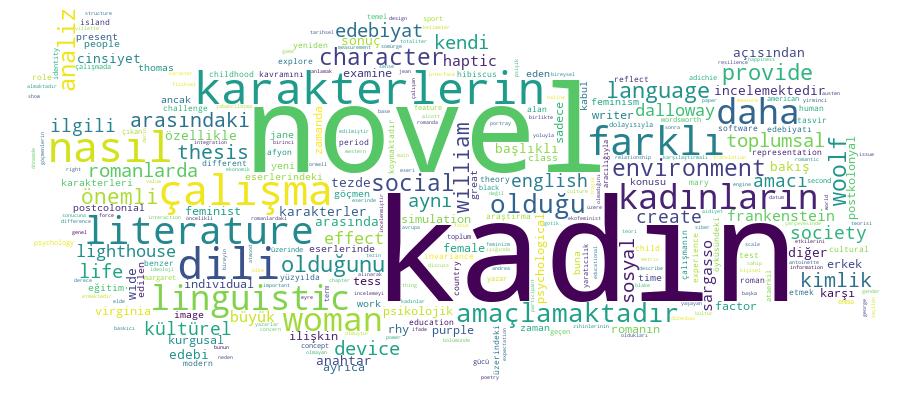
Competency Cloud
5 results
Scholarly Output Search Results
Now showing 1 - 5 of 5
Conference Object Citation - WoS: 6Personality and Individual Differences: Literature in Psychology-Psychology in Literature(Elsevier Science Bv, 2015) Aras, GoksenLiterature, which intertwines within such fields as history, philosophy, sociology, psychology and so on, is a discipline wherein language is used as a medium of expression so as to interpret man, existence and culture. The objective of this paper is to discuss literature in terms of its interdisciplinary structure, psychology, in particular, considering man and existence, personality and individual differences which have always been studied by writers, philosophers, artists, psychologists and psychiatrists. Several complex notions, unfathomable personalities and ambiguous motives have been associated with characters in literary genres: For example the term Bovarism is explained by means of Flaubert's Madame Bovary. Similar examples in literary works could be multiplied. Man and existence have been fundamental themes in literature, which has existed even before psychology. Works of literature and art enable individuals to be aware of their personalities and individual differences and to question life and existence, the main data in the field of psychology as well. It is overtly seen that there is a very strong correlation between literature and psychology since both of them deal with human beings and their reactions, miseries, desires, and their individual and social concerns by means of different concepts, methods, and approaches. (C) 2015 The Authors. Published by Elsevier Ltd.Conference Object Characterizing the Position of Cio(Ieee, 2012) Cano, Carmen; Fernandez-Sanz, Luis; Misra, SanjayThis paper describes how the CIO position appear as a key role in the organizations and which are the requirements for candidates to it. We have compared the requirements presented in different studies in order to know which are the most important for a successful performance as CIO..Conference Object Conference Object Citation - WoS: 1Haptic User Interface Integration for 3d Game Engines(Springer-verlag Berlin, 2014) Sengul, Gokhan; Cagiltay, Nergiz Ercil; Ozcelik, Erol; Tuner, Emre; Erol, BatuhanTouch and feel senses of human beings provide important information about the environment. When those senses are integrated with the eyesight, we may get all the necessary information about the environment. In terms of human-computer-interaction, the eyesight information is provided by visual displays. On the other hand, touch and feel senses are provided by means of special devices called "haptic" devices. Haptic devices are used in many fields such as computer-aided design, distance-surgery operations, medical simulation environments, training simulators for both military and medical applications, etc. Besides the touch and sense feelings haptic devices also provide force-feedbacks, which allows designing a realistic environment in virtual reality applications. Haptic devices can be categorized into three classes: tactile devices, kinesthetic devices and hybrid devices. Tactile devices simulate skin to create contact sensations. Kinesthetic devices apply forces to guide or inhibit body movement, and hybrid devices attempt to combine tactile and kinesthetic feedback. Among these kinesthetic devices exerts controlled forces on the human body, and it is the most suitable type for the applications such as surgical simulations. The education environments that require skill-based improvements, the touch and feel senses are very important. In some cases providing such educational environment is very expensive, risky and may also consist of some ethical issues. For example, surgical education is one of these fields. The traditional education is provided in operating room on real patients. This type of education is very expensive, requires long time periods, and does not allow any error-and-try type of experiences. It is stressfully for both the educators and the learners. Additionally there are several ethical considerations. Simulation environments supported by such haptic user interfaces provide an alternative and safer educational alternative. There are several studies showing some evidences of educational benefits of this type of education (Tsuda et al 2009; Sutherland et al 2006). Similarly, this technology can also be successfully integrated to the physical rehabilitation process of some diseases requiring motor skill improvements (Kampiopiotis & Theodorakou, 2003). Hence, today simulation environments are providing several opportunities for creating low cost and more effective training and educational environment. Today, combining three dimensional (3D) simulation environments with these haptic interfaces is an important feature for advancing current human-computer interaction. On the other hand haptic devices do not provide a full simulation environment for the interaction and it is necessary to enhance the environment by software environments. Game engines provide high flexibility to create 3-D simulation environments. Unity3D is one of the tools that provides a game engine and physics engine for creating better 3D simulation environments. In the literature there are many studies combining these two technologies to create several educational and training environments. However, in the literature, there are not many researches showing how these two technologies can be integrated to create simulation environment by providing haptic interfaces as well. There are several issues that need to be handled for creating such integration. First of all the haptic devices control libraries need to be integrated to the game engine. Second, the game engine simulation representations and real-time interaction features need to be coordinately represented by the haptic device degree of freedom and force-feedback speed and features. In this study, the integration architecture of Unity 3D game engine and the PHANToM Haptic device for creating a surgical education simulation environment is provided. The methods used for building this integration and handling the synchronization problems are also described. The algorithms developed for creating a better synchronization and user feedback such as providing a smooth feeling and force feedback for the haptic interaction are also provided. We believe that, this study will be helpful for the people who are creating simulation environment by using Unity3D technology and PHANToM haptic interfaces.Conference Object Citation - WoS: 3Quantitative and Qualitative Analysis of Globally Distributed Team Collaboration in Design and Development of Software(Ieee, 2013) Milewski, Allen E.; Serce, F. Cemile; Swigger, K.The goal of this study is to understand the dynamics of collaboration within globally-distributed teams working in a realistic Human-System Interaction design and software engineering context. Quantitative data on communications were collected by capturing virtually all of the communications between the team members. Qualitative data were collected through the interviews conducted by the instructors. The projects successfully ended in the software implementation of the front end of an Android app based on the Human-System Interaction design. The results reveal some of the challenges associated with working in interdisciplinary and global settings and suggest areas of caution for future such HSI educational experiences.
