Oymak, Hüseyin

Loading...
Profile Picture
Name Variants
Oymak, Hueseyin
Oymak,H.
Huseyin, Oymak
Oymak, H.
O., Hüseyin
H., Oymak
O.,Hüseyin
Oymak, Hüseyn
H.,Oymak
O.,Huseyin
O., Huseyin
Hüseyin, Oymak
Oymak, Huseyin
Oymak H.
Oymak, Hüseyin
Job Title
Doçent Doktor
Email Address
huseyin.oymak@atilim.edu.tr
Main Affiliation
Electrical-Electronics Engineering
Status
Website
ORCID ID
Scopus Author ID
Turkish CoHE Profile ID
Google Scholar ID
WoS Researcher ID

Sustainable Development Goals

SDG data is not available
Documents

18

Citations

151

h-index

8

This researcher does not have a WoS ID.
Scholarly Output

6

Articles

4

Views / Downloads

3/0

Supervised MSc Theses

1

Supervised PhD Theses

1

WoS Citation Count

14

Scopus Citation Count

11

WoS h-index

2

Scopus h-index

1

Patents

0

Projects

0

WoS Citations per Publication

2.33

Scopus Citations per Publication

1.83

Open Access Source

0

Supervised Theses

2

Google Analytics Visitor Traffic

JournalCount
International Journal of Modern Physics B1
International Journal of Modern Physics C1
Reviews in Theoretical Science1
The Journal of Physical Chemistry A1
Current Page: 1 / 1

Scopus Quartile Distribution

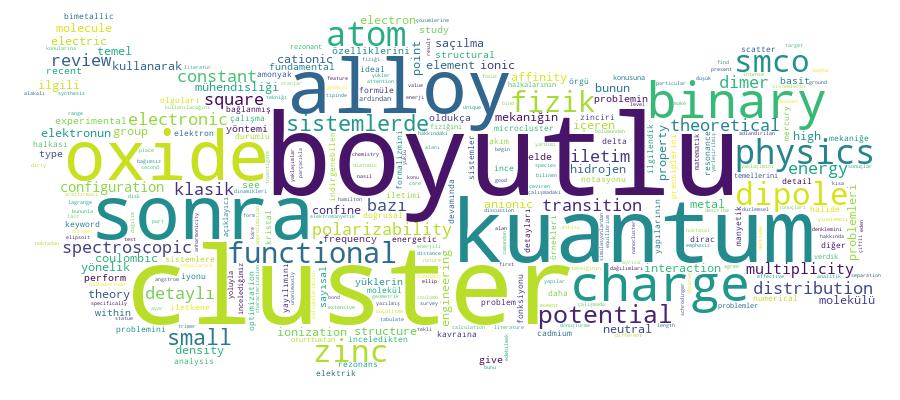
Competency Cloud

GCRIS Competency Cloud

Scholarly Output Search Results

Now showing 1 - 2 of 2
  • Review
    Citation - WoS: 5
    Binary Alloy Clusters: Structures and Electronic Properties
    (Amer Scientific Publishers, 2014) Pekoez, Rengin; Oymak, Hueseyin; Erkoc, Akir
    Synthesis, characterization, physics, and chemistry of nanoclusters have been the focus of intense attention for the last two decades. Also, their unique statues that they are between molecule and bulk material is the central reason for the theoretical researcher to understand the transition from atom to cluster/molecule and then to solid state. In this review we restrict ourselves to the recent advances in the structural and electronic properties of binary alloy clusters. This type of clusters is particularly of importance thanks to their very availability for being tuned, by changing their sizes, according to any special needs. A brief summary of the classification of clusters as well as the experimental techniques and theoretical methods to study them, and the possible applications of alloy clusters are given in the introduction part. Several binary alloy cluster types, including semiconductor, alkali and transition metal, oxide, and ionic binary alloy clusters, are widely reviewed considering extensively the most recent articles.
  • Review
    Citation - WoS: 8
    Citation - Scopus: 10
    Group 12 Elements and Their Small Clusters: Electric Dipole Polarizability of Zn, Cd and Hg, Zn2 Dimer and Higher Znn< Microclusters and Neutral, Cationic and Anionic Zinc Oxide Molecules (zno, Zno+ and Zno-)
    (World Scientific Publ Co Pte Ltd, 2012) Oymak, Huseyin; Erkoc, Sakir
    This review is in general about group 12 elements and their small microclusters. In this part, after presenting an extensive literature survey of the electric dipole polarizability studies of the Zn, Cd and Hg atoms, we specifically target zinc-containing small clusters, beginning with the Zn-2 dimer, the Zn-3 trimer, higher Zn-n clusters and the neutral, cationic and anionic zinc oxide clusters: ZnO, ZnO+ and ZnO-. We tabulated experimental and theoretical results for the spectroscopic constants (dissociation energy D-e or D-0, bond length r(e), fundamental frequency w(e), anharmonicity constant w(e)x(e) and dipole moment mu(e)) of the diatomic clusters and the first and second ionization potentials IP1 and IP2 and electron affinity EA of the species reviewed.