Oymak, Hüseyin

Loading...
Profile Picture
Name Variants
Oymak, Hueseyin
Oymak,H.
Huseyin, Oymak
Oymak, H.
O., Hüseyin
H., Oymak
O.,Hüseyin
Oymak, Hüseyn
H.,Oymak
O.,Huseyin
O., Huseyin
Hüseyin, Oymak
Oymak, Huseyin
Oymak H.
Oymak, Hüseyin
Job Title
Doçent Doktor
Email Address
huseyin.oymak@atilim.edu.tr
Main Affiliation
Electrical-Electronics Engineering
Status
Website
ORCID ID
Scopus Author ID
Turkish CoHE Profile ID
Google Scholar ID
WoS Researcher ID

Sustainable Development Goals

SDG data is not available
Documents

18

Citations

151

h-index

8

This researcher does not have a WoS ID.
Scholarly Output

6

Articles

4

Views / Downloads

3/0

Supervised MSc Theses

1

Supervised PhD Theses

1

WoS Citation Count

14

Scopus Citation Count

11

WoS h-index

2

Scopus h-index

1

Patents

0

Projects

0

WoS Citations per Publication

2.33

Scopus Citations per Publication

1.83

Open Access Source

0

Supervised Theses

2

Google Analytics Visitor Traffic

JournalCount
International Journal of Modern Physics B1
International Journal of Modern Physics C1
Reviews in Theoretical Science1
The Journal of Physical Chemistry A1
Current Page: 1 / 1

Scopus Quartile Distribution

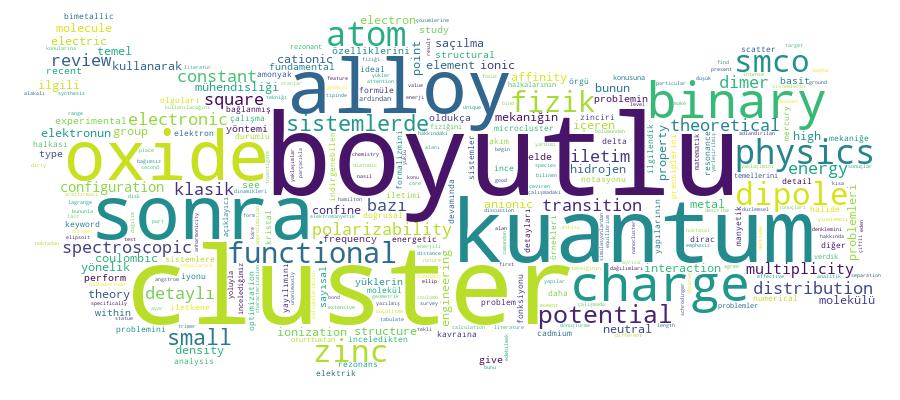
Competency Cloud

GCRIS Competency Cloud

Scholarly Output Search Results

Now showing 1 - 2 of 2
  • Review
    Citation - WoS: 8
    Citation - Scopus: 10
    Group 12 Elements and Their Small Clusters: Electric Dipole Polarizability of Zn, Cd and Hg, Zn2 Dimer and Higher Znn< Microclusters and Neutral, Cationic and Anionic Zinc Oxide Molecules (zno, Zno+ and Zno-)
    (World Scientific Publ Co Pte Ltd, 2012) Oymak, Huseyin; Erkoc, Sakir
    This review is in general about group 12 elements and their small microclusters. In this part, after presenting an extensive literature survey of the electric dipole polarizability studies of the Zn, Cd and Hg atoms, we specifically target zinc-containing small clusters, beginning with the Zn-2 dimer, the Zn-3 trimer, higher Zn-n clusters and the neutral, cationic and anionic zinc oxide clusters: ZnO, ZnO+ and ZnO-. We tabulated experimental and theoretical results for the spectroscopic constants (dissociation energy D-e or D-0, bond length r(e), fundamental frequency w(e), anharmonicity constant w(e)x(e) and dipole moment mu(e)) of the diatomic clusters and the first and second ionization potentials IP1 and IP2 and electron affinity EA of the species reviewed.
  • Article
    Minimum-Energy Distribution of Point Charges Confined To a Square
    (World Scientific Publ Co Pte Ltd, 2019) Oymak, Huseyin; Alkuwafi, Abdulwahhab
    The minimum-energy configurations of N(2 <= N <= 160) identical classical point charges confined within a square under the effect of a Coulombic 1/r potential have been determined by performing steepest-descent simulations. The energies of the final optimized configurations are given, along with their corresponding structural charge distributions. When all systems evolve in time to reach a minimum-energy configuration, local or global, they are all seen to be in quest of symmetry.