Erton, Halil İsmail

Loading...
Profile Picture
Name Variants
Erton, Ismail
Halil Ismail, Erton
Erton,H.İ.
E., Halil Ismail
H., Erton
Erton, Halil İsmail
Halil İsmail, Erton
Erton,H.I.
E.,Halil İsmail
E.,Halil Ismail
H.I.Erton
H.İ.Erton
Erton, Halil Ismail
H.,Erton
Erton, İsmail
Erton,İ.
Job Title
Doçent Doktor
Email Address
ismail.erton@atilim.edu.tr
Main Affiliation
English Translation and Interpretation
Status
Former Staff
Website
ORCID ID
Scopus Author ID
Turkish CoHE Profile ID
Google Scholar ID
WoS Researcher ID

Sustainable Development Goals

NO POVERTY1
NO POVERTY
0
Research Products
ZERO HUNGER2
ZERO HUNGER
4
Research Products
GOOD HEALTH AND WELL-BEING3
GOOD HEALTH AND WELL-BEING
0
Research Products
QUALITY EDUCATION4
QUALITY EDUCATION
2
Research Products
GENDER EQUALITY5
GENDER EQUALITY
1
Research Products
CLEAN WATER AND SANITATION6
CLEAN WATER AND SANITATION
0
Research Products
AFFORDABLE AND CLEAN ENERGY7
AFFORDABLE AND CLEAN ENERGY
0
Research Products
DECENT WORK AND ECONOMIC GROWTH8
DECENT WORK AND ECONOMIC GROWTH
1
Research Products
INDUSTRY, INNOVATION AND INFRASTRUCTURE9
INDUSTRY, INNOVATION AND INFRASTRUCTURE
0
Research Products
REDUCED INEQUALITIES10
REDUCED INEQUALITIES
0
Research Products
SUSTAINABLE CITIES AND COMMUNITIES11
SUSTAINABLE CITIES AND COMMUNITIES
0
Research Products
RESPONSIBLE CONSUMPTION AND PRODUCTION12
RESPONSIBLE CONSUMPTION AND PRODUCTION
0
Research Products
CLIMATE ACTION13
CLIMATE ACTION
0
Research Products
LIFE BELOW WATER14
LIFE BELOW WATER
0
Research Products
LIFE ON LAND15
LIFE ON LAND
0
Research Products
PEACE, JUSTICE AND STRONG INSTITUTIONS16
PEACE, JUSTICE AND STRONG INSTITUTIONS
0
Research Products
PARTNERSHIPS FOR THE GOALS17
PARTNERSHIPS FOR THE GOALS
0
Research Products
This researcher does not have a Scopus ID.
This researcher does not have a WoS ID.
Scholarly Output

39

Articles

18

Views / Downloads

186/772

Supervised MSc Theses

21

Supervised PhD Theses

0

WoS Citation Count

9

Scopus Citation Count

32

Patents

0

Projects

0

WoS Citations per Publication

0.23

Scopus Citations per Publication

0.82

Open Access Source

7

Supervised Theses

21

JournalCount
Journal of Language and Linguistic Studies4
Hacettepe Egitim Dergisi2
Dil ve Tarih-Coğrafya Fakültesi Dergisi1
IOJET1
SSRN Electronic Journal1
Current Page: 1 / 1

Scopus Quartile Distribution

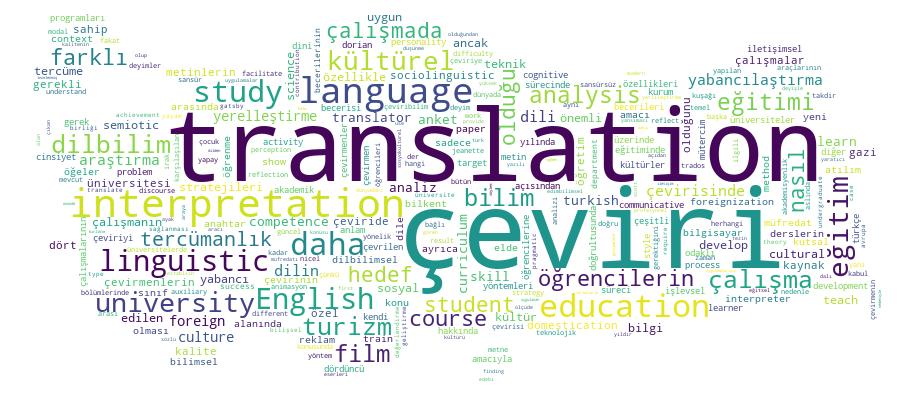
Competency Cloud

GCRIS Competency Cloud

Scholarly Output Search Results

Now showing 1 - 1 of 1
  • Article
    Citation - Scopus: 14
    Linguistic and Cognitive Aspects of Translation and Interpretation Skills
    (Selcuk University, 2020) Erton,İ.
    Translation receives a lot of attention from sociology, psychology, computer sciences, information technologies and from linguistics, from which it originates. With the advances in technology in the 21st century, studies show that translation is not a sterile linguistic activity, but a reflection of a set of skills and capabilities of the translator/interpreter (T/I). In this respect, the formation of translation competence and related practices requires a thorough perception of worldwide affairs embodying value systems that a language holds framed through sociocultural practices. The achievement of the nature of both source and target languages, henceforth, allows for the establishment of effective linguistic competencies. In turn, such sociolinguistic, communicative, strategic, pragmatic and semiotic competencies provide the T/I with the opportunity to consider the translation/interpretation task from a variety of perspectives, all of which might initially seem independent of each other, but inherently correlated in their nature. Especially, the study of the physical properties of speech helps interpreters perceive a wide range of sounds for fluency and strategic thinking. Therefore, translation/interpretation is said to be a communicative activity, to be recognized and acknowledged by practitioners more in the sense that language – the tool of the craft – is a reflection of value systems framed through sociocultural practices and a mindset formulated with critical and creative thinking. This is believed to play a key role in the way translation/interpretation is perceived and, hence, its success upon implementation. In accordance with this framework, this paper provides a set of key qualities accounting for a T/I’s success. © 2020 JLLS and the Authors - Published by JLLS.