Erton, Halil İsmail

Loading...
Profile Picture
Name Variants
Erton, Ismail
Halil Ismail, Erton
Erton,H.İ.
E., Halil Ismail
H., Erton
Erton, Halil İsmail
Halil İsmail, Erton
Erton,H.I.
E.,Halil İsmail
E.,Halil Ismail
H.I.Erton
H.İ.Erton
Erton, Halil Ismail
H.,Erton
Erton, İsmail
Erton,İ.
Job Title
Doçent Doktor
Email Address
ismail.erton@atilim.edu.tr
Main Affiliation
English Translation and Interpretation
Status
Former Staff
Website
ORCID ID
Scopus Author ID
Turkish CoHE Profile ID
Google Scholar ID
WoS Researcher ID

Sustainable Development Goals

NO POVERTY1
NO POVERTY
0
Research Products
ZERO HUNGER2
ZERO HUNGER
4
Research Products
GOOD HEALTH AND WELL-BEING3
GOOD HEALTH AND WELL-BEING
0
Research Products
QUALITY EDUCATION4
QUALITY EDUCATION
2
Research Products
GENDER EQUALITY5
GENDER EQUALITY
1
Research Products
CLEAN WATER AND SANITATION6
CLEAN WATER AND SANITATION
0
Research Products
AFFORDABLE AND CLEAN ENERGY7
AFFORDABLE AND CLEAN ENERGY
0
Research Products
DECENT WORK AND ECONOMIC GROWTH8
DECENT WORK AND ECONOMIC GROWTH
1
Research Products
INDUSTRY, INNOVATION AND INFRASTRUCTURE9
INDUSTRY, INNOVATION AND INFRASTRUCTURE
0
Research Products
REDUCED INEQUALITIES10
REDUCED INEQUALITIES
0
Research Products
SUSTAINABLE CITIES AND COMMUNITIES11
SUSTAINABLE CITIES AND COMMUNITIES
0
Research Products
RESPONSIBLE CONSUMPTION AND PRODUCTION12
RESPONSIBLE CONSUMPTION AND PRODUCTION
0
Research Products
CLIMATE ACTION13
CLIMATE ACTION
0
Research Products
LIFE BELOW WATER14
LIFE BELOW WATER
0
Research Products
LIFE ON LAND15
LIFE ON LAND
0
Research Products
PEACE, JUSTICE AND STRONG INSTITUTIONS16
PEACE, JUSTICE AND STRONG INSTITUTIONS
0
Research Products
PARTNERSHIPS FOR THE GOALS17
PARTNERSHIPS FOR THE GOALS
0
Research Products
This researcher does not have a Scopus ID.
This researcher does not have a WoS ID.
Scholarly Output

39

Articles

18

Views / Downloads

277/2660

Supervised MSc Theses

21

Supervised PhD Theses

0

WoS Citation Count

9

Scopus Citation Count

32

Patents

0

Projects

0

WoS Citations per Publication

0.23

Scopus Citations per Publication

0.82

Open Access Source

7

Supervised Theses

21

JournalCount
Journal of Language and Linguistic Studies4
Hacettepe Egitim Dergisi2
Dil ve Tarih-Coğrafya Fakültesi Dergisi1
IOJET1
SSRN Electronic Journal1
Current Page: 1 / 1

Scopus Quartile Distribution

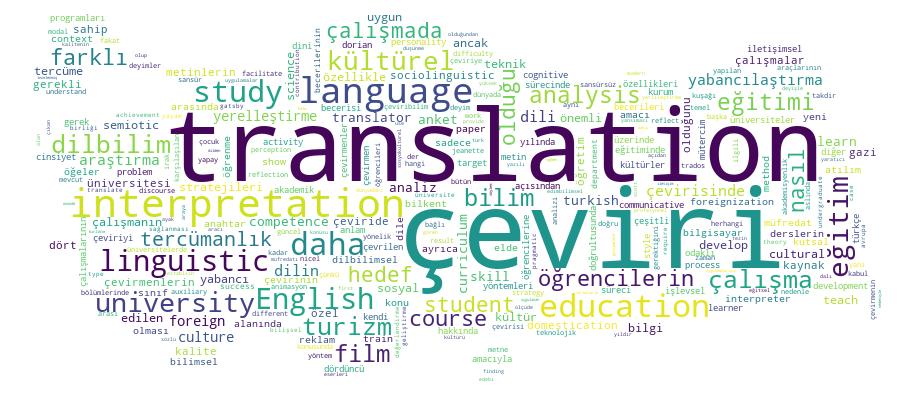
Competency Cloud

GCRIS Competency Cloud

Scholarly Output Search Results

Now showing 1 - 3 of 3
  • Article
    Citation - WoS: 8
    Citation - Scopus: 17
    Relations Between Personality Traits, Language Learning Styles and Success in Foreign Language Achievement
    (Hacettepe Univ, 2010) Erton, Ismail; English Translation and Interpretation
    The purpose of this paper is to show that the reflections of different personality types can be observed in students' developing different learning styles for themselves. It is hypothesized that personality may be a dominant factor in achieving the educational goals through several learning styles in foreign language achievement. To clarify this relationship, Maudsley's 'Personality' and Barsch's 'Learning Styles' inventories were distributed to Bilkent University Freshman students studying at the Faculty of Engineering, Science, Economics, Fine Arts, and Humanities & Letters, who received the English 101 course in their first year at the university. The results were evaluated statistically and the findings showed that there is not a statistically strong, but a low relationship between the personality traits of the learner, the way he/she establishes the learning styles and reflects these characteristics into success while learning a foreign language.
  • Article
    Citation - WoS: 1
    Citation - Scopus: 1
    Discourse Analysis in Translation Education at the University Level: an Assessment of Students' Attitudes
    (Hacettepe Univ, 2014) Erton, Ismail; English Translation and Interpretation
    Translator education, as most scholars agree, requires a detailed comprehension of linguistic rules and practices; hence the reason, why within the departments of translation and interpretation, extra importance is given to the discourse analysis course especially in the first two years of the bachelor's programme. The view presented in this paper is that the linguistics based 'discourse analysis' course plays a significant role in translation and interpretation education by strengthening the curriculum and enabling the development of various skills necessary for the translator. To determine the extent and the impact that learning linguistics has on .translator education, eight courses were selected from upper grades (3rd and 4th years) and their relevance with the discourse analysis course was tested by applying a survey to the corresponding students at the end of the academic year. The findings based on the statistical analysis show that improving linguistic competence throughout translator education at the universities result in success in translation and a better understanding of the source text regardless of its type and context.
  • Article
    Difficulties in Teaching English Modal Auxiliaries To Turkish Students: a Cognitive Pragmatic Approach
    (Arab World English Journal, 2018) Erton, Ismail
    Recently, attention in modern linguistic theory has been shifted to facilitating a broader understanding of the world, in which language is a tool to establish a bridge between the interlocutor and the recipient. To do so, the development of linguistic, communicative and socio-pragmatic competences enriched with socio-cultural inputs in English as a Foreign Language (EFL) or Second Language (L2) teaching and learning contexts have a significant impact on language learners both to develop their perception as native speakers of English and to facilitate the progress of cognitive skills and capabilities. The aim of this paper is to demonstrate a case study to show some of the difficulties in teaching English modal auxiliaries to Turkish students in EFL/L2 contexts which arise not only from structural characteristics, but also from insufficiently developed linguistic, communicative and socio-pragmatic competencies. It is also asserted that only teaching the lexical properties of modal auxiliaries in isolation from their socio-pragmatic and semiotic contexts alone cannot help learners to become successful communicators in the target language as it ends in communication failures, hesitation, a slower L2 progress, fear and misunderstandings. Therefore, role-play activities, doze tests, research assignments, writing tasks and songs can also be integrated into the teaching-learning process to assist learners to become more aware of their actual authentic usages in a wide range of contexts through different activities. On the whole, this would also free language learners to refer to their First Language (L1) input and shape a broader understanding of the Foreign Language (FL) framed with its actual authentic usage.