Akıncılar, Aykan

Loading...
Profile Picture
Name Variants
Akıncılar, Aykan
Aykan, Akincilar
A., Aykan
Aykan, Akıncılar
A.,Aykan
A.,Akıncılar
A.,Akincilar
A., Akincilar
Akincilar, Aykan
Akıncılar,A.
Akincilar,A.
Akıncı,A.
Job Title
Araştırma Görevlisi
Email Address
Main Affiliation
Industrial Engineering
Status
Former Staff
Website
ORCID ID
Scopus Author ID
Turkish CoHE Profile ID
Google Scholar ID
WoS Researcher ID

Sustainable Development Goals

SDG data is not available
This researcher does not have a Scopus ID.
This researcher does not have a WoS ID.
Scholarly Output

1

Articles

1

Views / Downloads

0/0

Supervised MSc Theses

0

Supervised PhD Theses

0

WoS Citation Count

0

Scopus Citation Count

4

WoS h-index

0

Scopus h-index

1

Patents

0

Projects

0

WoS Citations per Publication

0.00

Scopus Citations per Publication

4.00

Open Access Source

1

Supervised Theses

0

Google Analytics Visitor Traffic

JournalCount
Archives of Rheumatology1
Current Page: 1 / 1

Scopus Quartile Distribution

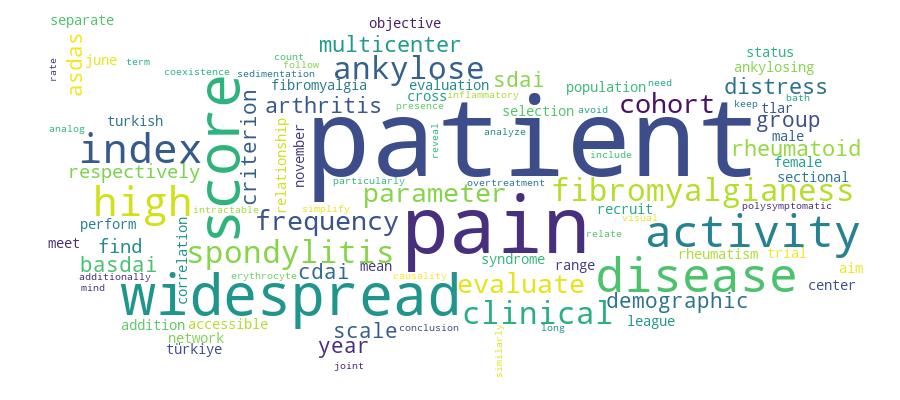
Competency Cloud

GCRIS Competency Cloud

Scholarly Output Search Results

Now showing 1 - 1 of 1
  • Article
    Citation - Scopus: 4
    Frequency of Fibromyalgianess in Patients With Rheumatoid Arthritis and Ankylosing Spondylitis: a Multicenter Study of Turkish League Against Rheumatism (tlar) Network
    (Turkish League Against Rheumatism (TLAR), 2024) Kozanoğlu, Erkan; Kelle, Bayram; Alaylı, Gamze; Kuru, Ömer; Fırat, Sibel Çubukçu; Demir, Ali Nail; Akıncı, Ayşen
    Objectives: This study aimed to evaluate the frequency of fibromyalgianess, fibromyalgia syndrome (FS), and widespread pain in patients with rheumatoid arthritis (RA) and ankylosing spondylitis (AS) and their relationship with clinical and demographic parameters. Patients and methods: This cross-sectional multicenter trial was performed in 14 centers across Türkiye between June 2018 and November 2019. Out of 685 patients recruited from the accessible population, 661 patients (342 RA, 319 AS; 264 males, 397 females; mean age: 48.1±12.9 years; range, 17 to 88 years) met the selection criteria. In these cohorts, those who did not meet the criteria for FS and had widespread pain (widespread pain index ≥7) were evaluated as a separate group. Clinical status and demographic parameters of patients in both cohorts were evaluated as well as the evaluations of RA and AS patients with widespread pain (widespread pain index ≥7) and RA and AS patients with FS groups. In addition, correlations between polysymptomatic distress scale (PSD) scores and Visual Analog Scale (VAS), Simplified Disease Activity Index (SDAI), Clinical Disease Activity Index (CDAI), and Disease Activity Score using 28 joint counts for RA patients and VAS, Bath Ankylosing Spondylitis Disease Activity Index (BASDAI), and Ankylosing Spondylitis Disease Activity Score (ASDAS) for AS patients were analyzed. Results: Frequencies of patients with FS and patients who had PSD scores ≥12 were 34.1% and 44.4% in all RA patients, respectively. Moreover, FS and PSD scores ≥12 were found in 29.2% and 36.9% of all AS patients, respectively. PSD scores of RA patients with FS were higher than all RA patients and RA patients with widespread pain. SDAI and CDAI scores of RA patients with FS were higher than all RA patients and RA patients with widespread pain. Similarly, PSD scores of AS patients with FS were higher than all AS patients and AS patients with widespread pain. ASDAS-erythrocyte sedimentation rate and BASDAI scores of AS patients with FS were found higher than all AS patients and AS patients with widespread pain. Conclusion: Disease activity scores, including pain in RA and AS, were higher in the presence of FS or fibromyalgianess. It may be related to clinical parameters, but cohort studies with long-term follow-up are needed to reveal causality. Additionally, to avoid overtreatment, coexistence of fibromyalgianess should be kept in mind in patients who have inflammatory diseases such as RA and AS, particularly with intractable widespread pain.