Baturay, Meltem Huri

Loading...
Profile Picture
Name Variants
B.,Meltem Huri
B., Meltem Huri
Baturay,M.H.
M.,Baturay
Meltem Huri, Baturay
M., Baturay
M.H.Baturay
Baturay, Meltem Huri
Job Title
Profesör Doktor
Email Address
meltem.baturay@atilim.edu.tr
Main Affiliation
Justice Program
Status
Former Staff
Website
ORCID ID
Scopus Author ID
Turkish CoHE Profile ID
Google Scholar ID
WoS Researcher ID

Sustainable Development Goals

14

LIFE BELOW WATER
LIFE BELOW WATER Logo

0

Research Products

2

ZERO HUNGER
ZERO HUNGER Logo

0

Research Products

11

SUSTAINABLE CITIES AND COMMUNITIES
SUSTAINABLE CITIES AND COMMUNITIES Logo

0

Research Products

1

NO POVERTY
NO POVERTY Logo

0

Research Products

12

RESPONSIBLE CONSUMPTION AND PRODUCTION
RESPONSIBLE CONSUMPTION AND PRODUCTION Logo

0

Research Products

7

AFFORDABLE AND CLEAN ENERGY
AFFORDABLE AND CLEAN ENERGY Logo

0

Research Products

5

GENDER EQUALITY
GENDER EQUALITY Logo

0

Research Products

3

GOOD HEALTH AND WELL-BEING
GOOD HEALTH AND WELL-BEING Logo

0

Research Products

9

INDUSTRY, INNOVATION AND INFRASTRUCTURE
INDUSTRY, INNOVATION AND INFRASTRUCTURE Logo

2

Research Products

13

CLIMATE ACTION
CLIMATE ACTION Logo

0

Research Products

6

CLEAN WATER AND SANITATION
CLEAN WATER AND SANITATION Logo

0

Research Products

10

REDUCED INEQUALITIES
REDUCED INEQUALITIES Logo

0

Research Products

4

QUALITY EDUCATION
QUALITY EDUCATION Logo

5

Research Products

15

LIFE ON LAND
LIFE ON LAND Logo

0

Research Products

16

PEACE, JUSTICE AND STRONG INSTITUTIONS
PEACE, JUSTICE AND STRONG INSTITUTIONS Logo

0

Research Products

17

PARTNERSHIPS FOR THE GOALS
PARTNERSHIPS FOR THE GOALS Logo

0

Research Products

8

DECENT WORK AND ECONOMIC GROWTH
DECENT WORK AND ECONOMIC GROWTH Logo

0

Research Products
This researcher does not have a Scopus ID.
This researcher does not have a WoS ID.
Scholarly Output

12

Articles

10

Views / Downloads

4/0

Supervised MSc Theses

0

Supervised PhD Theses

0

WoS Citation Count

105

Scopus Citation Count

208

WoS h-index

5

Scopus h-index

9

Patents

0

Projects

0

WoS Citations per Publication

8.75

Scopus Citations per Publication

17.33

Open Access Source

6

Supervised Theses

0

Google Analytics Visitor Traffic

JournalCount
Participatory Educational Research3
International Journal of Educational Technology in Higher Education2
Education and Information Technologies1
Springer Briefs in Education1
Turkish Online Journal of Distance Education1
Current Page: 1 / 2

Scopus Quartile Distribution

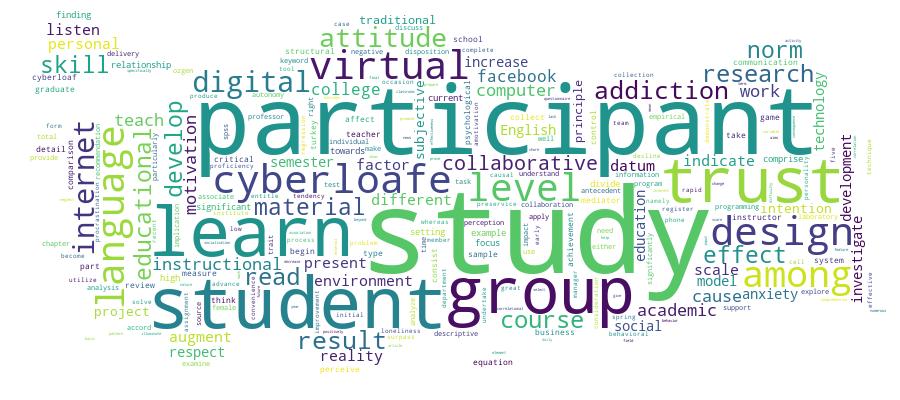
Competency Cloud

GCRIS Competency Cloud

Scholarly Output Search Results

Now showing 1 - 2 of 2
  • Article
    Citation - Scopus: 10
    Intention as a Mediator Between Attitudes, Subjective Norms, and Cyberloafing Among Preservice Teachers of English
    (Ozgen Korkmaz, 2021) Karabıyık,C.; Baturay,M.H.; Özdemir,M.
    Learning and teaching is fostered to a great deal by technology. Cell phones and internet can be utilized as effective tools in providing extended and diversified learning opportunities as well as promoters of learning and teaching. However, early internet-enabled cell phones or more recent smartphones have also become easily accessible avenues of distraction and escape. This study explored if and how intention to cyberloaf acts as a mediator in the relationship between attitudes, subjective norms, and cyberloafing with a focus on descriptive and prescriptive norms with respect to instructors and classmates separately. The research was undertaken at a foundation university in Ankara, Turkey with 214 preservice English teachers. The sample consisted of 152 (71.03%) females and 62 (28.97%) males. Cyberloafing scale developed by Kalaycı (2010), adapted versions of Askew et al.’s (2014) attitudes towards cyberloafing scale, subjective descriptive norms scale, cyberloafing intentions scale, and Blanchard and Henle’s (2008) norms scale were used as data collection instruments. Mediation analyses were performed using SPSS 22 with the utilization of SPSS macro, PROCESS v 3.4 (Hayes, 2017). The results of the regression analyses indicated that subjective norms and attitudes significantly predicted cyberloafing; and intentions to cyberloaf was found to be a significant but partial mediator between the variables. The results have significant implications both for academic research on cyberloafing and for educational practices. © 2021, Ozgen Korkmaz. All rights reserved.
  • Article
    Citation - Scopus: 24
    The Effect of Animation-Based Worked Examples Supported With Augmented Reality on the Academic Achievement, Attitude and Motivation of Students Towards Learning Programming
    (Ozgen Korkmaz, 2022) Cevahir,H.; Özdemir,M.; Baturay,M.H.
    This study examines the effect of using animation-based worked examples (ARAWEs) that are prepared using Augmented Reality (AR) technology instead of using traditional paper-based worked examples (TWEs) on the achievement, motivation, and attitude of high school students during their programming education. The research was designed through the “Nonequivalent Control Group Model”, one of the quasi-experimental models. The participants consisted of second year students (N=94) who were taking the “Basics of Programming” course in the Department of Information Technologies a vocational and technical Anatolian high school in Turkey. An achievement test was applied to the participants as pre-test and final test. Motivation of the students was measured by means of the “Instructional Materials Motivation Survey” developed by Kutu and Sözbilir (2011), and participant attitudes towards using AR was measured by means of the “AR Attitude Scale” developed by Küçük, Yılmaz, Baydaş and Göktaş (2014). According to the results, both the achievement and motivation levels of the students studying on ARAWEs increased significantly compared to those studying on TWEs. There was a high level of correlation between the final test scores and the attitude levels of the students studying on ARAWEs. Considering that instructional materials containing animation-based worked examples prepared using AR technology increase students' interest and motivation in the subject, their use in lessons that include teaching problem solving skills, such as mathematics, physics, and chemistry, can be implemented in future studies. © 2022, Ozgen Korkmaz. All rights reserved.