Kılıç, Hürevren

Loading...
Profile Picture
Name Variants
H., Kilic
Hürevren, Kılıç
Hurevren, Kilic
Kiliç H.
H.,Kilic
H.,Kılıç
H., Kılıç
K., Hürevren
K.,Hurevren
Kılıç,H.
Kilic,H.
Hürevren Kılıç
K.,Hürevren
K., Hurevren
Kilic H.
Kılıç H.
Kılıç, Hürevren
Kilic, Hurevren
Kilic,Hurevren
Job Title
Profesör Doktor
Email Address
hurevren.kilic@atilim.edu.tr
Main Affiliation
Computer Engineering
Status
Scopus Author ID
Turkish CoHE Profile ID
Google Scholar ID
WoS Researcher ID

Sustainable Development Goals

5

GENDER EQUALITY
GENDER EQUALITY Logo

0

Research Products

14

LIFE BELOW WATER
LIFE BELOW WATER Logo

0

Research Products

10

REDUCED INEQUALITIES
REDUCED INEQUALITIES Logo

0

Research Products

3

GOOD HEALTH AND WELL-BEING
GOOD HEALTH AND WELL-BEING Logo

1

Research Products

2

ZERO HUNGER
ZERO HUNGER Logo

0

Research Products

9

INDUSTRY, INNOVATION AND INFRASTRUCTURE
INDUSTRY, INNOVATION AND INFRASTRUCTURE Logo

0

Research Products

16

PEACE, JUSTICE AND STRONG INSTITUTIONS
PEACE, JUSTICE AND STRONG INSTITUTIONS Logo

0

Research Products

11

SUSTAINABLE CITIES AND COMMUNITIES
SUSTAINABLE CITIES AND COMMUNITIES Logo

0

Research Products

8

DECENT WORK AND ECONOMIC GROWTH
DECENT WORK AND ECONOMIC GROWTH Logo

0

Research Products

13

CLIMATE ACTION
CLIMATE ACTION Logo

0

Research Products

4

QUALITY EDUCATION
QUALITY EDUCATION Logo

1

Research Products

6

CLEAN WATER AND SANITATION
CLEAN WATER AND SANITATION Logo

2

Research Products

1

NO POVERTY
NO POVERTY Logo

0

Research Products

15

LIFE ON LAND
LIFE ON LAND Logo

0

Research Products

17

PARTNERSHIPS FOR THE GOALS
PARTNERSHIPS FOR THE GOALS Logo

1

Research Products

7

AFFORDABLE AND CLEAN ENERGY
AFFORDABLE AND CLEAN ENERGY Logo

0

Research Products

12

RESPONSIBLE CONSUMPTION AND PRODUCTION
RESPONSIBLE CONSUMPTION AND PRODUCTION Logo

0

Research Products
This researcher does not have a Scopus ID.
This researcher does not have a WoS ID.
Scholarly Output

34

Articles

8

Views / Downloads

46/0

Supervised MSc Theses

10

Supervised PhD Theses

0

WoS Citation Count

66

Scopus Citation Count

63

WoS h-index

4

Scopus h-index

5

Patents

0

Projects

0

WoS Citations per Publication

1.94

Scopus Citations per Publication

1.85

Open Access Source

2

Supervised Theses

10

Google Analytics Visitor Traffic

JournalCount
Proceedings of the 2007 Inaugural IEEE-IES Digital EcoSystems and Technologies Conference, DEST 2007 -- 2007 Inaugural IEEE-IES Digital EcoSystems and Technologies Conference, DEST 2007 -- 21 February 2007 through 23 February 2007 -- Cairns -- 702542
International Journal of Engineering Education2
2014 IEEE Symposium on Intelligent Agents (IA) -- DEC 09-12, 2014 -- Orlando, FL1
21st Signal Processing and Communications Applications Conference (SIU) -- APR 24-26, 2013 -- CYPRUS1
26th Annual International Symposium on Computer and Information Science -- SEP 26-28, 2011 -- Royal Soc London, London, ENGLAND1
Current Page: 1 / 5

Scopus Quartile Distribution

Competency Cloud

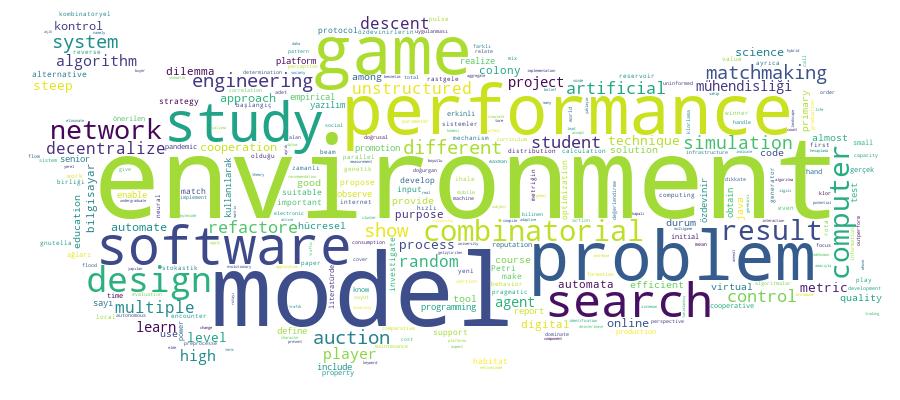
GCRIS Competency Cloud

Scholarly Output Search Results

Now showing 1 - 10 of 23
  • Conference Object
    F-Actor: a Multiagent Gaming Environment for Controlling Virtual Flow Networks
    (Univ Wolverhampton, 2008) Ocal, Ilter Kagan; Cevik, Ahmet; Cereci, Ibrahim; Kilic, Hurevren; Computer Engineering
    A gaming environment that enables agent-based local control of a configurable virtual flow network is developed. The gaming software what we call F-Actor provides a graph-based discrete virtual control environment on which user-developed controller agents reside and act according to their assigned design goals. Runtime performances of user-developed controller agent codes are made observable through a graphical user interface. The proposed game can be played by different developers having different level of control and programming knowledge. By playing with F-Actor, engineers (or students) can make practices on a virtual flow environment and try alternative intelligent control algorithms before their potential implementations on field.
  • Conference Object
    Citation - Scopus: 21
    An Empirical Study About Search-Based Refactoring Using Alternative Multiple and Population-Based Search Techniques
    (2012) Koc,E.; Ersoy,N.; Andac,A.; Camlidere,Z.S.; Cereci,I.; Kilic,H.
    Automated maintenance of object-oriented software system designs via refactoring is a performance demanding combinatorial optimization problem. In this study, we made an empirical comparative study to see the performances of alternative search algorithms under a quality model defined by an aggregated software fitness metric. We handled 20 different refactoring actions that realize searches on design landscape defined by combination of 24 object-oriented software metrics. The investigated algorithms include random, steepest descent, multiple first descent, multiple steepest descent, simulated annealing and artificial bee colony searches. The study is realized by using a tool called A-CMA developed in Java that accepts bytecode compiled Java codes as its input. The empiricial study showed that multiple steepest descent and population-based artificial bee colony algorithms are two most suitable approaches for the efficient solution of the search based refactoring problem. © 2012 Springer-Verlag London Limited.
  • Article
    Citation - WoS: 4
    Citation - Scopus: 6
    An Automata Networks Based Preprocessing Technique for Artificial Neural Network Modelling of Primary Production Levels in Reservoirs
    (Elsevier, 2007) Kilic, Hurevren; Soyupak, Selcuk; Tuzun, Ilhami; Ince, Ozlem; Basaran, Gokben
    Primary production in lakes and reservoirs develops as a result of complex reactions and interactions. Artificial neural networks (ANN) emerges as an approach in quantification of primary productivity in reservoirs. Almost all of the past ANN applications employed input data matrices whose vectors represent either water quality parameters or environmental characteristics. Most of the time, the components of input matrices are determined using expert opinion that implies possible factors that affect output vector. Major disadvantage of this approach is the possibility of ending-up with an input matrix that may have high correlations between some of its components. In this paper, an automata networks (AN) based preprocessing technique was developed to select suitable and appropriate constituents of input matrix to eliminate redundancy and to enhance calculation efficiency. The proposed technique specifically provides an apriori rough behavioral modeling through identification of minimal AN interaction topology. Predictive ANN models of primary production levels were developed for a reservoir following AN based pre-modeling step. The achieved levels of model precisions and performances were acceptable: the calculated root mean square error values (RMSE) were low; a correlation coefficient (R) as high as 0.83 was achieved with an ANN model of a specific structure. (c) 2006 Elsevier B.V. All rights reserved.
  • Conference Object
    Citation - WoS: 13
    Search-Based Parallel Refactoring Using Population-Based Direct Approaches
    (Springer-verlag Berlin, 2011) Kilic, Hurevren; Koc, Ekin; Cereci, Ibrahim
    Automated software refactoring is known to be one of the "hard" combinatorial optimization problems of the search-based software engineering field. The difficulty is mainly due to candidate solution representation, objective function description and necessity of functional behavior preservation of software. The problem is formulated as a combinatorial optimization problem whose objective function is characterized by an aggregate of object-oriented metrics or pareto-front solution description. In our recent empirical study, we have reported the results of a comparison among alternative search algorithms applied for the same problem: pure random, steepest descent, multiple first descent, simulated annealing, multiple steepest descent and artificial bee colony searches. The main goal of the study was to investigate potential of alternative multiple and population-based search techniques. The results showed that multiple steepest descent and artificial bee colony algorithms were most suitable two approaches for an efficient solution of the problem. An important observation was either with depth-oriented multiple steepest descent or breadth-oriented population-based artficial bee colony searches, better results could be obtained through higher number of executions supported by a lightweight solution representation. On the other hand different from multiple steepest descent search, population-based, scalable and being suitable for parallel execution characteristics of artificial bee colony search made the population-based choices to be the topic of this empirical study. I In this study, we report the search-based parallel refactoring results of an empirical comparative study among three population-based search techniques namely, artificial bee colony search, local beam search and stochastic beam search and a non-populated technique multiple steepest descent as the baseline. For our purpose, we used parallel features of our prototype automated refactoring tool A-CMA written in Java language. A-CMA accepts bytecode compiled Java codes as its input. It supports 20 different refactoring actions that realize searches on design landscape defined by an adhoc quality model being an aggregation of 24 object-oriented software metrics. We experimented 6 input programs written in Java where 5 of them being open source codes and one student project code. The empirical results showed that for almost all of the considered input programs with different run parameter settings, local beam search is the most suitable population-based search technique for the efficient solution of the search-based parallel refactoring problem in terms of mean and maximum normalized quality gain. However, we observed that the computational time requirement for local beam search becomes rather high when the beam size exceeds 60. On the other hand, even though it is not able to identify high quality designs for less populated search setups, time-efficiency and scalability properties of artificial bee colony search makes it a good choice for population sizes >= 200.
  • Conference Object
    An Investigation About Process Matchmaking Performances of Unstructured and Decentralized Digital Environments
    (Ieee, 2007) Cakir, Bugra; Kilic, Hurevren
    Efficient matchmaking is an important problem in unstructured and decentralized digital environments. We report the results of simulations of these environments and provide measurements of match performance focusing on unstructured and decentralized environments. In the study, different environment models including P2P (Hypergrid, Gnutella with/without ultrapeer); small-world (Watts-Strogatz); heavy-tailed and random versions of Autonomous System Waxman model showing power-law distribution property; random and 2D-Grid are considered. The flooding mechanism enabling process encounters for match purposes is uninformed Breadth-First-Search. Simulations show that the matchmaking performance of random environment outperforms the others for almost all different problems and time-to-live settings. On the other hand, the total cost of small world environment model is the highest for almost all setups.
  • Conference Object
    Citation - WoS: 3
    An Agent-based Trading Infrastructure for Combinatorial Reverse Auctions
    (Ieee, 2014) Bayindir, Hakan; Kilic, Hurevren; Rehan, Mohammed
    A Combinatorial Reverse Auction Trading Infrastructure - CRATI is designed and implemented as an agent-based system. Two basic building blocks Java Agent Development Framework (JADE) and an Open Source Java Constraint Programming Library (Choco Solver) are used to facilitate agent interactions and an optimization task. For our purpose, it is shown that auction Winner Determination Problem (WDP) can suitably be represented as a weighted set covering problem instance whose solution gives the decided winners of the auction process. In order to realize the system, a variation of Contract Net protocol is designed and implemented to handle auctions that occur in the platform from start to finish.
  • Conference Object
    Citation - WoS: 2
    CAWP A Combinatorial Auction Web Platform
    (Scitepress, 2010) Cereci, Ibrahim; Kilic, Hurevren
    Online auctions, including online Combinatorial Auctions, are important examples of e-commerce applications. In this paper, a Combinatorial Auction Web Platform (CAWP) is introduced. The platform enables both product selling and buying capabilities that can be realized in a combinatorial way. CAWP supports a Sealed-Bid Single-Unit type of Combinatorial Auctions. Easy customization for any selected problem domain is a distinguished feature of CAWP. Platform users are not expected to have any technical knowledge about how to solve the Winner Determination Problem (WDP) known to be critical for profit maximization of the auctioneers in Combinatorial Auctions.
  • Article
    Citation - WoS: 1
    Citation - Scopus: 1
    İki Boyutlu Doğrusal Tek Tip Hücresel Özdevinirlerin Başlangıç Durum Yoğunluklarını Dikkate Alan Sözde Rastgele Sayı Üretimlerinin Başarım Analizi
    (Gazi Univ, Fac Engineering Architecture, 2024) Kılıç, Hürevren
    Bu çalışmada, iki boyutlu doğrusal tek tip hücresel özdevinirlerin başlangıç durum yoğunluklarının sözde-rastgele sayı üretimlerine olan etkisi deneysel olarak incelenmiştir. Geliştirilen yaklaşım, hücresel özdevinirlerin kaliteli sözde-rastgele sayı üretimlerinde başlangıç durum yoğunluklarının dikkate alması açısından özgündür. Deneylerde 512 adet iki boyutlu doğrusal hücresel özdevinir (DHÖ) değerleri 0,05 ile 0,95 arasında değişen 19 adet farklı başlangıç durum yoğunlukları (ρ) için (toplam 512*19 = 9728 adet) incelenmiştir. Sayı dizisi üretimlerini takiben deneylerin ilk aşamasında söz konusu DHÖ’ler literatürde bilinen rastgele sayı üreteçleriyle birlikte National Institute of Standards and Technology (NIST) istatistiksel test süiti testlerine tabi tutulmuştur. İkinci aşamada ise, ilk aşamadaki NIST testlerinden başarılı olarak geçen 7 adet farklı yoğunluktaki hücresel özdevinire ve literatürde bilinen üreteçlere AIS31 ve TestU01 test süitlerinde yer alan testler uygulanmıştır. Yapılan karşılaştırmalı çalışma neticesinde, rastgele sayı üretimlerinde başarılı olan 2D doğrusal hücresel özdevinir üreteçlerin doğrudan kriptografik amaçlı uygulamalar için kullanımlarının uygun olmadığı, özellikle literatürde yer alan zorlu (stringent) testlerden olan TestU01 testlerinin uygulanması neticesinde görülmüştür. Bu netice literatürde bilinen sonuçları desteklemektedir. Öte yandan 9728 adet özdevinire uygulanan NIST testleri neticesinde alınan sonuçlara göre özdevinirlerin başlangıç durum yoğunluk oranlarının sözde rastgele sayı üretimlerini etkilemektedir ve literatürde dikkate alınmayan bu durum özdevinir tabanlı sözde rastgele sayı üretimi araştırmalarında dikkate alınmalıdır.
  • Conference Object
    Citation - WoS: 17
    An Empirical Study About Search-Based Refactoring Using Alternative Multiple and Population-Based Search Techniques
    (Springer-verlag London Ltd, 2012) Koc, Ekin; Ersoy, Nur; Andac, Ali; Camlidere, Zelal Seda; Cereci, Ibrahim; Kilic, Hurevren
    Automated maintenance of object-oriented software system designs via refactoring is a performance demanding combinatorial optimization problem. In this study, we made an empirical comparative study to see the performances of alternative search algorithms under. a quality model defined by an aggregated software fitness metric. We handled 20 different refactoring actions that realize searches on design landscape defined by combination of 24 object-oriented software metrics. The investigated algorithms include random, steepest descent, multiple first descent, multiple steepest descent, simulated annealing and artificial bee colony searches. The study is realized by using a tool called A-CMA developed in Java that accepts bytecode compiled Java codes as its input. The empiricial study showed that multiple steepest descent and population-based artificial bee colony algorithms are two most suitable approaches for the efficient solution of the search based refactoring problem.
  • Conference Object
    Citation - Scopus: 1
    Cooperation Formation and Progression Among Culturally Adaptive Rational Agents in Prisoner's Dilemma Game Environment
    (Ieee, 2024) Efe, Berat; Cerkez, Elif; Kilic, Hurevren
    We investigate whether a persistent and stable cooperative behavior can be observed among particle swarm inspired culturally adaptive and rational players in the context of Prisoner's Dilemma game environment. Our obtained results and discussions point out to the initial value sensitivity of the game set up for cooperation progression as well as soundness of the Prisoner's Dilemma game in the explanation player's behavior.