Erkan, Turan Erman

Loading...
Profile Picture
Name Variants
Turan Erman Erkan
Erkan T.
Erkan,T.E.
T.E.Erkan
E., Turan Erman
Turan Erman, Erkan
Erkan, Turan Erman
E.,Turan Erman
Erkan,Turan Erman
T. E. Erkan
T.,Erkan
T., Erkan
Erkan, E. T.
Job Title
Profesör Doktor
Email Address
erman.erkan@atilim.edu.tr
Main Affiliation
Industrial Engineering
Status
Website
Scopus Author ID
Turkish CoHE Profile ID
Google Scholar ID
WoS Researcher ID

Sustainable Development Goals

2

ZERO HUNGER
ZERO HUNGER Logo

0

Research Products

14

LIFE BELOW WATER
LIFE BELOW WATER Logo

0

Research Products

17

PARTNERSHIPS FOR THE GOALS
PARTNERSHIPS FOR THE GOALS Logo

1

Research Products

5

GENDER EQUALITY
GENDER EQUALITY Logo

0

Research Products

16

PEACE, JUSTICE AND STRONG INSTITUTIONS
PEACE, JUSTICE AND STRONG INSTITUTIONS Logo

1

Research Products

8

DECENT WORK AND ECONOMIC GROWTH
DECENT WORK AND ECONOMIC GROWTH Logo

3

Research Products

4

QUALITY EDUCATION
QUALITY EDUCATION Logo

4

Research Products

6

CLEAN WATER AND SANITATION
CLEAN WATER AND SANITATION Logo

0

Research Products

7

AFFORDABLE AND CLEAN ENERGY
AFFORDABLE AND CLEAN ENERGY Logo

0

Research Products

10

REDUCED INEQUALITIES
REDUCED INEQUALITIES Logo

1

Research Products

11

SUSTAINABLE CITIES AND COMMUNITIES
SUSTAINABLE CITIES AND COMMUNITIES Logo

3

Research Products

9

INDUSTRY, INNOVATION AND INFRASTRUCTURE
INDUSTRY, INNOVATION AND INFRASTRUCTURE Logo

5

Research Products

1

NO POVERTY
NO POVERTY Logo

1

Research Products

3

GOOD HEALTH AND WELL-BEING
GOOD HEALTH AND WELL-BEING Logo

4

Research Products

12

RESPONSIBLE CONSUMPTION AND PRODUCTION
RESPONSIBLE CONSUMPTION AND PRODUCTION Logo

2

Research Products

13

CLIMATE ACTION
CLIMATE ACTION Logo

0

Research Products

15

LIFE ON LAND
LIFE ON LAND Logo

0

Research Products
Documents

16

Citations

329

h-index

9

Documents

21

Citations

508

Scholarly Output

63

Articles

18

Views / Downloads

5/0

Supervised MSc Theses

28

Supervised PhD Theses

7

WoS Citation Count

476

Scopus Citation Count

695

WoS h-index

9

Scopus h-index

10

Patents

0

Projects

0

WoS Citations per Publication

7.56

Scopus Citations per Publication

11.03

Open Access Source

9

Supervised Theses

35

Google Analytics Visitor Traffic

JournalCount
Tehnicki Vjesnik4
5th World Conference on Educational Sciences (WCES) -- FEB 05-08, 2013 -- Rome Sapienza Univ, Rome, ITALY2
3rd International Conference on Information Management and Evaluation (ICIME) -- APR 16-17, 2012 -- Atilim Univ, Performance Management & Applicat Res Ctr, Ankara, TURKEY2
Gazi Üniversitesi İktisadi ve İdari Bilimler Fakültesi Dergisi2
Developing Dynamic and Sustainable Supply Chains to Achieve Sustainable Development Goals1
Current Page: 1 / 5

Scopus Quartile Distribution

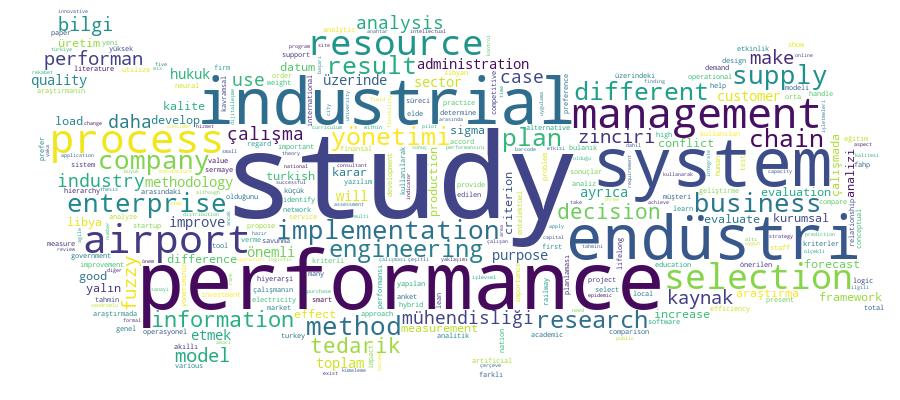
Competency Cloud

GCRIS Competency Cloud

Scholarly Output Search Results

Now showing 1 - 3 of 3
  • Article
    Citation - Scopus: 43
    Determination of Key Performance Indicators for Measuring Airport Success: a Case Study in Libya
    (Elsevier Ltd, 2018) Eshtaiwi,M.; Badi,I.; Abdulshahed,A.; Erkan,T.E.
    Airports need to evaluate their performance and effectiveness periodically to determine whether objectives are being achieved and how their performance compares to similar best practices. The goals of this paper are twofold: First, to offer a list of essential airport key performance indicators (KPIs) that can provide decision makers in the Libyan airport industry a practical framework to measure and monitor performance over time. The second goal is to use the AHP technique to derive the weights of the KPIs and to select the best international airport in Libya based on the values of the KPIs at each airport according to the judgments of experts. However, the implementation steps of the AHP method will be simplified by using the Expert Choice software. The paper presents the importance weights of seventeen KPIs across five aspects of airport performance. As a result of this study, Libyan airports can benchmark their performance against others or through internal benchmarking. © 2017 Elsevier Ltd
  • Article
    Citation - WoS: 22
    Citation - Scopus: 28
    Combining AHP and ROC with GIS for Airport Site Selection: A Case Study in Libya
    (Mdpi, 2020) Erkan, Turan Erman; Elsharida, Wael Mohamed
    Choosing airport locations requires thorough and comprehensive decisions to be made. To do so in a professional and logical manner is crucial for the social, economic, and logistic settings intended for any region. The present research takes place in Libya, where airports are just as vital for the economy in terms of tourism and investment by allowing for improved transportation throughout the developing market and supplier locations as well as trading between the industrial and financial sectors. For this reason, using the geographic information system (GIS) to determine the appropriate airport site, twenty-three criteria were considered. In addition, two different methods-analytic hierarchy process (AHP) and rank order centroid (ROC)-were utilized to derive the related weights. The comparison of the output maps from these two distinctive approaches shows that both approaches provide identical results. Finally, a sensitivity analysis was carried out to evaluate the reliability of the method used and select the best site among the proposed ones based on the result of the highest suitability index for each candidate site. This research provides a siting approach and substantial support for decision-makers in the issue of airport locations selection in Libya and other developing countries.
  • Article
    Citation - WoS: 22
    Citation - Scopus: 30
    Selecting the Best Warehouse Data Collecting System by Using Ahp and Fahp Methods
    (Univ Osijek, Tech Fac, 2014) Erkan, Turan Erman; Can, Gulin Feryal; Industrial Engineering
    Recently companies have begun to use their storage effectively to attain leadership in the market environment, utilizing Barcode and RFID (Radio Frequency Identification) systems for warehouse management. In this study AHP (Analytic Hierarchy Process) and FAHP (Fuzzy Analytic Hierarchy Process) are used to choose between Barcode and RFID systems for the company warehouse data collection system. This decision is affected by four criteria which are: cost, functionality, sustainability and performance. The barcode system was preferred by 68 % and RFID was preferred by 32 % according to AHP. For FAHP, barcode system was preferred by 72 % and RFID was preferred by 28 %. Consequently AHP values are consistent with FAHP values. Finally barcode system is selected for the company's warehouse data collection system and FAHP is found to be relatively more sufficient in terms of description of this decision-making process because of its fuzziness and vagueness compared to AHP method.