Korkmaz Özkan, Filiz

Loading...
Profile Picture
Name Variants
Korkmaz Ozkan,Filiz
K.,Filiz
F.,Korkmaz Ozkan
Filiz, Korkmaz Özkan
Korkmaz Ozkan,F.
K.Ö.Filiz
Korkmaz Özkan,F.
K. O. Filiz
Korkmaz F.
F.,Korkmaz Özkan
F., Korkmaz Ozkan
Filiz, Korkmaz Ozkan
Filiz Korkmaz Özkan
F., Korkmaz Özkan
Korkmaz Ozkan, Filiz
Korkmaz Özkan, Filiz
K. Ö. Filiz
K., Filiz
Özkan, Filiz Korkmaz
Korkmaz, Filiz
Job Title
Profesör Doktor
Email Address
filiz.korkmaz@atilim.edu.tr
Main Affiliation
Physics Group
Status
Website
Scopus Author ID
Turkish CoHE Profile ID
Google Scholar ID
WoS Researcher ID

Sustainable Development Goals

2

ZERO HUNGER
ZERO HUNGER Logo

0

Research Products

14

LIFE BELOW WATER
LIFE BELOW WATER Logo

0

Research Products

17

PARTNERSHIPS FOR THE GOALS
PARTNERSHIPS FOR THE GOALS Logo

0

Research Products

5

GENDER EQUALITY
GENDER EQUALITY Logo

0

Research Products

16

PEACE, JUSTICE AND STRONG INSTITUTIONS
PEACE, JUSTICE AND STRONG INSTITUTIONS Logo

0

Research Products

8

DECENT WORK AND ECONOMIC GROWTH
DECENT WORK AND ECONOMIC GROWTH Logo

0

Research Products

4

QUALITY EDUCATION
QUALITY EDUCATION Logo

0

Research Products

6

CLEAN WATER AND SANITATION
CLEAN WATER AND SANITATION Logo

3

Research Products

7

AFFORDABLE AND CLEAN ENERGY
AFFORDABLE AND CLEAN ENERGY Logo

0

Research Products

10

REDUCED INEQUALITIES
REDUCED INEQUALITIES Logo

0

Research Products

11

SUSTAINABLE CITIES AND COMMUNITIES
SUSTAINABLE CITIES AND COMMUNITIES Logo

0

Research Products

9

INDUSTRY, INNOVATION AND INFRASTRUCTURE
INDUSTRY, INNOVATION AND INFRASTRUCTURE Logo

0

Research Products

1

NO POVERTY
NO POVERTY Logo

0

Research Products

3

GOOD HEALTH AND WELL-BEING
GOOD HEALTH AND WELL-BEING Logo

3

Research Products

12

RESPONSIBLE CONSUMPTION AND PRODUCTION
RESPONSIBLE CONSUMPTION AND PRODUCTION Logo

0

Research Products

13

CLIMATE ACTION
CLIMATE ACTION Logo

0

Research Products

15

LIFE ON LAND
LIFE ON LAND Logo

2

Research Products
Documents

24

Citations

665

h-index

9

Documents

0

Citations

0

Scholarly Output

27

Articles

22

Views / Downloads

6/0

Supervised MSc Theses

4

Supervised PhD Theses

0

WoS Citation Count

597

Scopus Citation Count

618

WoS h-index

9

Scopus h-index

8

Patents

0

Projects

0

WoS Citations per Publication

22.11

Scopus Citations per Publication

22.89

Open Access Source

9

Supervised Theses

4

Google Analytics Visitor Traffic

JournalCount
Scientific Reports4
Spectrochimica Acta Part A: Molecular and Biomolecular Spectroscopy2
Physica B: Condensed Matter2
Archives of Biochemistry and Biophysics2
Journal of Biomolecular Structure and Dynamics1
Current Page: 1 / 4

Scopus Quartile Distribution

Competency Cloud

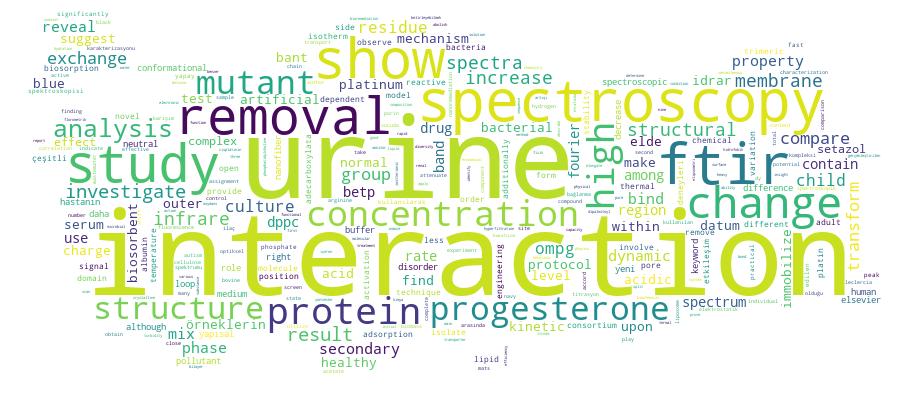
GCRIS Competency Cloud

Scholarly Output Search Results

Now showing 1 - 5 of 5
  • Article
    Citation - WoS: 355
    Citation - Scopus: 373
    A New Artificial Urine Protocol To Better Imitate Human Urine
    (Nature Portfolio, 2019) Sarigul, Neslihan; Korkmaz, Filiz; Kurultak, Ilhan
    Artificial urine has many advantages over human urine for research and educational purposes. By closely mimicking healthy individuals' urine, it may also be important in discovering novel biomarkers. However, up until now, there has not been any specific protocol to prove the similarity in terms of the chemical composition at the molecular level. In this study, a new artificial urine protocol is established to mimics the urine of healthy individuals. The multi-purpose artificial urine (MP-AU) presented here is compared with two other protocols most cited in literature. Furthermore, these three protocols are also compared with samples from 28 healthy young individuals. To do so, attenuated total reflection-Fourier transform infrared spectroscopy (ATR-FTIR) is used, according to which MP-AU shows a significantly close similarity with human urine. In formulating MP-AU, the infrared spectra of nine compounds is provided, making possible the band assignment of some absorption bands to certain compounds. Given its properties, the MP-AU protocol introduced here is both economical and practical, making it useful when designing comparative-controlled experiments.
  • Article
    Citation - WoS: 9
    Citation - Scopus: 9
    Urinalysis of Individuals With Renal Hyperfiltration Using Atr-Ftir Spectroscopy
    (Nature Portfolio, 2022) Kurultak, Ilhan; Sarigul, Neslihan; Kodal, Nil Su; Korkmaz, Filiz
    Abnormal increased glomerular filtration rate (GFR), otherwise known as renal hyperfiltration (RHf), is associated with an increased risk of chronic kidney disease and cardiovascular mortality. Although it is not considered as a disease alone in medicine today, early detection of RHf is essential to reducing risk in a timely manner. However, detecting RHf is a challenge since it does not have a practical biochemical marker that can be followed or quantified. In this study, we tested the ability of ATR-FTIR spectroscopy to distinguish 17 individuals with RHf (hyperfiltraters; RHf (+)), from 20 who have normal GFR (normofiltraters; RHf(-)), using urine samples. Spectra collected from hyperfiltraters were significantly different from the control group at positions 1621, 1390, 1346, 933 and 783/cm. Intensity changes at these positions could be followed directly from the absorbance spectra without the need for pre-processing. They were tentatively attributed to urea, citrate, creatinine, phosphate groups, and uric acid, respectively. Using principal component analysis (PCA), major peaks of the second derivative forms for the classification of two groups were determined. Peaks at 1540, 1492, 1390, 1200, 1000 and 840/cm were significantly different between the two groups. Statistical analysis showed that the spectra of normofiltraters are similar; however, those of hyperfiltraters show diversity at multiple positions that can be observed both from the absorbance spectra and the second derivative profiles. This observation implies that RHf can simultaneously affect the excretion of many substances, and that a spectroscopic analysis of urine can be used as a rapid and non-invasive pre-screening tool.
  • Article
    Author Correction: Using Urine Ftir Spectra To Screen Autism Spectrum Disorder
    (Nature Portfolio, 2024) Sarigul, Neslihan; Bozatli, Leyla; Kurultak, Ilhan; Korkmaz, Filiz
    [No Abstract Available]
  • Article
    Compositional Dependence of Optical Modes Frequencies in T1gax< Layered Mixed Crystals (0 ≤ x ≤ 1)
    (Polish Acad Sciences inst Physics, 2014) Isik, M.; Gasanly, N. M.; Korkmaz, F.
    The infrared transmittance and Raman scattering spectra in TlGaxIn1-xS2 (0 <= x <= 1) layered mixed crystals grown by the Bridgman method were studied in the frequency ranges of 400-2000 and 250-400 cm(-1), respectively. The bands observed at room temperature in IR transmittance spectra of TlGaxIn1-xS2 were interpreted in terms of multiphonon absorption processes. The dependences of the frequencies of IR- and Raman-active modes on the composition of TlGaxIn1-xS2 mixed crystals were also established. The structural characterization of the mixed crystals was investigated by means of X-ray diffraction measurements and compositional dependence of lattice parameters was revealed.
  • Article
    Citation - WoS: 31
    Citation - Scopus: 30
    Interaction of a Novel Platinum Drug With Bovine Serum Albumin: Ftir and Uv-Vis Spectroscopy Analysis
    (Royal Soc Chemistry, 2015) Korkmaz, Filiz; Erdogan, Deniz Altunoz; Ozalp-Yaman, Seniz
    Platinum complexes have proven to be very effective in cancer treatment. However, severe side effects of these drugs have lead scientists to pursue new platinum complex derivatives. A novel blue platinum compound, called Platinum-Blue (Pt-Blue), is one of the promising candidate platinum compounds to be used for tumor treatment. In this study, the interaction of Pt-Blue with bovine serum albumin (BSA) has been investigated using UV-Vis and FTIR spectroscopy. One of the findings is that the drug-protein interaction type depends on the drug concentration. Though Pt-Blue is attached to the surface of BSA at high concentrations, it interacts with a hydrophobic region of the protein at low concentrations with a binding constant of 1.93 x 10(5) M-1. Spectroscopic results indicate the hydrophobic docking position to be around Trp 213 in domain II, which is surrounded by a number of Asp and Glu. During this interaction, helices such as helix-10, helix-18, helix-19 and helix-24 change orientation and/or partially unfold to make room for the compound. Binding constants at high and low concentrations of Pt-Blue are determined using UV-Vis spectroscopy, which are found to be comparable to cisplatin. FTIR spectroscopy also reveals that the interaction between Pt-Blue and BSA is noncovalent, which makes the candidate drug favorable because it is available for DNA binding while being carried by albumin.