
Korkmaz Özkan, Filiz
Loading...
Profile URL
Name Variants
Korkmaz Ozkan,Filiz
K.,Filiz
F.,Korkmaz Ozkan
Filiz, Korkmaz Özkan
Korkmaz Ozkan,F.
K.Ö.Filiz
Korkmaz Özkan,F.
K. O. Filiz
Korkmaz F.
F.,Korkmaz Özkan
F., Korkmaz Ozkan
Filiz, Korkmaz Ozkan
Filiz Korkmaz Özkan
F., Korkmaz Özkan
Korkmaz Ozkan, Filiz
Korkmaz Özkan, Filiz
K. Ö. Filiz
K., Filiz
Özkan, Filiz Korkmaz
Korkmaz, Filiz
K.,Filiz
F.,Korkmaz Ozkan
Filiz, Korkmaz Özkan
Korkmaz Ozkan,F.
K.Ö.Filiz
Korkmaz Özkan,F.
K. O. Filiz
Korkmaz F.
F.,Korkmaz Özkan
F., Korkmaz Ozkan
Filiz, Korkmaz Ozkan
Filiz Korkmaz Özkan
F., Korkmaz Özkan
Korkmaz Ozkan, Filiz
Korkmaz Özkan, Filiz
K. Ö. Filiz
K., Filiz
Özkan, Filiz Korkmaz
Korkmaz, Filiz
Job Title
Profesör Doktor
Email Address
filiz.korkmaz@atilim.edu.tr
Main Affiliation
Physics Group
Status
Website
ORCID ID
Scopus Author ID
Turkish CoHE Profile ID
Google Scholar ID
WoS Researcher ID
Sustainable Development Goals
2
ZERO HUNGER

0
Research Products
14
LIFE BELOW WATER

0
Research Products
17
PARTNERSHIPS FOR THE GOALS

0
Research Products
5
GENDER EQUALITY

0
Research Products
16
PEACE, JUSTICE AND STRONG INSTITUTIONS

0
Research Products
8
DECENT WORK AND ECONOMIC GROWTH

0
Research Products
4
QUALITY EDUCATION

0
Research Products
6
CLEAN WATER AND SANITATION

3
Research Products
7
AFFORDABLE AND CLEAN ENERGY

0
Research Products
10
REDUCED INEQUALITIES

0
Research Products
11
SUSTAINABLE CITIES AND COMMUNITIES

0
Research Products
9
INDUSTRY, INNOVATION AND INFRASTRUCTURE

0
Research Products
1
NO POVERTY

0
Research Products
3
GOOD HEALTH AND WELL-BEING

3
Research Products
12
RESPONSIBLE CONSUMPTION AND PRODUCTION

0
Research Products
13
CLIMATE ACTION

0
Research Products
15
LIFE ON LAND

2
Research Products

Documents
24
Citations
665
h-index
9

Documents
0
Citations
0

Scholarly Output
27
Articles
22
Views / Downloads
6/0
Supervised MSc Theses
4
Supervised PhD Theses
0
WoS Citation Count
597
Scopus Citation Count
618
WoS h-index
9
Scopus h-index
8
Patents
0
Projects
0
WoS Citations per Publication
22.11
Scopus Citations per Publication
22.89
Open Access Source
9
Supervised Theses
4
Google Analytics Visitor Traffic
| Journal | Count |
|---|---|
| Scientific Reports | 4 |
| Spectrochimica Acta Part A: Molecular and Biomolecular Spectroscopy | 2 |
| Physica B: Condensed Matter | 2 |
| Archives of Biochemistry and Biophysics | 2 |
| Journal of Biomolecular Structure and Dynamics | 1 |
Current Page: 1 / 4
Scopus Quartile Distribution
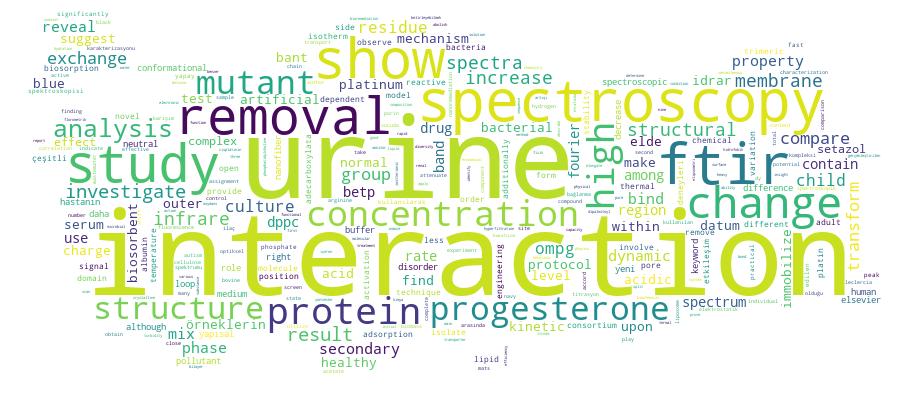
Competency Cloud
11 results
Scholarly Output Search Results
Now showing 1 - 10 of 11
Article Citation - WoS: 2Citation - Scopus: 2Biosorption of Reactive Dyes by Novel Bacterium Leclercia Adecarboxylata: Complete Removal of Reactive Black 5 and Molecular Insights Into the Adsorption Mechanism(Wiley, 2025) Sen, Seda; Korkmaz, Filiz; Kilic, Nur KocberberLeclercia adecarboxylata isolated from the D & uuml;den Waterfall (Turkey) was utilized as a biosorbent for the removal of Reactive Black 5 (RB5), Setazol Blue BRF-X (BRF-X), Setazol Navy Blue SBG (SNB), and Setazol Turquoise Blue G (STBG). Of the dyes, RB5 was removed with the highest efficiency, 97.4% after 60 min. The effect of parameters such as pH (3-9), initial biosorbent dose (0.1-2.0 g/L), and initial dye concentration (25-1200 mg/L) on the biosorption of RB5 was investigated. Increasing the biosorbent dosage from 0.1 to 2.0 g/L enhanced the RB5 removal from 55.3% to 100% within 10 min. The complete removal (100%) of RB5 was achieved in media with 2.0 g/L biosorbent and 25 mg/L RB5 at pH 3 after 10 min. Additionally, the soluble extracellular polymeric substances (EPS) of L. adecarboxylata were found to consist of proteins, lipids, nucleic acids, and polysaccharides according to Fourier transform infrared spectroscopy (FTIR) analysis. The EPS was found to play a crucial role in dye removal, forming chemical interactions with dye molecules. Zeta potential analysis was used to evaluate the charge distribution on the biosorbent surface (-12.6 +/- 1.1 mV) and its interactions in the biosorption process. Kinetic and isotherm models suggested a complex interaction mechanism between the biomass and the dye. Adsorption isotherm data were analyzed via nine isotherm models. Among them, the Hill model was found to be the best fit for describing the equilibrium adsorption process of the RB5 (R2 = 0.9993). Overall, the applied models elucidated the influence of both physical and chemical interactions on the mechanism. Kinetic studies revealed that the adsorption of RB5 fit a pseudo-second-order kinetic model. The unique biochemical composition of the indigenous L. adecarboxylata biosorbent provided a high affinity for RB5, offering a sustainable, rapid, and economical solution for the treatment of dye-polluted water.Article Citation - WoS: 32Citation - Scopus: 32Urine Analysis Using Ftir Spectroscopy: a Study on Healthy Adults and Children(Wiley-v C H verlag Gmbh, 2021) Sarigul, Neslihan; Kurultak, Ilhan; Gokceoglu, Arife Uslu; Korkmaz, FilizUrine spectra from 108 healthy volunteers are studied by attenuated total refraction-Fourier transform infrared (ATR-FTIR) spectroscopy. The spectral features are correlated with observable urine components. The variation of spectra within a healthy population is quantified and a library of reference spectra is constructed. Using the band assignments, these spectra are compared with both age-wise and gender-wise. Children show the least intensity variations compared to both adult groups. Young adults show the highest variation, particularly in the 1650 to 1400 cm(-1) and 1200 to 900 cm(-1) regions. These results indicate the importance of the size of the control group in comparative studies utilizing FTIR. Age-wise comparisons reveal that phosphate and sulfate excretion decreases with age, and that the variance of phosphate among individuals is higher with adults. As for gender-wise comparisons, females show a slightly higher citrate content at 1390 cm(-1) regardless of the age and they show a higher variance in the 1200 to 1000 cm(-1) region when compared to men.Article Web Server-Based Structure Prediction as a Supplementary Tool for Basic and Acidic Fgf Secondary Structure Analysis Using Ftir Spectroscopy and a Case Study Comparing Curve-Fit With the Model-Based Structure Inspection of the Ftir Data(DergiPark, 2023) Korkmaz,F.; Mollaoglu,A.; Adiguzel,Y.Fourier Transform Infrared (FTIR) spectroscopy can provide relative proportion of secondary structure elements in a protein. However, extracting this information from the Amide I band area of an FTIR spectrum is difficult. In addition to experimental methods, several protein secondary structure prediction algorithms serving on the Web can be used as supplementary tools requiring only protein amino acid sequences as inputs. In addition, web-server based docking tools can provide structure information when proteins are mixed and potentially interacting. Accordingly, we aimed to utilize web-server based structure predictors in fibroblast growth factor (FGF) protein structure determination through the FTIR data. Seven such predictors were selected and tested on basic FGF (bFGF) protein, to predict FGF secondary structure. Results were compared to available structure-files deposited in the Protein Data Bank (PDB). Then, FTIR spectra of bFGF and the acidic form of the protein with 50 folds more bovine serum albumin as carrier protein (1FGFA/50BSA) were collected. Optimized Amide I curve-fit parameters of bFGF with low (<5) root mean square deviation (RMSD) in the PDB data and the predictions were obtained. Those parameters were applied in curve-fitting of 1FGFA/50BSA data. Secondary structure was inspected also through applying models derived from the previously established methods. Results of model-based secondary structure estimation from FTIR data were compared with secondary structure calculated as 1 part contribution from 1FGFA/1BSA complex and 49 parts contribution from BSA. Complex structure was obtained through docking. RMSD in the PDB data and the predictions were respectively 3.05 and 2.39 with the optimized parameters. Those parameters did not work well for the 1FGFA/50BSA data. Models are better in this case, wherein one model (Model-1’) with the lowest average RMSD has 8.38 RMSD in the bFGF and 4.78 RMSD in the 1FGFA/50BSA structures. Model-based secondary structure predictions are better for determining bFGF and 1FGFA/50BSA secondary structures through the curve-fit approach that we followed, under non-optimal conditions like protein/BSA mixtures. Web servers can assist experimental studies investigating structures with unknown structures. Any web-based structure prediction supporting the experimental results would be enforcing the findings, but the unsupported results would not necessarily falsify the experimental data. © (2023), (DergiPark). All rights reserved.Article Citation - WoS: 2Citation - Scopus: 4Nanoremediation of Toxic Dyes Using a Bacterial Consortium Immobilized on Cellulose Acetate Nanofiber Mats(Wiley, 2024) Erkoc, Esra; Tuzun, Imre; Korkmaz, Filiz; San Keskin, Nalan Oya; Kocberber Kilic, NurStenotrophomonas maltophilia and Ochrobactrum sp. demonstrated the highest rates of dye bioremediation. The trials were performed at pH 8, which resulted in the highest bioremediation rate of 64.6% in media containing 21.2 mg L-1 dye. As the dye concentration increased, the pollutant removal decreased, with the maximum bioremoval rate of 70.3%. The removal capacity was increased with an increase in biomass concentration; the highest yield of 91.3% was obtained in media containing 14.2 mg L-1 dye and 12% (v/v) biomass. In nanoremediation studies, the bacterial consortium was immobilized on cellulose acetate nanofiber mats (CA-NFM). Scanning electron microscopic micrographs showed that bead-free nanofiber mats were effective in immobilizing bacterial cells. Moreover, nanofiber structures were capable of supporting exopolysaccharides formation, as confirmed by Fourier transform & imath;nfrared spectroscopy. The bacterial consortium immobilized on CA-NFM showed a maximum bioremoval rate of 56.5%. Reusability tests demonstrated that the consortium immobilized CA-NFM could be used at least five times. Furthermore, after leaving the mat for 1 month at 4 degrees C, it was still usable, and the removal efficiency was found to be 45.4%. Based on our findings, bacteria immobilized on CA-NFM have the potential to be used as highly effective and versatile nanobiotechnological biological sorbents in the treatment of wastewater containing dyes.Article Citation - WoS: 9Citation - Scopus: 9Urinalysis of Individuals With Renal Hyperfiltration Using Atr-Ftir Spectroscopy(Nature Portfolio, 2022) Kurultak, Ilhan; Sarigul, Neslihan; Kodal, Nil Su; Korkmaz, FilizAbnormal increased glomerular filtration rate (GFR), otherwise known as renal hyperfiltration (RHf), is associated with an increased risk of chronic kidney disease and cardiovascular mortality. Although it is not considered as a disease alone in medicine today, early detection of RHf is essential to reducing risk in a timely manner. However, detecting RHf is a challenge since it does not have a practical biochemical marker that can be followed or quantified. In this study, we tested the ability of ATR-FTIR spectroscopy to distinguish 17 individuals with RHf (hyperfiltraters; RHf (+)), from 20 who have normal GFR (normofiltraters; RHf(-)), using urine samples. Spectra collected from hyperfiltraters were significantly different from the control group at positions 1621, 1390, 1346, 933 and 783/cm. Intensity changes at these positions could be followed directly from the absorbance spectra without the need for pre-processing. They were tentatively attributed to urea, citrate, creatinine, phosphate groups, and uric acid, respectively. Using principal component analysis (PCA), major peaks of the second derivative forms for the classification of two groups were determined. Peaks at 1540, 1492, 1390, 1200, 1000 and 840/cm were significantly different between the two groups. Statistical analysis showed that the spectra of normofiltraters are similar; however, those of hyperfiltraters show diversity at multiple positions that can be observed both from the absorbance spectra and the second derivative profiles. This observation implies that RHf can simultaneously affect the excretion of many substances, and that a spectroscopic analysis of urine can be used as a rapid and non-invasive pre-screening tool.Article Citation - WoS: 2Citation - Scopus: 2Investigations of Ph-Dependent Dynamic Properties of Ompg-16sl, an Outer Membrane Protein G Mutant by Atr-Ftir Spectroscopy(Elsevier, 2022) Yilmaz, Irem; Korkmaz, FilizIn this paper, the dynamic properties of outer membrane protein G mutant (OmpG-16SL) are investigated with ATR-FTIR spectroscopy. While OmpG-WT has 14 beta-strands in its structure, the mutant is designed to have 16 beta-strands with the intention of creating an enlarged pore. Loop L6 is elongated by introducing six residues, two of which are negatively charged. The solvent accessibility of the OmpG-16SL mutant is compared with WT and a previously reported mutant OmpG-16S by tracking the H-1/H-2 exchange kinetics in acidic and neutral buffer conditions. The exchange kinetics and dynamics in the fast and slow exchange phases are separately investigated using the 2DCOS technique, which enables the tracking of the structural changes at each phase of the exchange process. The results suggest that the mutant OmpG-16SL is equally exposed to buffer in both acidic and neutral pH conditions. Additionally, the time range in the fast phase is very short - one-tenth of that for WT - and most of the exchange is completed in this phase. This fast exchange within minutes is also indicative of the presence of highly flexible and/or unstructured regions. In all, the fast exchange rates independent of the buffer pH justify the assumption that there is an altered interaction among the charged residues, which leads to a steadily-open pore. The role of the side-chain interactions within the pore and between the loops involving the loop L6 is also discussed.Master Thesis İnsan İdrarları Arasında Gözlenen Çeşitliliğin Yapay İdrar Sistemi ve Ftır Spektroskopisi Kullanılarak Anlaşılması(2023) Ahmed, Marıam Hany Farouk Mohamed; Özkan, Filiz Korkmazİdrar testleri, çeşitli tıbbi bozuklukları tanımlamanın ve teşhis etmenin yaygın ve uygun bir yoludur. Bu çalışmada, 9 yapay idrar bileşeninin normal minimum ve maksimum değerlerinin spektrumunu belirlemek için yeni bir yapay idrar protokolünü (MP-AU) kullanıyoruz. Fourier Transform Infrared (FTIR) spektroskopisi, varsa bozuklukların erken saptanmasına yardımcı olacak bu spektrumları oluşturmak için kullanılmıştır. Hastanın idrar numunesinden elde edilen spektrum, minimum ve maksimum normal değerler için yapay idrar çözeltilerinden elde edilen spektrumlarla karşılaştırılabilir. Bu karşılaştırmanın sonucu hastanın sağlığı ile ilgili olacaktır. Hastanın spektrumu bu iki normal spektrum arasında yer alıyorsa, hastanın sağlık olduğu düşünülebilir. Buna bağlı olarak, hastanın spektrumu normal aralığın dışına çıkarsa, anomaliyi saptamak için daha fazla test istenebilir. Bu çalışmanın bulguları, yapay idrar sistemi içindeki bileşenlerin miktarının, FTIR spektrumundaki tepe noktalarının genlikleri ile ilişkili olduğunu ortaya koymaktadır. Ayrıca, daha sonraki çalışmalarda referans olarak kullanılmak üzere, test edilen idrar bileşenlerinin karakteristik bant pozisyonları da belirlenmiştir. Bu çalışma Atılım Üniversitesi Araştırma Destek programı çerçevesinde ATÜ-ADP-2122-01 numaralı proje ile finansal olarak desteklenmiştir.Article Author Correction: Using Urine Ftir Spectra To Screen Autism Spectrum Disorder(Nature Portfolio, 2024) Sarigul, Neslihan; Bozatli, Leyla; Kurultak, Ilhan; Korkmaz, Filiz[No Abstract Available]Article Citation - WoS: 7Citation - Scopus: 6Using urine FTIR spectra to screen autism spectrum disorder(Nature Portfolio, 2023) Sarigul, Neslihan; Bozatli, Leyla; Kurultak, Ilhan; Korkmaz, FilizAutism spectrum disorder (ASD) is a heterogeneous neurodevelopmental disorder caused by multiple factors, lacking clear biomarkers. Diagnosing ASD still relies on behavioural and developmental signs and usually requires lengthy observation periods, all of which are demanding for both clinicians and parents. Although many studies have revealed valuable knowledge in this field, no clearly defined, practical, and widely acceptable diagnostic tool exists. In this study, 26 children with ASD (ASD+), aged 3-5 years, and 26 sex and age-matched controls are studied to investigate the diagnostic potential of the Attenuated Total Reflectance-Fourier Transform Infrared (ATR-FTIR) spectroscopy. The urine FTIR spectrum results show a downward trend in the 3000-2600/cm region for ASD+ children when compared to the typically developing (TD) children of the same age. The average area of this region is 25% less in ASD+ level 3 children, 29% less in ASD+ level 2 children, and 16% less in ASD+ level 1 children compared to that of the TD children. Principal component analysis was applied to the two groups using the entire spectrum window and five peaks were identified for further analysis. The correlation between the peaks and natural urine components is validated by artificial urine solutions. Less-than-normal levels of uric acid, phosphate groups, and ammonium (NH4+) can be listed as probable causes. This study shows that ATR-FTIR can serve as a practical and non-invasive method to screen ASD using the high-frequency region of the urine spectrum.Article Simultaneous Removal of Setazol Navy Blue and Cr(vi) by Mixed Microbial Culture Isolated From the Çubuk Stream(Springer int Publ Ag, 2024) Gunduz, A. Irem; Erkoc, Esra; Korkmaz, Filiz; Kilic, Nur KocberberWater samples taken from the & Ccedil;ubuk Stream (Ankara, Turkey) were inoculated into nutrient broth media containing Setazol Navy Blue SBG (SNB), an organic pollutant, and heavy metal Cr(VI), an inorganic pollutant, to obtain a pollutant-resistant mixed microbial culture. Experiments were conducted with this culture to remove SNB and heavy metal. The optimum conditions, where the mixed bacterial culture removed the pollutants most effectively, were determined, showing that the highest capacity for removal took place at pH 8 with removal percentages 96.3% for Cr(VI) and 78.5% for SNB. In media with 50.4 mg/L SNB and 9.7 mg/L Cr(VI), the SNB removal was 87.3%, and the Cr(VI) removal was 96.6% at the end of the 7-day incubation period. The highest removal was observed with a biomass concentration of 8% (v/v) of mixed culture [50 mg/L SNB dye+25 mg/L Cr(VI)]. The removal was 100% for both Cr(VI) and the SNB dye. The bacteria with the highest removal were isolated and identified using 16S rDNA gene sequence analysis as Microbacterium oxydans and Leucobacter aridicollis. The role of various functional groups and the structures of the microorganisms that might be involved in the removal mechanisms were discussed using their FTIR spectra. This report is the first study that investigates a mixed bacterial culture and pure cultures (M. oxydans and L. aridicollis) isolated from that mixed culture, removing both SNB and Cr(VI) simultaneously.
