Korkmaz Özkan, Filiz

Loading...
Profile Picture
Name Variants
Korkmaz Ozkan,Filiz
K.,Filiz
F.,Korkmaz Ozkan
Filiz, Korkmaz Özkan
Korkmaz Ozkan,F.
K.Ö.Filiz
Korkmaz Özkan,F.
K. O. Filiz
Korkmaz F.
F.,Korkmaz Özkan
F., Korkmaz Ozkan
Filiz, Korkmaz Ozkan
Filiz Korkmaz Özkan
F., Korkmaz Özkan
Korkmaz Ozkan, Filiz
Korkmaz Özkan, Filiz
K. Ö. Filiz
K., Filiz
Özkan, Filiz Korkmaz
Korkmaz, Filiz
Job Title
Profesör Doktor
Email Address
filiz.korkmaz@atilim.edu.tr
Main Affiliation
Physics Group
Status
Website
Scopus Author ID
Turkish CoHE Profile ID
Google Scholar ID
WoS Researcher ID

Sustainable Development Goals

2

ZERO HUNGER
ZERO HUNGER Logo

0

Research Products

14

LIFE BELOW WATER
LIFE BELOW WATER Logo

0

Research Products

17

PARTNERSHIPS FOR THE GOALS
PARTNERSHIPS FOR THE GOALS Logo

0

Research Products

5

GENDER EQUALITY
GENDER EQUALITY Logo

0

Research Products

16

PEACE, JUSTICE AND STRONG INSTITUTIONS
PEACE, JUSTICE AND STRONG INSTITUTIONS Logo

0

Research Products

8

DECENT WORK AND ECONOMIC GROWTH
DECENT WORK AND ECONOMIC GROWTH Logo

0

Research Products

4

QUALITY EDUCATION
QUALITY EDUCATION Logo

0

Research Products

6

CLEAN WATER AND SANITATION
CLEAN WATER AND SANITATION Logo

3

Research Products

7

AFFORDABLE AND CLEAN ENERGY
AFFORDABLE AND CLEAN ENERGY Logo

0

Research Products

10

REDUCED INEQUALITIES
REDUCED INEQUALITIES Logo

0

Research Products

11

SUSTAINABLE CITIES AND COMMUNITIES
SUSTAINABLE CITIES AND COMMUNITIES Logo

0

Research Products

9

INDUSTRY, INNOVATION AND INFRASTRUCTURE
INDUSTRY, INNOVATION AND INFRASTRUCTURE Logo

0

Research Products

1

NO POVERTY
NO POVERTY Logo

0

Research Products

3

GOOD HEALTH AND WELL-BEING
GOOD HEALTH AND WELL-BEING Logo

3

Research Products

12

RESPONSIBLE CONSUMPTION AND PRODUCTION
RESPONSIBLE CONSUMPTION AND PRODUCTION Logo

0

Research Products

13

CLIMATE ACTION
CLIMATE ACTION Logo

0

Research Products

15

LIFE ON LAND
LIFE ON LAND Logo

2

Research Products
Documents

24

Citations

665

h-index

9

Documents

0

Citations

0

Scholarly Output

27

Articles

22

Views / Downloads

6/0

Supervised MSc Theses

4

Supervised PhD Theses

0

WoS Citation Count

597

Scopus Citation Count

618

WoS h-index

9

Scopus h-index

8

Patents

0

Projects

0

WoS Citations per Publication

22.11

Scopus Citations per Publication

22.89

Open Access Source

9

Supervised Theses

4

Google Analytics Visitor Traffic

JournalCount
Scientific Reports4
Spectrochimica Acta Part A: Molecular and Biomolecular Spectroscopy2
Physica B: Condensed Matter2
Archives of Biochemistry and Biophysics2
Journal of Biomolecular Structure and Dynamics1
Current Page: 1 / 4

Scopus Quartile Distribution

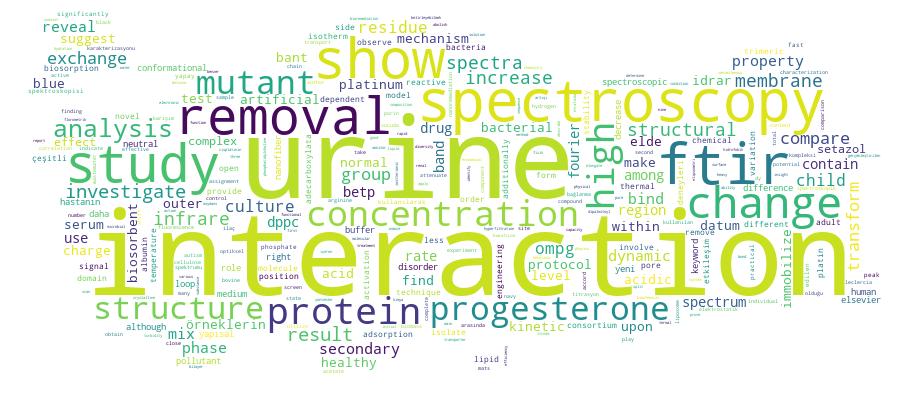
Competency Cloud

GCRIS Competency Cloud

Scholarly Output Search Results

Now showing 1 - 3 of 3
  • Article
    Citation - WoS: 2
    Citation - Scopus: 2
    Biosorption of Reactive Dyes by Novel Bacterium Leclercia Adecarboxylata: Complete Removal of Reactive Black 5 and Molecular Insights Into the Adsorption Mechanism
    (Wiley, 2025) Sen, Seda; Korkmaz, Filiz; Kilic, Nur Kocberber
    Leclercia adecarboxylata isolated from the D & uuml;den Waterfall (Turkey) was utilized as a biosorbent for the removal of Reactive Black 5 (RB5), Setazol Blue BRF-X (BRF-X), Setazol Navy Blue SBG (SNB), and Setazol Turquoise Blue G (STBG). Of the dyes, RB5 was removed with the highest efficiency, 97.4% after 60 min. The effect of parameters such as pH (3-9), initial biosorbent dose (0.1-2.0 g/L), and initial dye concentration (25-1200 mg/L) on the biosorption of RB5 was investigated. Increasing the biosorbent dosage from 0.1 to 2.0 g/L enhanced the RB5 removal from 55.3% to 100% within 10 min. The complete removal (100%) of RB5 was achieved in media with 2.0 g/L biosorbent and 25 mg/L RB5 at pH 3 after 10 min. Additionally, the soluble extracellular polymeric substances (EPS) of L. adecarboxylata were found to consist of proteins, lipids, nucleic acids, and polysaccharides according to Fourier transform infrared spectroscopy (FTIR) analysis. The EPS was found to play a crucial role in dye removal, forming chemical interactions with dye molecules. Zeta potential analysis was used to evaluate the charge distribution on the biosorbent surface (-12.6 +/- 1.1 mV) and its interactions in the biosorption process. Kinetic and isotherm models suggested a complex interaction mechanism between the biomass and the dye. Adsorption isotherm data were analyzed via nine isotherm models. Among them, the Hill model was found to be the best fit for describing the equilibrium adsorption process of the RB5 (R2 = 0.9993). Overall, the applied models elucidated the influence of both physical and chemical interactions on the mechanism. Kinetic studies revealed that the adsorption of RB5 fit a pseudo-second-order kinetic model. The unique biochemical composition of the indigenous L. adecarboxylata biosorbent provided a high affinity for RB5, offering a sustainable, rapid, and economical solution for the treatment of dye-polluted water.
  • Article
    Citation - WoS: 2
    Citation - Scopus: 4
    Nanoremediation of Toxic Dyes Using a Bacterial Consortium Immobilized on Cellulose Acetate Nanofiber Mats
    (Wiley, 2024) Erkoc, Esra; Tuzun, Imre; Korkmaz, Filiz; San Keskin, Nalan Oya; Kocberber Kilic, Nur
    Stenotrophomonas maltophilia and Ochrobactrum sp. demonstrated the highest rates of dye bioremediation. The trials were performed at pH 8, which resulted in the highest bioremediation rate of 64.6% in media containing 21.2 mg L-1 dye. As the dye concentration increased, the pollutant removal decreased, with the maximum bioremoval rate of 70.3%. The removal capacity was increased with an increase in biomass concentration; the highest yield of 91.3% was obtained in media containing 14.2 mg L-1 dye and 12% (v/v) biomass. In nanoremediation studies, the bacterial consortium was immobilized on cellulose acetate nanofiber mats (CA-NFM). Scanning electron microscopic micrographs showed that bead-free nanofiber mats were effective in immobilizing bacterial cells. Moreover, nanofiber structures were capable of supporting exopolysaccharides formation, as confirmed by Fourier transform & imath;nfrared spectroscopy. The bacterial consortium immobilized on CA-NFM showed a maximum bioremoval rate of 56.5%. Reusability tests demonstrated that the consortium immobilized CA-NFM could be used at least five times. Furthermore, after leaving the mat for 1 month at 4 degrees C, it was still usable, and the removal efficiency was found to be 45.4%. Based on our findings, bacteria immobilized on CA-NFM have the potential to be used as highly effective and versatile nanobiotechnological biological sorbents in the treatment of wastewater containing dyes.
  • Article
    Citation - WoS: 7
    Citation - Scopus: 6
    Using urine FTIR spectra to screen autism spectrum disorder
    (Nature Portfolio, 2023) Sarigul, Neslihan; Bozatli, Leyla; Kurultak, Ilhan; Korkmaz, Filiz
    Autism spectrum disorder (ASD) is a heterogeneous neurodevelopmental disorder caused by multiple factors, lacking clear biomarkers. Diagnosing ASD still relies on behavioural and developmental signs and usually requires lengthy observation periods, all of which are demanding for both clinicians and parents. Although many studies have revealed valuable knowledge in this field, no clearly defined, practical, and widely acceptable diagnostic tool exists. In this study, 26 children with ASD (ASD+), aged 3-5 years, and 26 sex and age-matched controls are studied to investigate the diagnostic potential of the Attenuated Total Reflectance-Fourier Transform Infrared (ATR-FTIR) spectroscopy. The urine FTIR spectrum results show a downward trend in the 3000-2600/cm region for ASD+ children when compared to the typically developing (TD) children of the same age. The average area of this region is 25% less in ASD+ level 3 children, 29% less in ASD+ level 2 children, and 16% less in ASD+ level 1 children compared to that of the TD children. Principal component analysis was applied to the two groups using the entire spectrum window and five peaks were identified for further analysis. The correlation between the peaks and natural urine components is validated by artificial urine solutions. Less-than-normal levels of uric acid, phosphate groups, and ammonium (NH4+) can be listed as probable causes. This study shows that ATR-FTIR can serve as a practical and non-invasive method to screen ASD using the high-frequency region of the urine spectrum.