Şimşir, Caner

Loading...
Profile Picture
Name Variants
C.,Simsir
Simsir, Caner
Şimşir, Caner
C., Simsir
Simsir,C.
C.,Şimşir
S.,Caner
S., Caner
Caner, Simsir
Şimşir,C.
Caner, Şimşir
Ş.,Caner
Simsir, C.
Job Title
Doktor Öğretim Üyesi
Email Address
caner.simsir@atilim.edu.tr
Main Affiliation
Manufacturing Engineering
Status
Former Staff
Website
ORCID ID
Scopus Author ID
Turkish CoHE Profile ID
Google Scholar ID
WoS Researcher ID

Sustainable Development Goals

2

ZERO HUNGER
ZERO HUNGER Logo

0

Research Products

14

LIFE BELOW WATER
LIFE BELOW WATER Logo

0

Research Products

17

PARTNERSHIPS FOR THE GOALS
PARTNERSHIPS FOR THE GOALS Logo

0

Research Products

5

GENDER EQUALITY
GENDER EQUALITY Logo

0

Research Products

16

PEACE, JUSTICE AND STRONG INSTITUTIONS
PEACE, JUSTICE AND STRONG INSTITUTIONS Logo

0

Research Products

8

DECENT WORK AND ECONOMIC GROWTH
DECENT WORK AND ECONOMIC GROWTH Logo

0

Research Products

4

QUALITY EDUCATION
QUALITY EDUCATION Logo

0

Research Products

6

CLEAN WATER AND SANITATION
CLEAN WATER AND SANITATION Logo

0

Research Products

7

AFFORDABLE AND CLEAN ENERGY
AFFORDABLE AND CLEAN ENERGY Logo

0

Research Products

10

REDUCED INEQUALITIES
REDUCED INEQUALITIES Logo

0

Research Products

11

SUSTAINABLE CITIES AND COMMUNITIES
SUSTAINABLE CITIES AND COMMUNITIES Logo

0

Research Products

9

INDUSTRY, INNOVATION AND INFRASTRUCTURE
INDUSTRY, INNOVATION AND INFRASTRUCTURE Logo

3

Research Products

1

NO POVERTY
NO POVERTY Logo

0

Research Products

3

GOOD HEALTH AND WELL-BEING
GOOD HEALTH AND WELL-BEING Logo

2

Research Products

12

RESPONSIBLE CONSUMPTION AND PRODUCTION
RESPONSIBLE CONSUMPTION AND PRODUCTION Logo

0

Research Products

13

CLIMATE ACTION
CLIMATE ACTION Logo

0

Research Products

15

LIFE ON LAND
LIFE ON LAND Logo

0

Research Products
This researcher does not have a Scopus ID.
This researcher does not have a WoS ID.
Scholarly Output

33

Articles

14

Views / Downloads

0/0

Supervised MSc Theses

12

Supervised PhD Theses

0

WoS Citation Count

176

Scopus Citation Count

228

WoS h-index

8

Scopus h-index

9

Patents

0

Projects

0

WoS Citations per Publication

5.33

Scopus Citations per Publication

6.91

Open Access Source

6

Supervised Theses

12

Google Analytics Visitor Traffic

JournalCount
Computational Materials Science3
Materialwissenschaft und Werkstofftechnik3
Hittite Journal of Science and Engineering2
Materials Performance and Characterization2
International Conference on the Technology of Plasticity (ICTP) -- SEP 17-22, 2017 -- Cambridge, ENGLAND1
Current Page: 1 / 3

Scopus Quartile Distribution

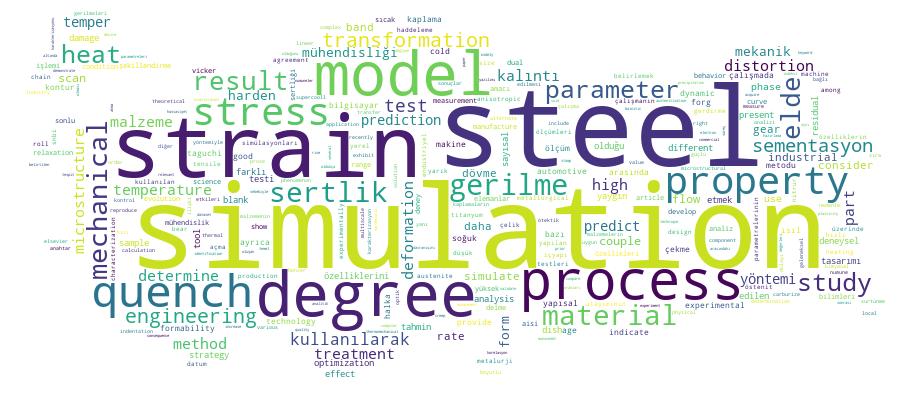
Competency Cloud

GCRIS Competency Cloud

Scholarly Output Search Results

Now showing 1 - 1 of 1
  • Article
    Citation - WoS: 13
    Citation - Scopus: 19
    Multiscale Modeling of Tempering of Aisi H13 Hot-Work Tool Steel - Part 2: Coupling Predicted Mechanical Properties With Fem Simulations
    (Elsevier Science Bv, 2016) Eser, A.; Broeckmann, C.; Simsir, C.
    Simulation of austenitization and quenching of steel using the Finite Element Method (FEM) is nowadays a common tool to predict residual stresses and deformations during these processes. However the simulation of tempering, which determines the final residual stresses and distortions has been often neglected or performed in a purely phenomenological and highly simplified way. The objective of this study is to precisely predict the relaxation of internal stresses during tempering, taking explicitly into account the evolution of the microstructure. Mechanical properties which determine the relaxation of stress; namely the drop of the yield stress and the creep mechanism are the key factors for the success of the simulation. These mechanical parameters can be determined experimentally for a specific tempering temperature. However tempering temperature for most steels varies for each industrial application in order to adjust the desired hardness-toughness relation. Consequently, experimentally measurement of decisive mechanical properties which determine the amount of stress relaxation for each tempering temperature is very costly. Therefore, these material parameters were simulated from physically based material models with coupled microstructural simulations in the first part of this two-part investigation. In this part of the study, the simulated mechanical properties will be coupled with the FEM simulations using "Abaqus (R)", in order to simulate the stress relaxation during the tempering process of a thick-walled workpiece made of hot-work tool steel AISI H13 (DIN 1.2344, X40CrMoV5-1). Utilizing this methodology, different tempering conditions (soaking time, tempering temperature) can be considered in the model to predict the stress relaxation in macroscopic scale. (C) 2015 Elsevier B.V. All rights reserved.